THE ADVENTURE COLLECTIVE® · Independent discovery and booking for outdoor travel

Walk terraced rice fields, cross bamboo bridges and spend a night in a Ta Van homestay on this accessible 2-day Sapa trek. Expect village life, local cooking, and steady valley views across Hoang Lien Son.
Walk terraced rice fields, cross bamboo bridges and spend a night in a Ta Van homestay on this accessible 2-day Sapa trek. Expect village life, local cooking, and steady valley views across Hoang Lien Son.
Mornings in Muong Hoa arrive like a slow exhale: mist peels off the rice terraces and the stream below dares you to follow its winding route.
Verified experiences and guided adventures in the surrounding area.
Operated by Sapa May Travel · Sapa, Lao Cai
Mornings in Muong Hoa arrive like a slow exhale: mist peels off the rice terraces and the stream below dares you to follow its winding route.
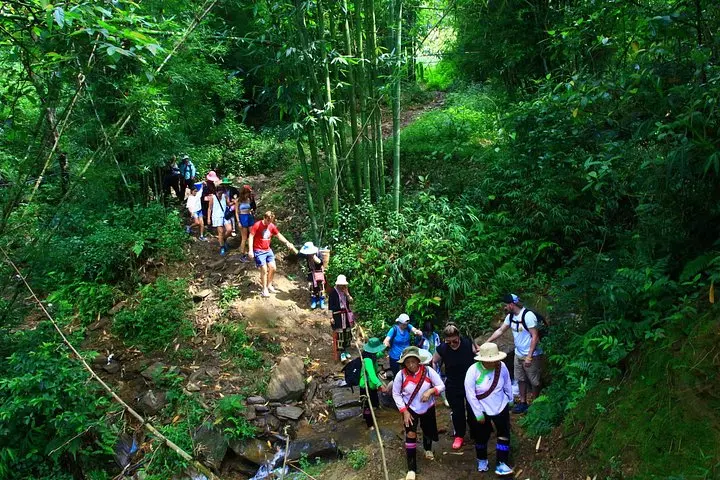
On this two-day trek from Sapa you move through carved terraces, cross bamboo footbridges and pass low slate houses where smoke threads toward the Hoang Lien Son ridgeline. Day one covers roughly 8–10 km from Sapa through Y Linh Ho and Lao Chai to Ta Van, where a private room at a local homestay becomes basecamp. Day two continues through Giang Ta Chai and Supan, another 6 km of village tracks, before a return to Sapa.
The region sits on ancient uplifted limestone and metamorphic rock at the margins of the Hoang Lien range; Fansipan, Vietnam’s highest peak, presides nearby. The valley is home to Black Hmong, Red Dao and Giay communities whose weaving, architecture and small plots shape the landscape as much as the terraces do. French hill-station history and local ethnic traditions overlap in villages and markets.
Practical guidance: expect uneven dirt paths, occasional stone steps and muddy sections after rain. Altitude is modest (~1,200–1,600 m) but mornings are cool. Carry water, snacks and layers; you’ll have two lunches and an included homestay dinner and breakfast.
This itinerary is ideal for travelers who want cultural contact and manageable trekking rather than technical mountaineering. Pace yourself across two days, respect homestay customs, and leave no trace—these fields feed local families and the trail recovers slowly from overuse.
The route is non-technical and suitable for beginners with reasonable fitness—expect uneven ground and hills but no climbing gear is required.
This tour provides a private room at the Ta Van homestay as listed, though facilities are simple compared with hotels.
Yes—two lunches, one dinner and one breakfast are included; local dishes and a cooking activity are often part of the homestay experience.
A local English-speaking guide is included; guides navigate trails, coordinate village visits and liaise with homestay hosts.
Sapa May Travel operates guided outdoor trips and adventures with an emphasis on safety, stewardship, and memorable experiences.
Mornings in Muong Hoa arrive like a slow exhale: mist peels off the rice terraces and the stream below dares you to follow its winding route.
Mornings in Muong Hoa arrive like a slow exhale: mist peels off the rice terraces and the stream below dares you to follow its winding route.
On this two-day trek from Sapa you move through carved terraces, cross bamboo footbridges and pass low slate houses where smoke threads toward the Hoang Lien Son ridgeline. Day one covers roughly 8–10 km from Sapa through Y Linh Ho and Lao Chai to Ta Van, where a private room at a local homestay becomes basecamp. Day two continues through Giang Ta Chai and Supan, another 6 km of village tracks, before a return to Sapa.
The region sits on ancient uplifted limestone and metamorphic rock at the margins of the Hoang Lien range; Fansipan, Vietnam’s highest peak, presides nearby. The valley is home to Black Hmong, Red Dao and Giay communities whose weaving, architecture and small plots shape the landscape as much as the terraces do. French hill-station history and local ethnic traditions overlap in villages and markets.
Practical guidance: expect uneven dirt paths, occasional stone steps and muddy sections after rain. Altitude is modest (~1,200–1,600 m) but mornings are cool. Carry water, snacks and layers; you’ll have two lunches and an included homestay dinner and breakfast.
This itinerary is ideal for travelers who want cultural contact and manageable trekking rather than technical mountaineering. Pace yourself across two days, respect homestay customs, and leave no trace—these fields feed local families and the trail recovers slowly from overuse.