THE ADVENTURE COLLECTIVE® · Independent discovery and booking for outdoor travel

A compact two-day transfer that doubles as a Herzegovina primer: Tito’s bunker, Blagaj’s karst spring, Kravica waterfalls and Mostar’s Old Bridge, with an overnight in Mostar. It’s transport and cultural highlights in one streamlined itinerary.
A compact two-day transfer that doubles as a Herzegovina primer: Tito’s bunker, Blagaj’s karst spring, Kravica waterfalls and Mostar’s Old Bridge, with an overnight in Mostar. It’s transport and cultural highlights in one streamlined itinerary.
You step off the minivan where the Neretva runs cold and green, the old stone bridge of Mostar cutting a clean arc against the afternoon light. On this two-day transfer, roads become the route and stops become the story: WWII ruins, an underground Cold War bunker, a karst spring that pushes water with force, and a series of villages where Ottoman stonework still frames daily life.
Verified experiences and guided adventures in the surrounding area.
Operated by Funky Tours · Mostar, Herzegovina-Neretva Canton
You step off the minivan where the Neretva runs cold and green, the old stone bridge of Mostar cutting a clean arc against the afternoon light. On this two-day transfer, roads become the route and stops become the story: WWII ruins, an underground Cold War bunker, a karst spring that pushes water with force, and a series of villages where Ottoman stonework still frames daily life.
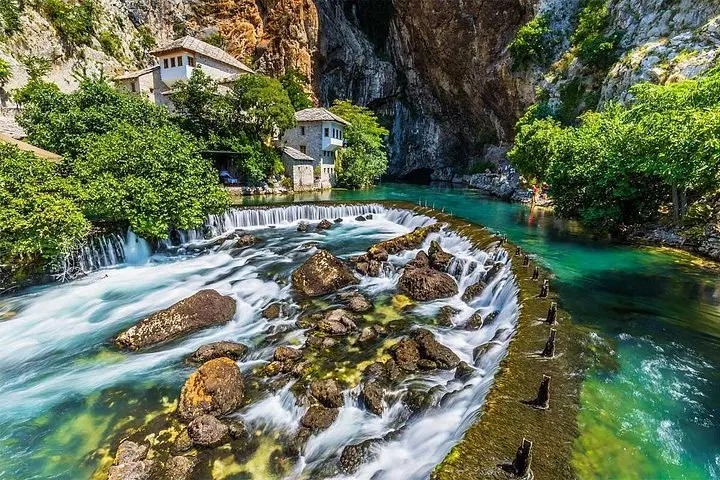
The itinerary threads together Herzegovina’s layered history. In Konjic you’ll hear about the infamous Tito’s Bunker—built roughly 270 m below ground in the 1950s–70s—then glance over Jablaničko Lake and the Prenj massif where wartime battles shaped modern memory. Blagaj’s Buna spring gushes from a cave at roughly 43 m3/s, feeding a river that dares you to stop and listen; beside it stands the 16th-century Blagaj Tekke, an intact example of Ottoman religious architecture. Kravica’s travertine amphitheater (waterfalls 26–28 m high) offers a geological show; Vjetrenica Cave exposes one of the region’s richest underground ecosystems.
Practical side: expect multiple short walks—Mostar’s Old Town and Počitelj involve 10–30 minute uphill sections on uneven stone steps. Travel between stops is by comfortable minivan; luggage is handled, and a 4* hotel night in Mostar is included. Bring layers for coastal-to-mountain microclimates, euros for small purchases and lunches, and swimwear in summer for Kravica. If you want context on winemaking or wartime history, ask guides for side details—the tour is paced to showcase both landscape and local life without rush.
You can start in Sarajevo and finish in Dubrovnik/Split/Kotor (or the reverse); the operator offers door-to-door transfer points—confirm at booking.
Yes—one night in a 4* hotel in Mostar (twin/double sharing) with breakfast is included.
Most listed entrance fees (Tito’s Bunker, Vjetrenica, Kravice, Radimlja, Dervish House, Bosnaseum) and a local wine tasting are included per the itinerary.
The tour is rated easy and generally suitable for most fitness levels; however, expect uneven surfaces and stairs at historic sites—contact the operator about specific mobility needs.
Funky Tours operates guided outdoor trips and adventures with an emphasis on safety, stewardship, and memorable experiences.
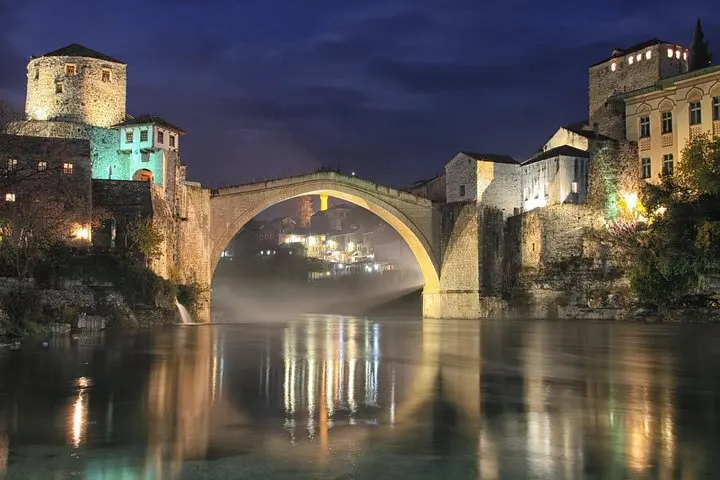
You step off the minivan where the Neretva runs cold and green, the old stone bridge of Mostar cutting a clean arc against the afternoon light. On this two-day transfer, roads become the route and stops become the story: WWII ruins, an underground Cold War bunker, a karst spring that pushes water with force, and a series of villages where Ottoman stonework still frames daily life.
You step off the minivan where the Neretva runs cold and green, the old stone bridge of Mostar cutting a clean arc against the afternoon light. On this two-day transfer, roads become the route and stops become the story: WWII ruins, an underground Cold War bunker, a karst spring that pushes water with force, and a series of villages where Ottoman stonework still frames daily life.
The itinerary threads together Herzegovina’s layered history. In Konjic you’ll hear about the infamous Tito’s Bunker—built roughly 270 m below ground in the 1950s–70s—then glance over Jablaničko Lake and the Prenj massif where wartime battles shaped modern memory. Blagaj’s Buna spring gushes from a cave at roughly 43 m3/s, feeding a river that dares you to stop and listen; beside it stands the 16th-century Blagaj Tekke, an intact example of Ottoman religious architecture. Kravica’s travertine amphitheater (waterfalls 26–28 m high) offers a geological show; Vjetrenica Cave exposes one of the region’s richest underground ecosystems.
Practical side: expect multiple short walks—Mostar’s Old Town and Počitelj involve 10–30 minute uphill sections on uneven stone steps. Travel between stops is by comfortable minivan; luggage is handled, and a 4* hotel night in Mostar is included. Bring layers for coastal-to-mountain microclimates, euros for small purchases and lunches, and swimwear in summer for Kravica. If you want context on winemaking or wartime history, ask guides for side details—the tour is paced to showcase both landscape and local life without rush.