THE ADVENTURE COLLECTIVE® · Independent discovery and booking for outdoor travel

Walk With Me’s Savannah 101 is a focused, two-hour guided walk through the city’s original squares, covering colonial planning, antebellum architecture, and Civil War history. Start at Johnson Square and finish in Wright Square while learning the people and events that shaped Savannah.
Walk With Me’s Savannah 101 is a focused, two-hour guided walk through the city’s original squares, covering colonial planning, antebellum architecture, and Civil War history. Start at Johnson Square and finish in Wright Square while learning the people and events that shaped Savannah.
The fountain in Johnson Square spits and sparkles as the guide in an orange polo gathers the group; live oaks lean in, Spanish moss brushing the air like a slow curtain. This two-hour walk threads the original 18th-century grid of Savannah, moving from the eastern fountain by Christ Church through a sequence of public squares that condense centuries into a few city blocks.
Verified experiences and guided adventures in the surrounding area.
The fountain in Johnson Square spits and sparkles as the guide in an orange polo gathers the group; live oaks lean in, Spanish moss brushing the air like a slow curtain. This two-hour walk threads the original 18th-century grid of Savannah, moving from the eastern fountain by Christ Church through a sequence of public squares that condense centuries into a few city blocks.
Savannah’s plan, laid out by James Oglethorpe, reflects Enlightenment ideas about civic order and defense; here the stones still remember colonial ports, cotton fortunes, and wartime occupations. The tour pauses at Factors Walk and River Street to discuss the cotton trade and its human cost, then pivots inland to examine Federal- and Regency-era houses, William Jay’s architecture, and the Owens-Thomas House’s complex social history. Guides touch on the Civil War’s local effects, Sherman’s occupation, and cultural figures such as Juliette Gordon Low and Flannery O’Connor.
The geology is low-lying coastal plain—sand and silt underfoot—so routes are flat and accessible, though cobbles and steps appear around historic buildings. Expect roughly 0.5–0.8 miles of walking at an easy pace with stops; elevation change is negligible but plan for sun, sudden coastal breezes, and crowded squares on weekend afternoons.
Practical notes: meet at Johnson Square’s eastern fountain 10–15 minutes early; wear sturdy walking shoes, carry water and sun protection, and be prepared to move at a steady, conversational pace. The guide’s narration is interactive and suitable for all ages, and the route finishes in Wright Square with options to continue exploring local museums, cafés, and the riverfront.
Meet at Johnson Square’s eastern fountain near the Christ Church historical marker; the guide wears a bright orange polo with the company logo.
Yes—surfaces and routes are generally accessible, though some cobbled areas may require care; staff note it’s suitable for most mobility devices.
Infants and small children in strollers are welcome; well-behaved pets are allowed but service animals are preferred for accessibility and crowding.
Tipping is customary for guided walking tours; 10–20% of the ticket price is a common guideline if you enjoyed the experience.
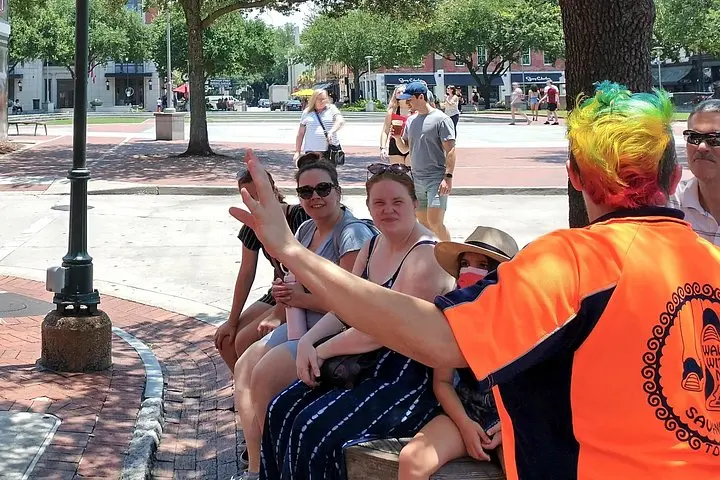
The fountain in Johnson Square spits and sparkles as the guide in an orange polo gathers the group; live oaks lean in, Spanish moss brushing the air like a slow curtain. This two-hour walk threads the original 18th-century grid of Savannah, moving from the eastern fountain by Christ Church through a sequence of public squares that condense centuries into a few city blocks.
The fountain in Johnson Square spits and sparkles as the guide in an orange polo gathers the group; live oaks lean in, Spanish moss brushing the air like a slow curtain. This two-hour walk threads the original 18th-century grid of Savannah, moving from the eastern fountain by Christ Church through a sequence of public squares that condense centuries into a few city blocks.
Savannah’s plan, laid out by James Oglethorpe, reflects Enlightenment ideas about civic order and defense; here the stones still remember colonial ports, cotton fortunes, and wartime occupations. The tour pauses at Factors Walk and River Street to discuss the cotton trade and its human cost, then pivots inland to examine Federal- and Regency-era houses, William Jay’s architecture, and the Owens-Thomas House’s complex social history. Guides touch on the Civil War’s local effects, Sherman’s occupation, and cultural figures such as Juliette Gordon Low and Flannery O’Connor.
The geology is low-lying coastal plain—sand and silt underfoot—so routes are flat and accessible, though cobbles and steps appear around historic buildings. Expect roughly 0.5–0.8 miles of walking at an easy pace with stops; elevation change is negligible but plan for sun, sudden coastal breezes, and crowded squares on weekend afternoons.
Practical notes: meet at Johnson Square’s eastern fountain 10–15 minutes early; wear sturdy walking shoes, carry water and sun protection, and be prepared to move at a steady, conversational pace. The guide’s narration is interactive and suitable for all ages, and the route finishes in Wright Square with options to continue exploring local museums, cafés, and the riverfront.