THE ADVENTURE COLLECTIVE® · Independent discovery and booking for outdoor travel

A short private trek from Sapa Town leads into Muong Hoa Valley to Cat Cat Village, where Black Hmong culture, terraced rice fields and a French-era waterfall create a compact, informative walk suitable for most fitness levels.
A short private trek from Sapa Town leads into Muong Hoa Valley to Cat Cat Village, where Black Hmong culture, terraced rice fields and a French-era waterfall create a compact, informative walk suitable for most fitness levels.
A narrow dirt lane drops away from Sapa’s busy market, and the town’s chatter is traded for the steady sound of trekking feet and tumbling water. Within minutes the path narrows between stone walls and terraced rice paddies, the air cooling as you descend into the Muong Hoa Valley toward Cat Cat Village. Black Hmong homes sit along the stream; children wave from wooden bridges and woven textiles hang out to dry.
Verified experiences and guided adventures in the surrounding area.
Operated by Authentic HALONG · Sapa, Lao Cai
A narrow dirt lane drops away from Sapa’s busy market, and the town’s chatter is traded for the steady sound of trekking feet and tumbling water. Within minutes the path narrows between stone walls and terraced rice paddies, the air cooling as you descend into the Muong Hoa Valley toward Cat Cat Village. Black Hmong homes sit along the stream; children wave from wooden bridges and woven textiles hang out to dry.
The village sits at the foot of Fansipan and reflects a layered history: traditional Black Hmong culture overlaid by French-era infrastructure — including the small hydraulic power works near the main waterfall — and the agricultural engineering of steep rice terraces. Geologically, the valley is carved by seasonal streams that feed cataracts and channel silty soil down steep slopes, creating the stepped fields you’ll pass.
Expect 2.5 km of walking, mostly downhill then a steady climb back to the pickup point, on stone and dirt trails that can be uneven and slippery when wet. A local English-speaking guide leads the private walk, explaining textile techniques, daily life, and the village’s relationship to Fansipan’s watershed.
Practically: wear grippy footwear, carry water, and plan for sudden showers in shoulder seasons. Mornings are coolest and offer clearer views; late afternoons bring warmer light but more chance of rain. The walk is a compact cultural trek — sensory and accessible — that pairs a short hike with meaningful cultural contact and easy logistics from Sapa town.
The guided walking portion covers about 2.5 km and typically takes 2 hours; the full tour block is around 3–3.5 hours including transfers and stops.
Yes—pickup and drop-off in Sapa Town are provided; confirm your hotel name and pickup time when booking.
The route is suitable for most ages but includes steep steps and an uphill return; those with mobility issues should consider staying in town or arranging a vehicle for the return leg.
Entrance to Cat Cat Village is included as part of the tour inclusions—confirm with your operator for any additional local fees.
Authentic HALONG operates guided outdoor trips and adventures with an emphasis on safety, stewardship, and memorable experiences.
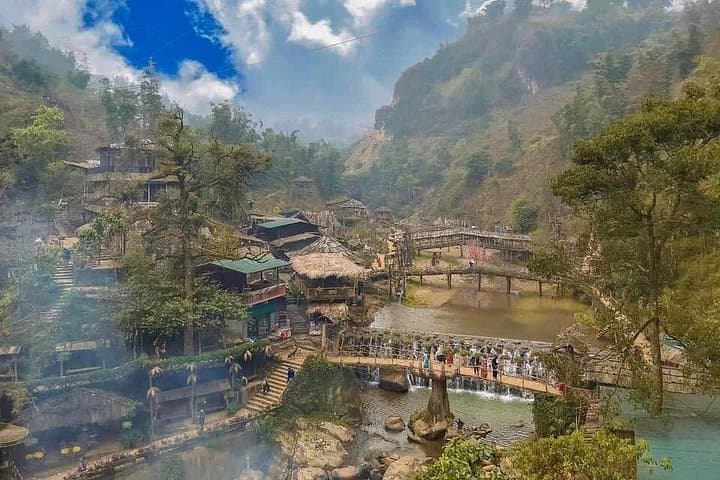


A narrow dirt lane drops away from Sapa’s busy market, and the town’s chatter is traded for the steady sound of trekking feet and tumbling water. Within minutes the path narrows between stone walls and terraced rice paddies, the air cooling as you descend into the Muong Hoa Valley toward Cat Cat Village. Black Hmong homes sit along the stream; children wave from wooden bridges and woven textiles hang out to dry.
A narrow dirt lane drops away from Sapa’s busy market, and the town’s chatter is traded for the steady sound of trekking feet and tumbling water. Within minutes the path narrows between stone walls and terraced rice paddies, the air cooling as you descend into the Muong Hoa Valley toward Cat Cat Village. Black Hmong homes sit along the stream; children wave from wooden bridges and woven textiles hang out to dry.
The village sits at the foot of Fansipan and reflects a layered history: traditional Black Hmong culture overlaid by French-era infrastructure — including the small hydraulic power works near the main waterfall — and the agricultural engineering of steep rice terraces. Geologically, the valley is carved by seasonal streams that feed cataracts and channel silty soil down steep slopes, creating the stepped fields you’ll pass.
Expect 2.5 km of walking, mostly downhill then a steady climb back to the pickup point, on stone and dirt trails that can be uneven and slippery when wet. A local English-speaking guide leads the private walk, explaining textile techniques, daily life, and the village’s relationship to Fansipan’s watershed.
Practically: wear grippy footwear, carry water, and plan for sudden showers in shoulder seasons. Mornings are coolest and offer clearer views; late afternoons bring warmer light but more chance of rain. The walk is a compact cultural trek — sensory and accessible — that pairs a short hike with meaningful cultural contact and easy logistics from Sapa town.