THE ADVENTURE COLLECTIVE® · Independent discovery and booking for outdoor travel

Skip the postage-stamp view and walk Venice on a human scale. In 90 minutes this guided route threads St. Mark’s grandeur with lesser-known squares, Marco Polo’s house and artisan alleys that still hum with trade.
Skip the postage-stamp view and walk Venice on a human scale. In 90 minutes this guided route threads St. Mark’s grandeur with lesser-known squares, Marco Polo’s house and artisan alleys that still hum with trade.
You step out of the shadow of the Campanile and the city changes scale: the roar of Piazza San Marco softens into the click of heels on stone, and alleys fold inward like pages of an old book. For 90 minutes a guide pulls a thread through Venice’s dense weave — not the postcard façades, but the small, human corners where merchants, shipwrights and performers left fingerprints.
Verified experiences and guided adventures in the surrounding area.
Operated by Star Florence · Venice, Veneto
You step out of the shadow of the Campanile and the city changes scale: the roar of Piazza San Marco softens into the click of heels on stone, and alleys fold inward like pages of an old book. For 90 minutes a guide pulls a thread through Venice’s dense weave — not the postcard façades, but the small, human corners where merchants, shipwrights and performers left fingerprints.
The tour begins where Venice’s public life converges: the square around St. Mark’s Basilica. Here, architecture reads like civic biography — Byzantine mosaics, Gothic loggias, and the Campanile that kept time for a republic built on trade and tides. From this high stage the route slips into quieter neighborhoods: a little square that was once a market for sailors, a modest house said to belong to Marco Polo, and the Scuola Grande di San Marco, which marks the medical and charitable heart of the lagoon city.
Geology and engineering thread through the stories. Venice exists because generations drove timber piles into silt and built on top; narrow canals and low bridges are as much practical solutions as aesthetic choices. The Mercerie, the tour’s final stretch, is the artery that joined Rialto’s merchants to San Marco’s politics — today it still hums with artisans and small ateliers, echoing a mercantile pulse that shaped Europe.
Culturally, the walk is a primer in Venetian contradictions: immense wealth and razor-thin alleys, public spectacle and private devotion. Guides use vivid anecdotes to connect architecture to politics, explain why a church bears an odd name, or recount the theater fires that pushed a city’s culture into new shapes.
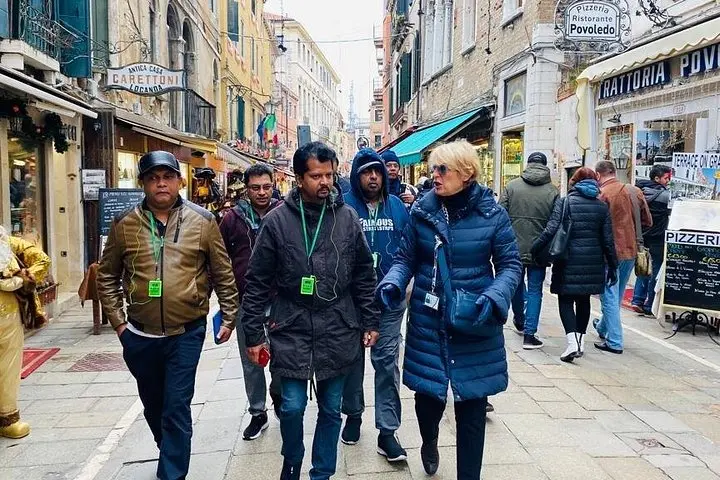
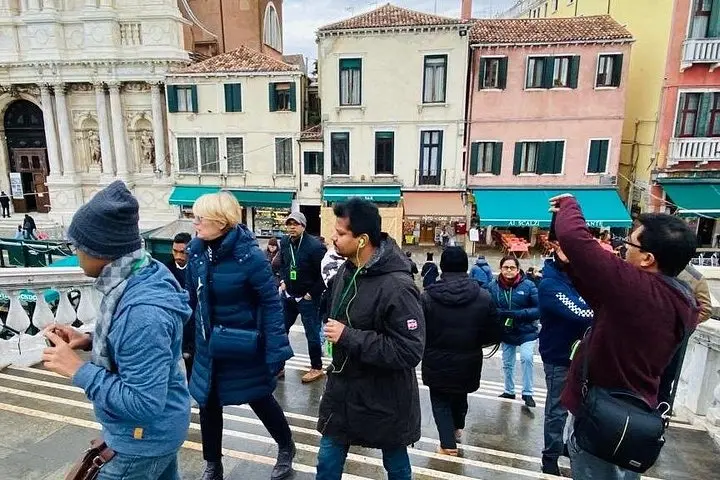
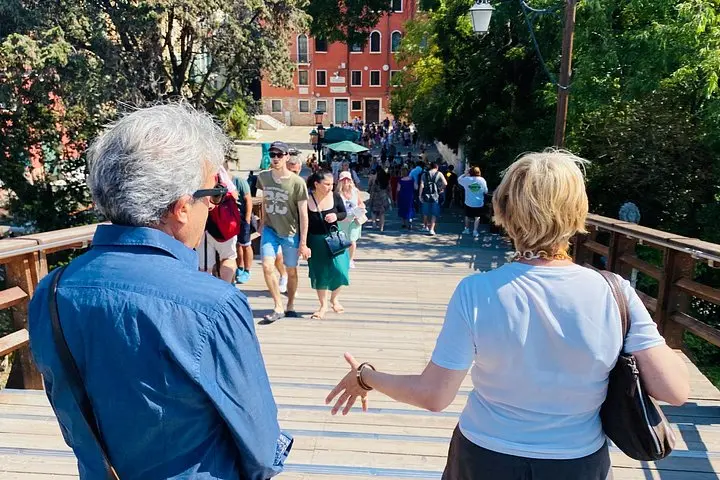
Practicalities are straightforward. The route is entirely outdoors and mostly flat, but expect cobbles, short staircases over bridges, and single-file passages. The meeting point is behind the Museo Correr at the wooden souvenir kiosk next to the post office — punctuality matters: late arrivals cannot join. The tour doesn’t enter paid monuments, so there are no skip-the-line benefits, but the radio system ensures you won’t lose the guide’s voice in crowded squares.
Best for first-time visitors who want context beyond guidebook blurbs, the walk is accessible to most hikers comfortable with urban walking. Bring comfortable, grippy shoes and a small water bottle, and plan for tides: acqua alta can affect low-lying streets in autumn and winter. If you want to photograph intimate alleys, aim for early morning light; for people-watching, mercerie at mid-afternoon is vivid. This is Venice at human scale — a city that insists on conversation, instruction, and the occasional surprise behind a narrow doorway.
The tour is 90 minutes and starts behind the Museo Correr at the wooden souvenir kiosk next to the post office in Piazza San Marco.
No — the route includes bridges with steps and narrow passages; all guests must be able to walk and climb steps independently.
No — the tour provides external commentary only and does not include entrances to paid monuments.
The tour runs in fair weather; if cancelled for weather or insufficient participants you’ll be offered an alternative date or a full refund.
Yes, older children who can walk for 90 minutes and manage stairs will enjoy the stories, but it’s not adapted for strollers.
A mobile voucher is accepted; follow the meeting instructions on your booking confirmation and arrive on time.
Star Florence operates guided outdoor trips and adventures with an emphasis on safety, stewardship, and memorable experiences.

You step out of the shadow of the Campanile and the city changes scale: the roar of Piazza San Marco softens into the click of heels on stone, and alleys fold inward like pages of an old book. For 90 minutes a guide pulls a thread through Venice’s dense weave — not the postcard façades, but the small, human corners where merchants, shipwrights and performers left fingerprints.
You step out of the shadow of the Campanile and the city changes scale: the roar of Piazza San Marco softens into the click of heels on stone, and alleys fold inward like pages of an old book. For 90 minutes a guide pulls a thread through Venice’s dense weave — not the postcard façades, but the small, human corners where merchants, shipwrights and performers left fingerprints.
The tour begins where Venice’s public life converges: the square around St. Mark’s Basilica. Here, architecture reads like civic biography — Byzantine mosaics, Gothic loggias, and the Campanile that kept time for a republic built on trade and tides. From this high stage the route slips into quieter neighborhoods: a little square that was once a market for sailors, a modest house said to belong to Marco Polo, and the Scuola Grande di San Marco, which marks the medical and charitable heart of the lagoon city.
Geology and engineering thread through the stories. Venice exists because generations drove timber piles into silt and built on top; narrow canals and low bridges are as much practical solutions as aesthetic choices. The Mercerie, the tour’s final stretch, is the artery that joined Rialto’s merchants to San Marco’s politics — today it still hums with artisans and small ateliers, echoing a mercantile pulse that shaped Europe.
Culturally, the walk is a primer in Venetian contradictions: immense wealth and razor-thin alleys, public spectacle and private devotion. Guides use vivid anecdotes to connect architecture to politics, explain why a church bears an odd name, or recount the theater fires that pushed a city’s culture into new shapes.
Practicalities are straightforward. The route is entirely outdoors and mostly flat, but expect cobbles, short staircases over bridges, and single-file passages. The meeting point is behind the Museo Correr at the wooden souvenir kiosk next to the post office — punctuality matters: late arrivals cannot join. The tour doesn’t enter paid monuments, so there are no skip-the-line benefits, but the radio system ensures you won’t lose the guide’s voice in crowded squares.
Best for first-time visitors who want context beyond guidebook blurbs, the walk is accessible to most hikers comfortable with urban walking. Bring comfortable, grippy shoes and a small water bottle, and plan for tides: acqua alta can affect low-lying streets in autumn and winter. If you want to photograph intimate alleys, aim for early morning light; for people-watching, mercerie at mid-afternoon is vivid. This is Venice at human scale — a city that insists on conversation, instruction, and the occasional surprise behind a narrow doorway.