THE ADVENTURE COLLECTIVE® · Independent discovery and booking for outdoor travel

An interactive, self-guided city quest that sends teams through Garetubani, 19th-century tenement streets and the multicultural old town. Ideal for families and groups who want a playful, educational walk with wine tasting and a coffee break.
An interactive, self-guided city quest that sends teams through Garetubani, 19th-century tenement streets and the multicultural old town. Ideal for families and groups who want a playful, educational walk with wine tasting and a coffee break.
A smartphone screen lights up and the game begins: you stand at the edge of Garetubani, alleyways whispering challenges and building facades asking questions. The city presses close — cobbles underfoot, occasional tram bells, and the Kura River low and steady — while your party splits into small teams to chase clues through new and old Tbilisi.
Verified experiences and guided adventures in the surrounding area.
Operated by Georgian Promenade · Tbilisi, Tbilisi
A smartphone screen lights up and the game begins: you stand at the edge of Garetubani, alleyways whispering challenges and building facades asking questions. The city presses close — cobbles underfoot, occasional tram bells, and the Kura River low and steady — while your party splits into small teams to chase clues through new and old Tbilisi.
The route threads 19th-century tenement façades, modernist streets, and the layered quarters where Jewish, Armenian and Azerbaijani communities left visible marks in synagogues, churches and merchant houses. Tbilisi’s geology — a city built on terraces and hot springs — means short steep streets and sandstone steps punctuate otherwise walkable blocks. The experience doubles as a compact cultural primer: local food samples, a coffee break, and a wine tasting that punctuate puzzle-solving.
This is a self-guided, messenger-driven quest: organizers meet participants at the start and finish, then send tasks by Telegram/WhatsApp/Viber. Expect roughly three hours of walking, frequent stops, and flexible pacing; the path includes narrow lanes, staircases and some uneven pavements, so steady shoes matter. The game uses public spaces and local businesses for clues, so be respectful of private property and quiet residential areas.
Practical tip: bring a charged smartphone and a small power bank, wear comfortable shoes for cobbles and steps, and plan for weather—an umbrella or light rain jacket if showers are forecast. This format suits families and mixed-age groups who enjoy urban exploration, quick history bites, and playful competition without a constant guide.
No — the game materials and messaging support are typically provided in English and Russian; basic local language helps when asking residents for hints but isn’t required.
Organizers meet participants at the start to explain the rules and again at the finish; the quest itself is self-guided with remote assistance via messenger if needed.
Parts of Old Tbilisi include steep streets and staircases; stroller use may be difficult and some sections are not wheelchair friendly.
The tour notes a coffee break, wine tasting and local snacks (e.g., churchkhela); check booking details for exact inclusions and any age restrictions for alcohol.
Georgian Promenade operates guided outdoor trips and adventures with an emphasis on safety, stewardship, and memorable experiences.
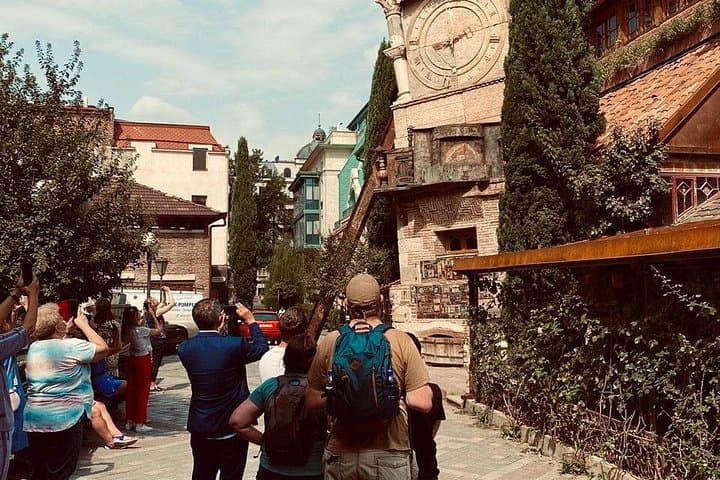



A smartphone screen lights up and the game begins: you stand at the edge of Garetubani, alleyways whispering challenges and building facades asking questions. The city presses close — cobbles underfoot, occasional tram bells, and the Kura River low and steady — while your party splits into small teams to chase clues through new and old Tbilisi.
A smartphone screen lights up and the game begins: you stand at the edge of Garetubani, alleyways whispering challenges and building facades asking questions. The city presses close — cobbles underfoot, occasional tram bells, and the Kura River low and steady — while your party splits into small teams to chase clues through new and old Tbilisi.
The route threads 19th-century tenement façades, modernist streets, and the layered quarters where Jewish, Armenian and Azerbaijani communities left visible marks in synagogues, churches and merchant houses. Tbilisi’s geology — a city built on terraces and hot springs — means short steep streets and sandstone steps punctuate otherwise walkable blocks. The experience doubles as a compact cultural primer: local food samples, a coffee break, and a wine tasting that punctuate puzzle-solving.
This is a self-guided, messenger-driven quest: organizers meet participants at the start and finish, then send tasks by Telegram/WhatsApp/Viber. Expect roughly three hours of walking, frequent stops, and flexible pacing; the path includes narrow lanes, staircases and some uneven pavements, so steady shoes matter. The game uses public spaces and local businesses for clues, so be respectful of private property and quiet residential areas.
Practical tip: bring a charged smartphone and a small power bank, wear comfortable shoes for cobbles and steps, and plan for weather—an umbrella or light rain jacket if showers are forecast. This format suits families and mixed-age groups who enjoy urban exploration, quick history bites, and playful competition without a constant guide.