THE ADVENTURE COLLECTIVE® · Independent discovery and booking for outdoor travel

Cross sand ridges, ride bactrian camels and spend a night beside a nomadic family before wandering the ruins and temples of Kharkhorum. This overnight private trip blends dune hiking and cultural encounters with long but scenic drives across central Mongolia.
Cross sand ridges, ride bactrian camels and spend a night beside a nomadic family before wandering the ruins and temples of Kharkhorum. This overnight private trip blends dune hiking and cultural encounters with long but scenic drives across central Mongolia.
You crest a low ridge of wind-sculpted sand and the plain opens: a ribbon of tamarisk, a handful of yurt felt glinting white, and the two-humped outline of a bactrian camel waiting like an old companion. The Semi-Gobi—locally Elsen Tasarkhai—sits at the edge of Mongolia’s steppe, where sand moves in slow, audible breaths and the sky feels nearer.
Verified experiences and guided adventures in the surrounding area.
Operated by Nomadic Hospitality Mongolia · Kharkhorin, Övörkhangai Province
You crest a low ridge of wind-sculpted sand and the plain opens: a ribbon of tamarisk, a handful of yurt felt glinting white, and the two-humped outline of a bactrian camel waiting like an old companion. The Semi-Gobi—locally Elsen Tasarkhai—sits at the edge of Mongolia’s steppe, where sand moves in slow, audible breaths and the sky feels nearer.
This loop pairs living nomadic culture with Kharkhorum’s ruins. Kharkhorum was the 13th-century seat of the Mongol Empire; Erdene Zuu monastery that follows was built from the stones of the ruined capital and remains the country’s oldest surviving Buddhist complex. Geologically the Semi-Gobi is a transition zone: dune fields interrupted by pockets of scrub and small forest fragments shaped by wind and seasonal streams.
Expect long drives—roughly 3–5 hours between Ulaanbaatar and Kharkhorin, depending on conditions—and a mix of activities: short dune hikes, camel rides, a visit to a nomadic family for traditional food and an overnight yurt, plus the Kharkhorin Museum and Erdene Zuu. Terrain is sandy and uneven near dunes, flat and grassy elsewhere; elevation is generally 1,200–1,400 m, so nights can be cool.
Practical: wear sturdy boots for sand and scrub, layer for big diurnal temperature swings, carry at least 2–3 liters of water, and plan buffer time for road delays. Respect nomadic camps—ask before photographing—and use biodegradable products near grazing land. The trip is immersive, low-tech, and rooted in landscape and hospitality—an accessible way to feel how history and nomadic life still shape Mongolia.
From Ulaanbaatar count roughly 3–5 hours each way to Kharkhorin depending on road and weather; plan for long days with stops.
Options include a private yurt near a nomadic family; facilities are basic but insulated with felt and typically provide bedding and meals.
Yes—bactrian camel rides are included around the dunes; guides assist first-time riders and rides are short and gentle.
There are basic rest stops along the route and at visitor points; expect primitive facilities at nomadic camps and prepare accordingly.
Nomadic Hospitality Mongolia operates guided outdoor trips and adventures with an emphasis on safety, stewardship, and memorable experiences.
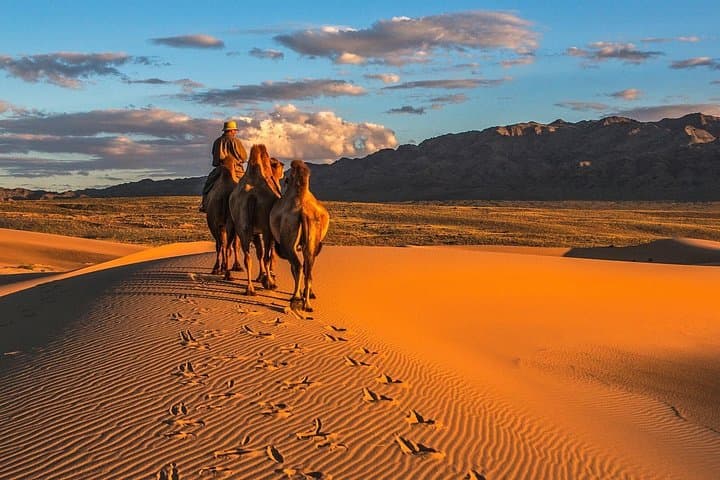
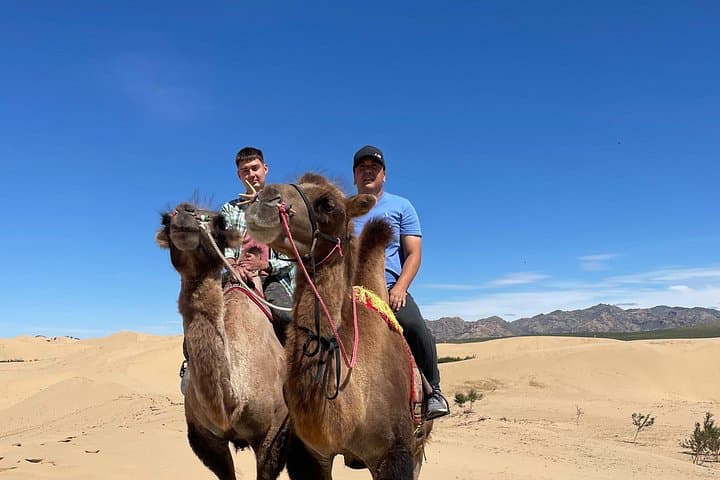


You crest a low ridge of wind-sculpted sand and the plain opens: a ribbon of tamarisk, a handful of yurt felt glinting white, and the two-humped outline of a bactrian camel waiting like an old companion. The Semi-Gobi—locally Elsen Tasarkhai—sits at the edge of Mongolia’s steppe, where sand moves in slow, audible breaths and the sky feels nearer.
You crest a low ridge of wind-sculpted sand and the plain opens: a ribbon of tamarisk, a handful of yurt felt glinting white, and the two-humped outline of a bactrian camel waiting like an old companion. The Semi-Gobi—locally Elsen Tasarkhai—sits at the edge of Mongolia’s steppe, where sand moves in slow, audible breaths and the sky feels nearer.
This loop pairs living nomadic culture with Kharkhorum’s ruins. Kharkhorum was the 13th-century seat of the Mongol Empire; Erdene Zuu monastery that follows was built from the stones of the ruined capital and remains the country’s oldest surviving Buddhist complex. Geologically the Semi-Gobi is a transition zone: dune fields interrupted by pockets of scrub and small forest fragments shaped by wind and seasonal streams.
Expect long drives—roughly 3–5 hours between Ulaanbaatar and Kharkhorin, depending on conditions—and a mix of activities: short dune hikes, camel rides, a visit to a nomadic family for traditional food and an overnight yurt, plus the Kharkhorin Museum and Erdene Zuu. Terrain is sandy and uneven near dunes, flat and grassy elsewhere; elevation is generally 1,200–1,400 m, so nights can be cool.
Practical: wear sturdy boots for sand and scrub, layer for big diurnal temperature swings, carry at least 2–3 liters of water, and plan buffer time for road delays. Respect nomadic camps—ask before photographing—and use biodegradable products near grazing land. The trip is immersive, low-tech, and rooted in landscape and hospitality—an accessible way to feel how history and nomadic life still shape Mongolia.