THE ADVENTURE COLLECTIVE® · Independent discovery and booking for outdoor travel

Stand on the icy fringe of Shiretoko as Steller’s sea and white-tailed eagles wheel over drift ice. This focused winter tour near Rausu pairs local knowledge with high-probability eagle viewing and practical, low-impact wildlife etiquette.
Stand on the icy fringe of Shiretoko as Steller’s sea and white-tailed eagles wheel over drift ice. This focused winter tour near Rausu pairs local knowledge with high-probability eagle viewing and practical, low-impact wildlife etiquette.
A raw wind from the Sea of Okhotsk pushes fingers of drift ice along the Shiretoko coast as a black-and-white silhouette drops from a low cloud and dominates the sky. On a winter morning near Rausu you stand with binoculars as a Steller’s sea eagle—huge, focused, almost theatrical—casts a shadow over the floes; the white-tailed eagle circles above like a slow clock hand.
Verified experiences and guided adventures in the surrounding area.
Operated by Picchio Shiretoko · Rausu, Hokkaido
A raw wind from the Sea of Okhotsk pushes fingers of drift ice along the Shiretoko coast as a black-and-white silhouette drops from a low cloud and dominates the sky. On a winter morning near Rausu you stand with binoculars as a Steller’s sea eagle—huge, focused, almost theatrical—casts a shadow over the floes; the white-tailed eagle circles above like a slow clock hand.
Shiretoko’s shoreline is carved from volcanic rock and ancient tectonic uplift; cliffs, narrow coves and sea ice create concentrated feeding grounds that draw these raptors each winter. The peninsula sits on Ainu lands and is a UNESCO World Natural Heritage Site for its intact ecosystems and seasonal migrations. Local fishing communities adapted to harsh winters and the presence of ice, and today small operator-led tours channel that local knowledge into high-probability viewing outings.
Expect patient, low-impact wildlife watching: guides position you where eagles habitually perch and feed, and natural behavior—perching, soaring, diving—is the show. You may also spot Ezo sika deer and red foxes on the shoreline and seals on the ice.
Practical guidance: dress in layers with a windproof outer shell, bring spare batteries for cold-weather shooting, and use binoculars or the free rental optics offered. Tours run best from late December through March when drift ice and prey concentrations are highest. Respect distance rules, follow your guide’s instructions, and plan accommodations in Rausu or nearby Utoro the night before to maximize early-morning light and eagle activity.
Late December through March offers the highest chance when drift ice and fish concentrations attract large eagles.
No—this is an easy viewing tour with short walks on coastal ground; guides position viewing points to minimize exertion.
Many operators provide free binocular rentals, but bringing your own optics ensures familiarity and quicker spotting.
Tours are often canceled for severe weather or insufficient participants; policies typically allow a full refund if canceled at least 24 hours in advance.
Picchio Shiretoko operates guided outdoor trips and adventures with an emphasis on safety, stewardship, and memorable experiences.
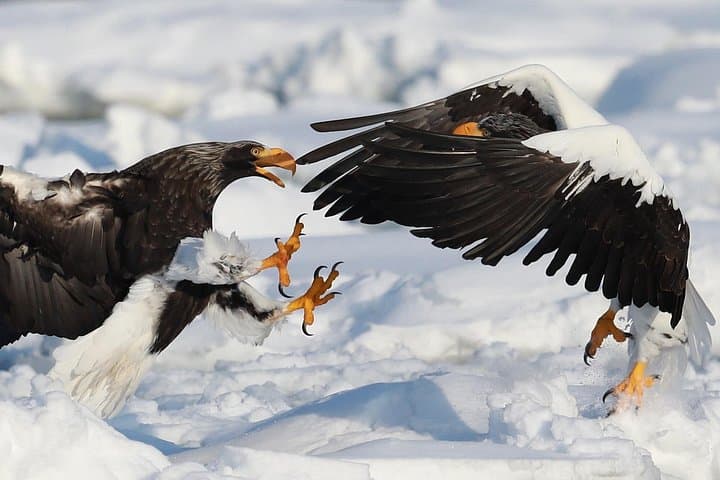


A raw wind from the Sea of Okhotsk pushes fingers of drift ice along the Shiretoko coast as a black-and-white silhouette drops from a low cloud and dominates the sky. On a winter morning near Rausu you stand with binoculars as a Steller’s sea eagle—huge, focused, almost theatrical—casts a shadow over the floes; the white-tailed eagle circles above like a slow clock hand.
A raw wind from the Sea of Okhotsk pushes fingers of drift ice along the Shiretoko coast as a black-and-white silhouette drops from a low cloud and dominates the sky. On a winter morning near Rausu you stand with binoculars as a Steller’s sea eagle—huge, focused, almost theatrical—casts a shadow over the floes; the white-tailed eagle circles above like a slow clock hand.
Shiretoko’s shoreline is carved from volcanic rock and ancient tectonic uplift; cliffs, narrow coves and sea ice create concentrated feeding grounds that draw these raptors each winter. The peninsula sits on Ainu lands and is a UNESCO World Natural Heritage Site for its intact ecosystems and seasonal migrations. Local fishing communities adapted to harsh winters and the presence of ice, and today small operator-led tours channel that local knowledge into high-probability viewing outings.
Expect patient, low-impact wildlife watching: guides position you where eagles habitually perch and feed, and natural behavior—perching, soaring, diving—is the show. You may also spot Ezo sika deer and red foxes on the shoreline and seals on the ice.
Practical guidance: dress in layers with a windproof outer shell, bring spare batteries for cold-weather shooting, and use binoculars or the free rental optics offered. Tours run best from late December through March when drift ice and prey concentrations are highest. Respect distance rules, follow your guide’s instructions, and plan accommodations in Rausu or nearby Utoro the night before to maximize early-morning light and eagle activity.