THE ADVENTURE COLLECTIVE® · Independent discovery and booking for outdoor travel

Cycle 20 km through rice paddies, lotus ponds, and village lanes south of Siem Reap, stopping at a pagoda and organic farms to learn local life. This 4-hour guided tour combines gentle riding with cultural and nature insights—ideal for travelers who want a hands-on glimpse of Cambodia's rural rhythms.
Cycle 20 km through rice paddies, lotus ponds, and village lanes south of Siem Reap, stopping at a pagoda and organic farms to learn local life. This 4-hour guided tour combines gentle riding with cultural and nature insights—ideal for travelers who want a hands-on glimpse of Cambodia's rural rhythms.
A morning on the Siem Reap countryside arrives with the soft slap of a bicycle tire against packed earth and the metallic clink of gears. Riders leave the city behind and pedal into a sweep of flooded rice paddies, lotus ponds, and single-track village lanes where water buffalo lift their heads as you pass. The guide pauses at a colorful pagoda; prayer flags and incense mark a living practice of Theravada Buddhism that threads village life.
Verified experiences and guided adventures in the surrounding area.
Operated by Bayon Guide · Siem Reap, Siem Reap Province
A morning on the Siem Reap countryside arrives with the soft slap of a bicycle tire against packed earth and the metallic clink of gears. Riders leave the city behind and pedal into a sweep of flooded rice paddies, lotus ponds, and single-track village lanes where water buffalo lift their heads as you pass. The guide pauses at a colorful pagoda; prayer flags and incense mark a living practice of Theravada Buddhism that threads village life.
This landscape sits on the flat Tonle Sap plain, shaped by seasonal floods that push nutrient-rich water across the fields each wet season. The geology is simple—alluvial soils and shallow aquifers—yet that simplicity supports dense biodiversity: shorebirds, frogs, and wetland plants concentrated in ponds and irrigation channels. Cambodian rural culture is visible in small details—rice threshing platforms, Khmer script on storefronts, and families tending organic vegetable beds to diversify income beyond rice.
Expect roughly 20 km of mostly flat, mixed surface riding—paved lanes, packed dirt, and short off-road sections—with multiple guided stops. The route is instructive: learn about rice cycles, watch lotus harvesting, and enter a village for a walking segment to meet artisans and farmers.
Practical notes: wear closed-toe shoes, use sun protection, and bring a reusable water bottle (water provided but refillable bottles cut plastic). Mornings are cooler and wind is usually light; late-afternoon rains appear in the wet season. Fitness needs are moderate—this is a culturally rich ride rather than a technical mountain-bike adventure.
The tour is about 4 hours and covers roughly 20 km with multiple stops for sites and village walks.
No advanced skills are needed—riders should be comfortable on a standard mountain bike and able to ride mixed surfaces for several kilometers.
Yes, quality mountain bikes and helmets are provided; you may bring your own helmet for better fit and comfort.
Restroom access is limited to village stops and pagoda areas; bring snacks if you need extra energy between breaks.
Bayon Guide operates guided outdoor trips and adventures with an emphasis on safety, stewardship, and memorable experiences.
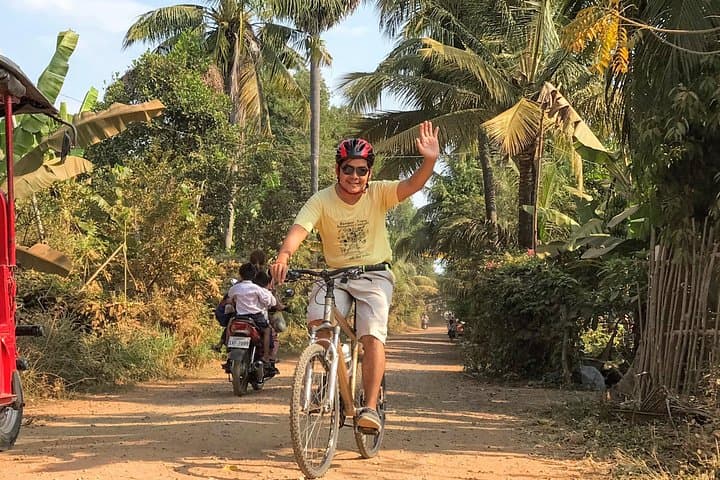
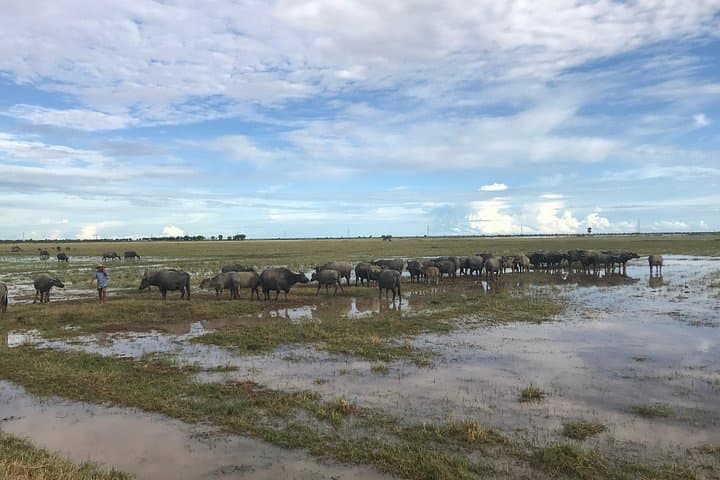
A morning on the Siem Reap countryside arrives with the soft slap of a bicycle tire against packed earth and the metallic clink of gears. Riders leave the city behind and pedal into a sweep of flooded rice paddies, lotus ponds, and single-track village lanes where water buffalo lift their heads as you pass. The guide pauses at a colorful pagoda; prayer flags and incense mark a living practice of Theravada Buddhism that threads village life.
A morning on the Siem Reap countryside arrives with the soft slap of a bicycle tire against packed earth and the metallic clink of gears. Riders leave the city behind and pedal into a sweep of flooded rice paddies, lotus ponds, and single-track village lanes where water buffalo lift their heads as you pass. The guide pauses at a colorful pagoda; prayer flags and incense mark a living practice of Theravada Buddhism that threads village life.
This landscape sits on the flat Tonle Sap plain, shaped by seasonal floods that push nutrient-rich water across the fields each wet season. The geology is simple—alluvial soils and shallow aquifers—yet that simplicity supports dense biodiversity: shorebirds, frogs, and wetland plants concentrated in ponds and irrigation channels. Cambodian rural culture is visible in small details—rice threshing platforms, Khmer script on storefronts, and families tending organic vegetable beds to diversify income beyond rice.
Expect roughly 20 km of mostly flat, mixed surface riding—paved lanes, packed dirt, and short off-road sections—with multiple guided stops. The route is instructive: learn about rice cycles, watch lotus harvesting, and enter a village for a walking segment to meet artisans and farmers.
Practical notes: wear closed-toe shoes, use sun protection, and bring a reusable water bottle (water provided but refillable bottles cut plastic). Mornings are cooler and wind is usually light; late-afternoon rains appear in the wet season. Fitness needs are moderate—this is a culturally rich ride rather than a technical mountain-bike adventure.