THE ADVENTURE COLLECTIVE® · Independent discovery and booking for outdoor travel

Leave Kalutara before sunrise and spend a long day climbing Sigiriya’s Lion Rock and exploring Dambulla’s cave temples. This guided day trip blends dramatic climbs, ancient frescoes, and practical logistics for travelers who want a dense cultural outing without overnight travel.
Leave Kalutara before sunrise and spend a long day climbing Sigiriya’s Lion Rock and exploring Dambulla’s cave temples. This guided day trip blends dramatic climbs, ancient frescoes, and practical logistics for travelers who want a dense cultural outing without overnight travel.
Before dawn the van slides out of Kalutara and the coastline’s humidity gives way to the dry heat of the island’s interior. By the time the first rays free themselves over the plain, Sigiriya’s monolithic shoulder rises from the fields — a raw vertical challenge, bright as a wound against the sky. Climbers begin on a narrow, engineered route that threads through gardens, past the Mirror Wall and the painted frescoes, then up iron staircases that heave out from bare rock until the summit plateaus into royal ruin and a panoramic sweep of jungle, paddy, and reservoir.
Verified experiences and guided adventures in the surrounding area.
Operated by Ceylon Travel Dream · Sigiriya, Central Province
Before dawn the van slides out of Kalutara and the coastline’s humidity gives way to the dry heat of the island’s interior. By the time the first rays free themselves over the plain, Sigiriya’s monolithic shoulder rises from the fields — a raw vertical challenge, bright as a wound against the sky. Climbers begin on a narrow, engineered route that threads through gardens, past the Mirror Wall and the painted frescoes, then up iron staircases that heave out from bare rock until the summit plateaus into royal ruin and a panoramic sweep of jungle, paddy, and reservoir.
Sigiriya and Dambulla occupy two different chapters of Sri Lanka’s long book. Sigiriya — the Lion Rock — was converted into a fortified palace by King Kashyapa in the late 5th century AD and is notable for its engineered water gardens and dramatic frescoes halfway up the face. Dambulla, south of the rock, preserves five living-rock caves that have been sanctified since at least the 1st century BCE and contain hundreds of painted panels and Buddha statues spanning many centuries. Geologically, Sigiriya is a hardened outcrop of an ancient magma plug; the arteries of iron ladders and stone steps are modern additions, but the rock itself has stood weathering erosion for millennia.
Culturally, both sites are active places of reverence. Visitors remove shoes at cave thresholds, murmur with the local worshippers, and navigate narrow temple quarters crowded with gilded figures and frescoed ceilings. The tour pairs history with practical logistics: expect about 12–13 hours total, roughly 3 hours driving each way from Kalutara, a guided climb at Sigiriya with roughly 1,200 steps and an elevation gain near 180–200 meters, and a 45–60 minute walk through the Dambulla cave complex with short stair access.
Practical guidance matters here. Wear good trekking shoes for iron staircases and slick ledges, carry at least 1–2 liters of water, and bring sun protection — the climb exposes you to full sun. Photography is excellent from the summit and at the Dambulla cave entrance, but respect sacred areas and local worship practices. The included midday lunch gives a welcome break; note that cave entry fees are typically paid on site. For tight schedules, start with Sigiriya to catch the softer morning light and finish at Dambulla when the caves are cooler.
This is a day for movement: walking through history, negotiating the raw geology of Lion Rock, and standing under a layered ceiling of painted devotion. With a knowledgeable local guide and a well-packed day bag, it’s a compact but immersive survey of Sri Lanka’s cultural heartland.
No — the tour price usually excludes site entrance fees; these are paid on arrival at Sigiriya and Dambulla (bring cash or card where accepted).
Expect roughly 3 hours each way depending on traffic—total driving time is about six hours for the round trip.
The route includes steep sections and metal staircases; children and older travelers should assess mobility and be comfortable with heights.
No — visitors must remove shoes before entering the cave temples out of respect and to preserve sacred spaces.
Yes, a midday lunch is included in the tour, typically at a local restaurant en route between attractions.
Photography is generally permitted in many cave areas but follow signage and requests from temple staff—avoid flash where indicated.
Ceylon Travel Dream operates guided outdoor trips and adventures with an emphasis on safety, stewardship, and memorable experiences.
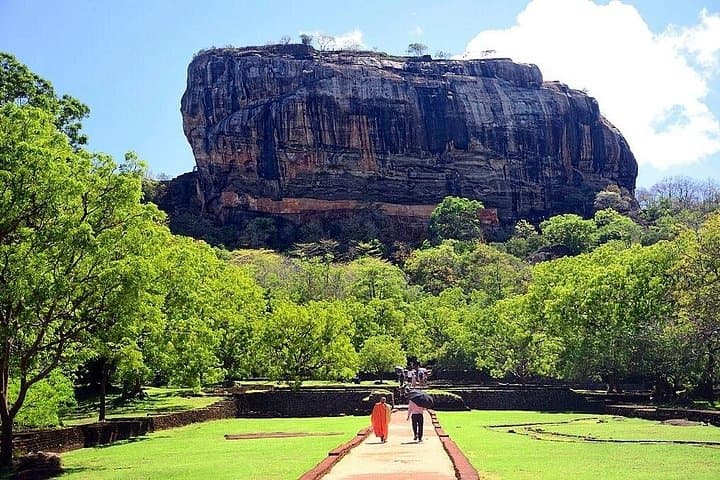


Before dawn the van slides out of Kalutara and the coastline’s humidity gives way to the dry heat of the island’s interior. By the time the first rays free themselves over the plain, Sigiriya’s monolithic shoulder rises from the fields — a raw vertical challenge, bright as a wound against the sky. Climbers begin on a narrow, engineered route that threads through gardens, past the Mirror Wall and the painted frescoes, then up iron staircases that heave out from bare rock until the summit plateaus into royal ruin and a panoramic sweep of jungle, paddy, and reservoir.
Before dawn the van slides out of Kalutara and the coastline’s humidity gives way to the dry heat of the island’s interior. By the time the first rays free themselves over the plain, Sigiriya’s monolithic shoulder rises from the fields — a raw vertical challenge, bright as a wound against the sky. Climbers begin on a narrow, engineered route that threads through gardens, past the Mirror Wall and the painted frescoes, then up iron staircases that heave out from bare rock until the summit plateaus into royal ruin and a panoramic sweep of jungle, paddy, and reservoir.
Sigiriya and Dambulla occupy two different chapters of Sri Lanka’s long book. Sigiriya — the Lion Rock — was converted into a fortified palace by King Kashyapa in the late 5th century AD and is notable for its engineered water gardens and dramatic frescoes halfway up the face. Dambulla, south of the rock, preserves five living-rock caves that have been sanctified since at least the 1st century BCE and contain hundreds of painted panels and Buddha statues spanning many centuries. Geologically, Sigiriya is a hardened outcrop of an ancient magma plug; the arteries of iron ladders and stone steps are modern additions, but the rock itself has stood weathering erosion for millennia.
Culturally, both sites are active places of reverence. Visitors remove shoes at cave thresholds, murmur with the local worshippers, and navigate narrow temple quarters crowded with gilded figures and frescoed ceilings. The tour pairs history with practical logistics: expect about 12–13 hours total, roughly 3 hours driving each way from Kalutara, a guided climb at Sigiriya with roughly 1,200 steps and an elevation gain near 180–200 meters, and a 45–60 minute walk through the Dambulla cave complex with short stair access.
Practical guidance matters here. Wear good trekking shoes for iron staircases and slick ledges, carry at least 1–2 liters of water, and bring sun protection — the climb exposes you to full sun. Photography is excellent from the summit and at the Dambulla cave entrance, but respect sacred areas and local worship practices. The included midday lunch gives a welcome break; note that cave entry fees are typically paid on site. For tight schedules, start with Sigiriya to catch the softer morning light and finish at Dambulla when the caves are cooler.
This is a day for movement: walking through history, negotiating the raw geology of Lion Rock, and standing under a layered ceiling of painted devotion. With a knowledgeable local guide and a well-packed day bag, it’s a compact but immersive survey of Sri Lanka’s cultural heartland.