THE ADVENTURE COLLECTIVE® · Independent discovery and booking for outdoor travel

Explore the Kerikeri River in near-silence aboard New Zealand’s first hireable electric boats. This guide covers the river’s character, local history, and practical tips for a smooth, wildlife-friendly outing.
Explore the Kerikeri River in near-silence aboard New Zealand’s first hireable electric boats. This guide covers the river’s character, local history, and practical tips for a smooth, wildlife-friendly outing.
The river slows to a whisper as your boat slips around the next bend and the motor makes itself nearly invisible—only the water tapping the hull marks your progress. Mangrove roots claw at the shoreline, white-faced herons stand like watchful statues, and every bend opens a fresh, sheltered view of the Kerikeri River estuary.
Verified experiences and guided adventures in the surrounding area.
The river slows to a whisper as your boat slips around the next bend and the motor makes itself nearly invisible—only the water tapping the hull marks your progress. Mangrove roots claw at the shoreline, white-faced herons stand like watchful statues, and every bend opens a fresh, sheltered view of the Kerikeri River estuary.
The Kerikeri area is one of Aotearoa’s earliest European settlement sites; nearby the Stone Store and Mission House speak to early 19th-century colonial and missionary history. Geologically the river threads through a low-lying, estuarine plain shaped by tides and ancient alluvial deposits, creating shallow channels, sandbars, and sheltered backwaters favored by fish and seabirds. The local culture is a blend of Māori kāinga (settlement) history and modern small-town horticulture—keri (to seek) seems apt as each paddle reveals something new.
Practical guidance: these electric hires require no license, and boats are simple to handle—pick the Akaroa model if you want the easiest controls. Plan trips around tides and wind: the estuary is calm on incoming tides and can feel choppier in exposed sections at low tide. Bring waterproof layers, sun protection, and binoculars for birding.
Safety notes: keep distance from nesting birds, watch for shallow ground at low tide, and secure any loose gear on deck. For timing, early morning and late afternoon offer the best light and quieter wildlife encounters. Whether you want a relaxed family cruise or a focused wildlife run, the silent motor makes close, low-impact viewing practical and memorable.
No license or prior experience is required; staff will give a short briefing and the boats are designed for easy handling.
There are five boat models accommodating singles up to groups of seven, with a maximum on-site capacity of 21 people at once.
Policies vary—check with the operator before booking; bring a pet lifejacket if allowed and your pet is accustomed to boats.
Early morning and late afternoon are best for bird activity and quieter waters; plan around tides for wider channel access.
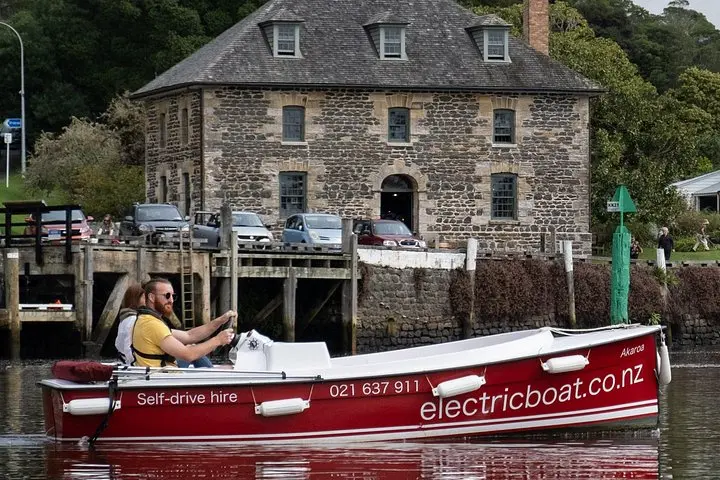
The river slows to a whisper as your boat slips around the next bend and the motor makes itself nearly invisible—only the water tapping the hull marks your progress. Mangrove roots claw at the shoreline, white-faced herons stand like watchful statues, and every bend opens a fresh, sheltered view of the Kerikeri River estuary.
The river slows to a whisper as your boat slips around the next bend and the motor makes itself nearly invisible—only the water tapping the hull marks your progress. Mangrove roots claw at the shoreline, white-faced herons stand like watchful statues, and every bend opens a fresh, sheltered view of the Kerikeri River estuary.
The Kerikeri area is one of Aotearoa’s earliest European settlement sites; nearby the Stone Store and Mission House speak to early 19th-century colonial and missionary history. Geologically the river threads through a low-lying, estuarine plain shaped by tides and ancient alluvial deposits, creating shallow channels, sandbars, and sheltered backwaters favored by fish and seabirds. The local culture is a blend of Māori kāinga (settlement) history and modern small-town horticulture—keri (to seek) seems apt as each paddle reveals something new.
Practical guidance: these electric hires require no license, and boats are simple to handle—pick the Akaroa model if you want the easiest controls. Plan trips around tides and wind: the estuary is calm on incoming tides and can feel choppier in exposed sections at low tide. Bring waterproof layers, sun protection, and binoculars for birding.
Safety notes: keep distance from nesting birds, watch for shallow ground at low tide, and secure any loose gear on deck. For timing, early morning and late afternoon offer the best light and quieter wildlife encounters. Whether you want a relaxed family cruise or a focused wildlife run, the silent motor makes close, low-impact viewing practical and memorable.