THE ADVENTURE COLLECTIVE® · Independent discovery and booking for outdoor travel

Travel from Dunhuang’s singing sand dunes to Xining’s Tibetan monasteries on an eight-day private Silk Road route. Expect desert geology, ancient grottoes, and plateau culture with private transport and timed-site logistics.
Travel from Dunhuang’s singing sand dunes to Xining’s Tibetan monasteries on an eight-day private Silk Road route. Expect desert geology, ancient grottoes, and plateau culture with private transport and timed-site logistics.
You step from an air-conditioned car into a wind-shaped horizon; sand dunes rise like slow waves and the Crescent Lake holds a quiet like a secret kept for centuries.
Verified experiences and guided adventures in the surrounding area.
Operated by happychinatours · Dunhuang, Gansu
You step from an air-conditioned car into a wind-shaped horizon; sand dunes rise like slow waves and the Crescent Lake holds a quiet like a secret kept for centuries.
This eight-day private itinerary threads the northern Silk Road — Dunhuang’s singing sands and Mogao Grottoes, the strategic passes of Jiayuguan, Zhangye’s painted Danxia, the river-carved Bingling Grottos, and the Tibetan-influenced monasteries around Xiahe, Tongren and Xining. Geology and history overlap here: shifting deserts rest against compacted loess and rammed-earth fortifications, while Buddhist art—murals, statues and tangkas—records a millennium of cultural exchange.
Local life still moves slowly: traders’ routes became villages, and Salar, Tibetan and Han communities leave visible traces in cuisine, architecture and festivities. Regong painting and Labrang’s monastic rituals offer cultural texture beyond the monuments.
Practical guidance: allow time to acclimatize as you climb to plateau towns like Xiahe; Mogao’s grottoes limit group sizes, so book early and carry your passport for timed tickets. Desert days mean strong sun and cold nights—layered clothing is essential. Transport is included with a private vehicle and some rail segments typical of Chinese intercity travel; bring small cash for markets and optional camel rides or sand-sledding. Expect comfortable 4-star hotels most nights and several substantial drives—plan for hydration breaks and modest hikes at each site.
This trip suits travelers wanting concentrated cultural immersion across varied landscapes, balanced by private logistics and local guides to translate history into place.
A valid passport is required for national park and grotto ticketing; visitors from abroad must hold the appropriate Chinese visa before arrival.
The tour is mostly vehicle-based with brief walks and stair-climbs at grottoes and monasteries—no technical hiking, but basic mobility is needed.
Breakfasts and selected lunches are included; hotels are generally 4-star as listed but special holiday dates may require extra fees.
Yes—this is a private tour and guides can adapt visits within logistical limits, but major changes may affect transport and admission timing.
happychinatours operates guided outdoor trips and adventures with an emphasis on safety, stewardship, and memorable experiences.
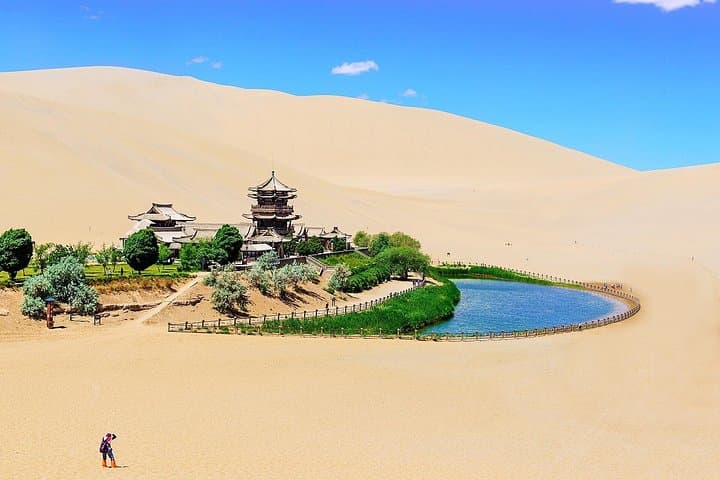


You step from an air-conditioned car into a wind-shaped horizon; sand dunes rise like slow waves and the Crescent Lake holds a quiet like a secret kept for centuries.
You step from an air-conditioned car into a wind-shaped horizon; sand dunes rise like slow waves and the Crescent Lake holds a quiet like a secret kept for centuries.
This eight-day private itinerary threads the northern Silk Road — Dunhuang’s singing sands and Mogao Grottoes, the strategic passes of Jiayuguan, Zhangye’s painted Danxia, the river-carved Bingling Grottos, and the Tibetan-influenced monasteries around Xiahe, Tongren and Xining. Geology and history overlap here: shifting deserts rest against compacted loess and rammed-earth fortifications, while Buddhist art—murals, statues and tangkas—records a millennium of cultural exchange.
Local life still moves slowly: traders’ routes became villages, and Salar, Tibetan and Han communities leave visible traces in cuisine, architecture and festivities. Regong painting and Labrang’s monastic rituals offer cultural texture beyond the monuments.
Practical guidance: allow time to acclimatize as you climb to plateau towns like Xiahe; Mogao’s grottoes limit group sizes, so book early and carry your passport for timed tickets. Desert days mean strong sun and cold nights—layered clothing is essential. Transport is included with a private vehicle and some rail segments typical of Chinese intercity travel; bring small cash for markets and optional camel rides or sand-sledding. Expect comfortable 4-star hotels most nights and several substantial drives—plan for hydration breaks and modest hikes at each site.
This trip suits travelers wanting concentrated cultural immersion across varied landscapes, balanced by private logistics and local guides to translate history into place.