THE ADVENTURE COLLECTIVE® · Independent discovery and booking for outdoor travel

Leave the daytime crowds behind and explore Sintra’s Moon Mountain under the stars. This private night hike visits prehistoric tholos, hidden caves, and windswept sanctuary ruins—expect rocky terrain, coastal winds, and a guide who brings local legend to life.
Leave the daytime crowds behind and explore Sintra’s Moon Mountain under the stars. This private night hike visits prehistoric tholos, hidden caves, and windswept sanctuary ruins—expect rocky terrain, coastal winds, and a guide who brings local legend to life.
Moonlight flattens the forest and sharpens shadows as a small convoy climbs the serpentine road above Sintra. The air turns cooler, wind pushing through stone pines, and the guide’s beam picks out lichen and the glint of old mortar on ruined aqueduct arches. Walking here at night reframes the mountain: rocks become thresholds, caves take on intent, and the path feels like a thread through centuries.
Verified experiences and guided adventures in the surrounding area.
Moonlight flattens the forest and sharpens shadows as a small convoy climbs the serpentine road above Sintra. The air turns cooler, wind pushing through stone pines, and the guide’s beam picks out lichen and the glint of old mortar on ruined aqueduct arches. Walking here at night reframes the mountain: rocks become thresholds, caves take on intent, and the path feels like a thread through centuries.
The Serra de Sintra is a geological jumble of granite outcrops and sandstone layers carved by Atlantic weather. Human traces range from prehistoric Tholos do Monge burial stones to the 18th-century Peninha chapel that overlooks the coast. Local lore—pagan rites, hermit legends, and aqueduct myths—fuses with the landscape; the Goddess Stone and Loba Cave are touchstones for those stories.
Expect roughly 3 km of uneven, rocky night hiking spread over a 3–5 hour private tour that mixes short drives with on-foot exploration. Terrain is steep in places and can be slippery after rain; sturdy boots and a reliable headlamp are non-negotiable. Time your visit around a clear moon phase for the best visibility, and allow extra minutes to stop at the exposed Peninha sanctuary for wind-blown views.
Practicalities: carry 1–2 liters of water, dress in layers for coastal gusts, and bring a spare battery for lighting. The guide manages navigation and context, but participants should be comfortable on rocky trails and able to move deliberately in the dark. This is an intimate, slightly raw encounter with Sintra’s wilder side—history, geology, and legend all active under the moon.
This tour is best for hikers who are comfortable on uneven rocky trails and walking up to 3 km in the dark; beginners with steady footing may participate but should disclose concerns to the guide.
Heavy rain or storms can make the route unsafe; operators may reschedule or cancel for safety—check weather and cancellation policy before booking.
Age limits vary by operator; children able to safely navigate rocky terrain and who can follow night safety instructions may be permitted—confirm at booking.
A full or near-full moon significantly improves visibility; the guide’s lighting highlights key features, but expect limited details compared to daytime visits.
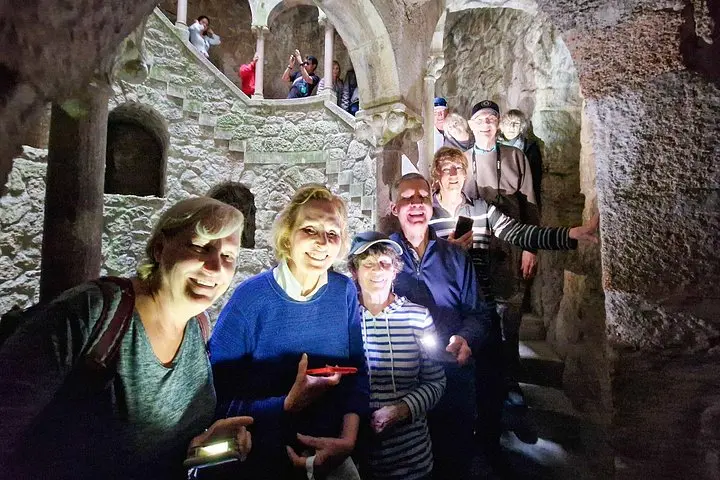
Moonlight flattens the forest and sharpens shadows as a small convoy climbs the serpentine road above Sintra. The air turns cooler, wind pushing through stone pines, and the guide’s beam picks out lichen and the glint of old mortar on ruined aqueduct arches. Walking here at night reframes the mountain: rocks become thresholds, caves take on intent, and the path feels like a thread through centuries.
Moonlight flattens the forest and sharpens shadows as a small convoy climbs the serpentine road above Sintra. The air turns cooler, wind pushing through stone pines, and the guide’s beam picks out lichen and the glint of old mortar on ruined aqueduct arches. Walking here at night reframes the mountain: rocks become thresholds, caves take on intent, and the path feels like a thread through centuries.
The Serra de Sintra is a geological jumble of granite outcrops and sandstone layers carved by Atlantic weather. Human traces range from prehistoric Tholos do Monge burial stones to the 18th-century Peninha chapel that overlooks the coast. Local lore—pagan rites, hermit legends, and aqueduct myths—fuses with the landscape; the Goddess Stone and Loba Cave are touchstones for those stories.
Expect roughly 3 km of uneven, rocky night hiking spread over a 3–5 hour private tour that mixes short drives with on-foot exploration. Terrain is steep in places and can be slippery after rain; sturdy boots and a reliable headlamp are non-negotiable. Time your visit around a clear moon phase for the best visibility, and allow extra minutes to stop at the exposed Peninha sanctuary for wind-blown views.
Practicalities: carry 1–2 liters of water, dress in layers for coastal gusts, and bring a spare battery for lighting. The guide manages navigation and context, but participants should be comfortable on rocky trails and able to move deliberately in the dark. This is an intimate, slightly raw encounter with Sintra’s wilder side—history, geology, and legend all active under the moon.