THE ADVENTURE COLLECTIVE® · Independent discovery and booking for outdoor travel

Skip the lines at Herculaneum with a focused two‑hour audio tour that brings the streets, villas and preserved woodwork of ancient Ercolano to life. Perfect for history lovers who want a self‑paced, expert‑narrated visit without long waits.
Skip the lines at Herculaneum with a focused two‑hour audio tour that brings the streets, villas and preserved woodwork of ancient Ercolano to life. Perfect for history lovers who want a self‑paced, expert‑narrated visit without long waits.
You step through a modern gate and the city compresses around you: narrow Roman alleys run cool and shaded, walls still bearing bright plaster and fresco fragments, doorways opening onto small atria where the ash has held the shapes of wooden beams and furniture.
Verified experiences and guided adventures in the surrounding area.
You step through a modern gate and the city compresses around you: narrow Roman alleys run cool and shaded, walls still bearing bright plaster and fresco fragments, doorways opening onto small atria where the ash has held the shapes of wooden beams and furniture.
Herculaneum was sealed in 79 AD when the same eruption of Mount Vesuvius that buried Pompeii sent scorching pyroclastic flows down the Bay of Naples. Those flows baked and carbonized organic materials, preserving wooden doors, household items and upper floors that rarely survive in archaeological sites. The audio tour guides you room by room—bath complexes humming with past steam, a boathouse crushed where the sea once lapped—while short interpretive stops explain Roman plumbing, commerce and family life.
Local context matters: the site sits below modern Ercolano, with the Gulf of Naples visible beyond. Geologically, the contrast between ash in Pompeii and the denser, hotter surge that hit Herculaneum explains what you see: a city frozen in rapid, violent heat rather than slow burial.
Practical guide: fast-entry tickets remove a long queue at peak season but expect uneven stone, stepped thresholds, and narrow passages—sturdy shoes are a must. The audio commentary fills gaps left by minimal onsite signage and lets you self‑pace through roughly two hours of highlights. Arrive early to avoid heat and crowds, carry water (no large bags allowed), and reserve time afterward to visit the nearby Antiquarium museum in Ercolano for artifacts recovered from the sea and tunnels.
The standard recommended visit is about two hours, enough to cover the main streets, villas and the seaside boathouse at a relaxed pace.
Most providers offer multiple language tracks—check the booking page for available languages and select the one you need when redeeming the ticket.
Herculaneum has uneven surfaces, steps and narrow passages; accessibility is limited and many areas are not suitable for wheelchairs or strollers.
Casual photography is generally permitted for personal use, but avoid flash in enclosed spaces and respect any signage limiting tripods or professional equipment.
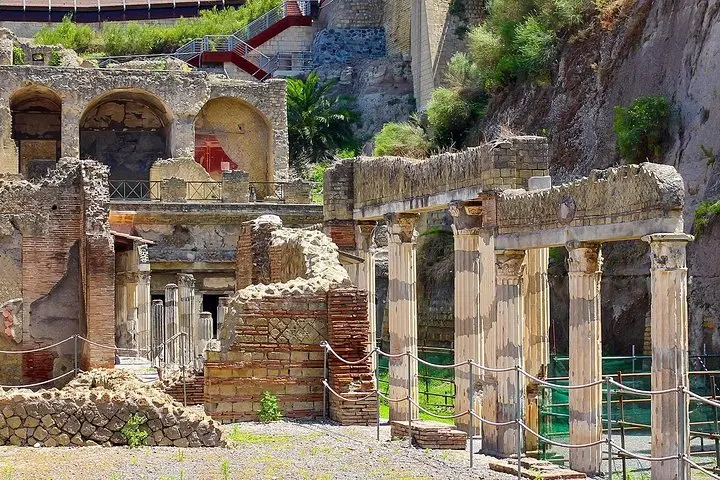
You step through a modern gate and the city compresses around you: narrow Roman alleys run cool and shaded, walls still bearing bright plaster and fresco fragments, doorways opening onto small atria where the ash has held the shapes of wooden beams and furniture.
You step through a modern gate and the city compresses around you: narrow Roman alleys run cool and shaded, walls still bearing bright plaster and fresco fragments, doorways opening onto small atria where the ash has held the shapes of wooden beams and furniture.
Herculaneum was sealed in 79 AD when the same eruption of Mount Vesuvius that buried Pompeii sent scorching pyroclastic flows down the Bay of Naples. Those flows baked and carbonized organic materials, preserving wooden doors, household items and upper floors that rarely survive in archaeological sites. The audio tour guides you room by room—bath complexes humming with past steam, a boathouse crushed where the sea once lapped—while short interpretive stops explain Roman plumbing, commerce and family life.
Local context matters: the site sits below modern Ercolano, with the Gulf of Naples visible beyond. Geologically, the contrast between ash in Pompeii and the denser, hotter surge that hit Herculaneum explains what you see: a city frozen in rapid, violent heat rather than slow burial.
Practical guide: fast-entry tickets remove a long queue at peak season but expect uneven stone, stepped thresholds, and narrow passages—sturdy shoes are a must. The audio commentary fills gaps left by minimal onsite signage and lets you self‑pace through roughly two hours of highlights. Arrive early to avoid heat and crowds, carry water (no large bags allowed), and reserve time afterward to visit the nearby Antiquarium museum in Ercolano for artifacts recovered from the sea and tunnels.