THE ADVENTURE COLLECTIVE® · Independent discovery and booking for outdoor travel

A two-day slow-boat journey from Chiang Rai towards Luang Prabang unfolds the Mekong’s quieter side—limestone shoulders, riverside villages, and an overnight onboard that turns travel into an experience. Plan for long seated stretches, border formalities, and changing weather between day and night.
A two-day slow-boat journey from Chiang Rai towards Luang Prabang unfolds the Mekong’s quieter side—limestone shoulders, riverside villages, and an overnight onboard that turns travel into an experience. Plan for long seated stretches, border formalities, and changing weather between day and night.
You step onto the riverbank before dawn, the Mekong moving like a slow decision—deep, constant, and pulling the light east. Boarding near the Thai–Laos border, a long, low boat becomes both transport and vantage point: seats, a shared restroom, and a balcony that frames limestone ridges as they loom and recede.
Verified experiences and guided adventures in the surrounding area.
You step onto the riverbank before dawn, the Mekong moving like a slow decision—deep, constant, and pulling the light east. Boarding near the Thai–Laos border, a long, low boat becomes both transport and vantage point: seats, a shared restroom, and a balcony that frames limestone ridges as they loom and recede.
This route follows a section of the Mekong that has shaped borders, villages, and trade for centuries. Geologically, the river carves through older sandstone and younger limestone outcrops; you’ll pass small towns whose wooden houses cling to the water and rice paddies that rise and fall with the seasons. Local culture is visible from the deck—fishermen setting nets, children waving from riverbanks, and Buddhist temples tucked up on forested hills.
Practicalities matter: the trip runs roughly 48 hours with an overnight stay on board. Expect long stretches of seated travel punctuated by short stops at riverside villages. Prepare for heat by day and cooler, breezy nights; insects are active near dusk. Carry passports and check visa-on-arrival rules at the Lao crossing, bring cash in small bills, and pack snacks for gaps between stops.
Timber-clad hills dare you to look further; currents push the journey forward. This is not a speed run—it's a two-day, low-key passage that rewards patience with slow panoramas and genuine snapshots of Mekong life. If you want an immersive, unhurried way to travel between northern Thailand and Luang Prabang, this slow-boat crossing delivers both scenery and a practical corridor across borders.
The advertised trip takes about 48 hours with an overnight on board; exact times depend on river conditions and stops.
Inclusions vary by operator—some offer basic snacks or simple meals, but it’s wise to bring extra food and water for gaps between stops.
Boats typically offer bench seating that converts for overnight rest or simple sleeping platforms; comfort levels range from basic to modestly cushioned.
Many nationalities can obtain a visa on arrival at the border, but rules change—confirm your specific requirements before travel.
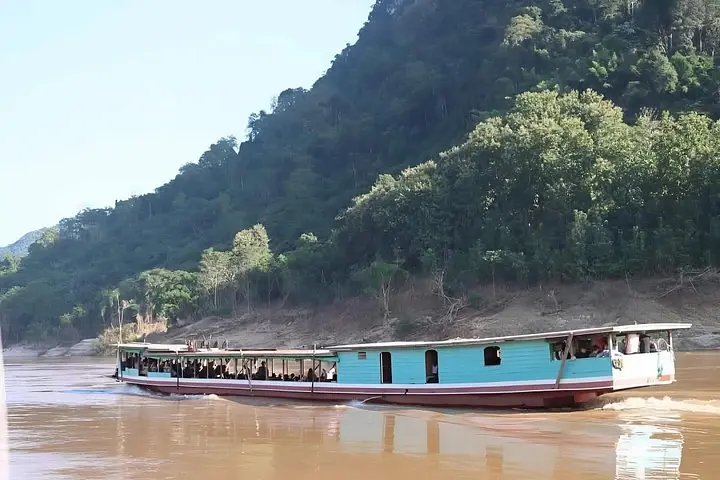
You step onto the riverbank before dawn, the Mekong moving like a slow decision—deep, constant, and pulling the light east. Boarding near the Thai–Laos border, a long, low boat becomes both transport and vantage point: seats, a shared restroom, and a balcony that frames limestone ridges as they loom and recede.
You step onto the riverbank before dawn, the Mekong moving like a slow decision—deep, constant, and pulling the light east. Boarding near the Thai–Laos border, a long, low boat becomes both transport and vantage point: seats, a shared restroom, and a balcony that frames limestone ridges as they loom and recede.
This route follows a section of the Mekong that has shaped borders, villages, and trade for centuries. Geologically, the river carves through older sandstone and younger limestone outcrops; you’ll pass small towns whose wooden houses cling to the water and rice paddies that rise and fall with the seasons. Local culture is visible from the deck—fishermen setting nets, children waving from riverbanks, and Buddhist temples tucked up on forested hills.
Practicalities matter: the trip runs roughly 48 hours with an overnight stay on board. Expect long stretches of seated travel punctuated by short stops at riverside villages. Prepare for heat by day and cooler, breezy nights; insects are active near dusk. Carry passports and check visa-on-arrival rules at the Lao crossing, bring cash in small bills, and pack snacks for gaps between stops.
Timber-clad hills dare you to look further; currents push the journey forward. This is not a speed run—it's a two-day, low-key passage that rewards patience with slow panoramas and genuine snapshots of Mekong life. If you want an immersive, unhurried way to travel between northern Thailand and Luang Prabang, this slow-boat crossing delivers both scenery and a practical corridor across borders.