THE ADVENTURE COLLECTIVE® · Independent discovery and booking for outdoor travel

A compact, private day tour linking Chora Sfakion’s wild coast, the Venetian castle at Frangokastello and the shaded village of Vrysses. Expect short hikes, a historic fortress on a sandy beach and authentic Cretan coffee breaks.
A compact, private day tour linking Chora Sfakion’s wild coast, the Venetian castle at Frangokastello and the shaded village of Vrysses. Expect short hikes, a historic fortress on a sandy beach and authentic Cretan coffee breaks.
The bus eases off the main road and the White Mountains—Lefka Ori—drop into view like a block of weathered limestone, their pale faces backlit by an open Mediterranean sky. Salt air from the Libyan Sea presses into the windows as the driver steers toward Chora Sfakion, the southernmost port of continental Europe. In town, the rhythm is measured: fishermen mend nets, a kafenion pours thick elliniko coffee, and olive trees shade narrow lanes. This private full-day tour stitches together raw coastline, Venetian stone, and village life in a single, fluid circuit.
Verified experiences and guided adventures in the surrounding area.
Operated by SeaByBus Explore Crete · Chania, Crete
The bus eases off the main road and the White Mountains—Lefka Ori—drop into view like a block of weathered limestone, their pale faces backlit by an open Mediterranean sky. Salt air from the Libyan Sea presses into the windows as the driver steers toward Chora Sfakion, the southernmost port of continental Europe. In town, the rhythm is measured: fishermen mend nets, a kafenion pours thick elliniko coffee, and olive trees shade narrow lanes. This private full-day tour stitches together raw coastline, Venetian stone, and village life in a single, fluid circuit.
Frangokastello arrives first as a surprise — a rectangular Venetian fortress planted on sand where dune grass flutters. Built between 1371 and 1374, its towers stand squat against the wind. At dawn in mid-May, locals claim the Drosoulites—dew-men—appear: ephemeral shadowy ranks said to be soldiers from the 1828 battle, an atmospheric phenomenon a photographer or folklore buff will want to note.
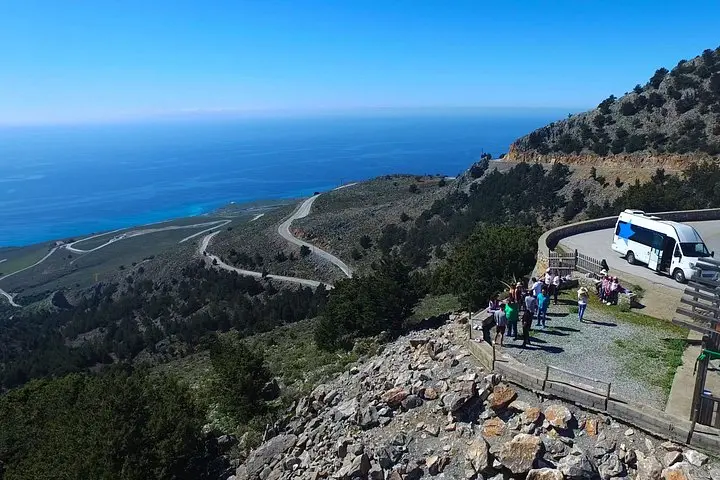
A short drive inland delivers the Imbros Gorge viewpoint. Unlike Samaria’s marathon drop, Imbros is compact and approachable: roughly 11 km long, with a start point around 700 m above sea level and a famously narrow squeeze — as slim as 1.6 m at points. Expect pine-scented passages, loose scree underfoot, and limestone walls that sharpen the light.
The day cools off in Vrysses, where plane trees form a cathedral of shade above riverbanks and tavernas serve thick goat yogurt and grilled dishes that taste of mountain herbs. The village is small but crucial—a snapshot of Cretan social life where elders argue over cards and children race along the water.
Practical notes: the tour runs about nine hours with private transport, on-board Wi-Fi, snacks (kalitsounia and sandwiches), and local commentary in English and German. Stops are timed — roughly an hour in Sfakia, two hours at Frangokastello for castle and beach, a brief Imbros stop for the viewpoint with optional walk, and an hour in Vrysses to linger.
Bring sturdy shoes for short hikes through Imbros, a swim kit for Frangokastello’s sandy bay, and sun protection; mid-summer sun is relentless and many coastal stretches are exposed. Cash is useful in small villages for coffee or extra taverna orders. Families and less-fit travelers will find this itinerary accessible — the route balances short walks with relaxed drives through some of Crete’s most dramatic geography.
In one day this loop threads geology, history and living culture: Venetian stones, gorge-cut limestone, and villages that still keep the tempo of a slower island life. It’s a practical, sensory way to read the south coast: raw, hospitable, and surprisingly close to Chania’s civilized comforts.
The private tour is approximately nine hours with hotel pickup in the Chania region; exact pickup time is confirmed after booking.
A viewpoint and short section are part of the itinerary; the full Imbros Gorge walk (about 2.5 hours, 11 km) is optional—its narrowest point is around 1.6 m.
Yes—Frangokastello has a sandy beach suitable for swimming; umbrellas are provided, but bring a towel and swimsuit.
The Drosoulites phenomenon is reported around dawn in mid-May and sometimes into early June; sightings are seasonal and not guaranteed.
Yes—the itinerary is family-friendly with short walks and timed rests; bring snacks for young children and supervise near water and narrow gorge sections.
Local tour leaders speak English and German; the tour includes snacks (kalitsounia and sandwiches), bottled water, and an offer of Greek coffee in a kafenion.
SeaByBus Explore Crete operates guided outdoor trips and adventures with an emphasis on safety, stewardship, and memorable experiences.
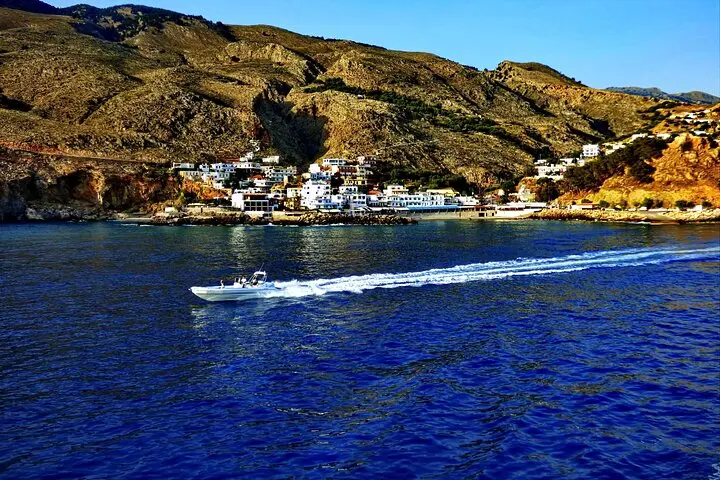
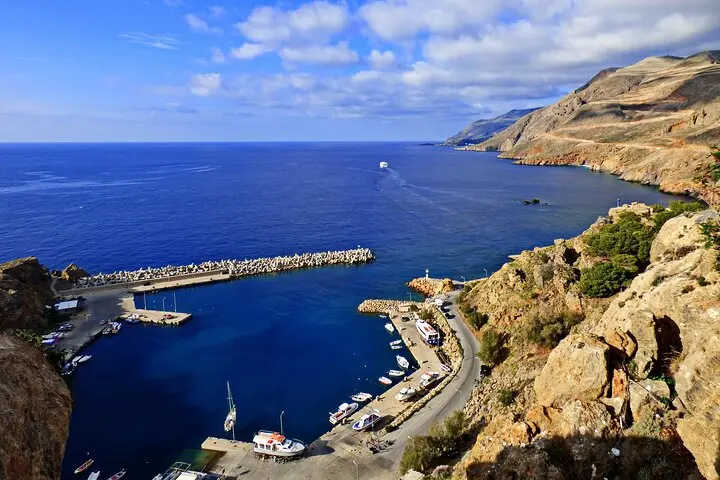
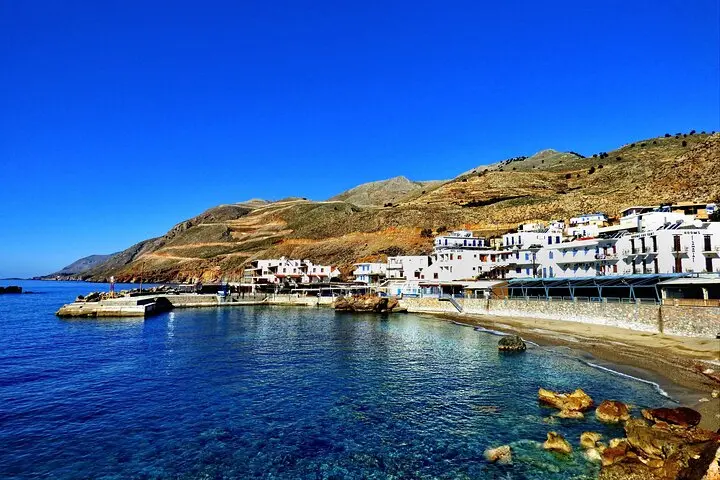
The bus eases off the main road and the White Mountains—Lefka Ori—drop into view like a block of weathered limestone, their pale faces backlit by an open Mediterranean sky. Salt air from the Libyan Sea presses into the windows as the driver steers toward Chora Sfakion, the southernmost port of continental Europe. In town, the rhythm is measured: fishermen mend nets, a kafenion pours thick elliniko coffee, and olive trees shade narrow lanes. This private full-day tour stitches together raw coastline, Venetian stone, and village life in a single, fluid circuit.
The bus eases off the main road and the White Mountains—Lefka Ori—drop into view like a block of weathered limestone, their pale faces backlit by an open Mediterranean sky. Salt air from the Libyan Sea presses into the windows as the driver steers toward Chora Sfakion, the southernmost port of continental Europe. In town, the rhythm is measured: fishermen mend nets, a kafenion pours thick elliniko coffee, and olive trees shade narrow lanes. This private full-day tour stitches together raw coastline, Venetian stone, and village life in a single, fluid circuit.
Frangokastello arrives first as a surprise — a rectangular Venetian fortress planted on sand where dune grass flutters. Built between 1371 and 1374, its towers stand squat against the wind. At dawn in mid-May, locals claim the Drosoulites—dew-men—appear: ephemeral shadowy ranks said to be soldiers from the 1828 battle, an atmospheric phenomenon a photographer or folklore buff will want to note.
A short drive inland delivers the Imbros Gorge viewpoint. Unlike Samaria’s marathon drop, Imbros is compact and approachable: roughly 11 km long, with a start point around 700 m above sea level and a famously narrow squeeze — as slim as 1.6 m at points. Expect pine-scented passages, loose scree underfoot, and limestone walls that sharpen the light.
The day cools off in Vrysses, where plane trees form a cathedral of shade above riverbanks and tavernas serve thick goat yogurt and grilled dishes that taste of mountain herbs. The village is small but crucial—a snapshot of Cretan social life where elders argue over cards and children race along the water.
Practical notes: the tour runs about nine hours with private transport, on-board Wi-Fi, snacks (kalitsounia and sandwiches), and local commentary in English and German. Stops are timed — roughly an hour in Sfakia, two hours at Frangokastello for castle and beach, a brief Imbros stop for the viewpoint with optional walk, and an hour in Vrysses to linger.
Bring sturdy shoes for short hikes through Imbros, a swim kit for Frangokastello’s sandy bay, and sun protection; mid-summer sun is relentless and many coastal stretches are exposed. Cash is useful in small villages for coffee or extra taverna orders. Families and less-fit travelers will find this itinerary accessible — the route balances short walks with relaxed drives through some of Crete’s most dramatic geography.
In one day this loop threads geology, history and living culture: Venetian stones, gorge-cut limestone, and villages that still keep the tempo of a slower island life. It’s a practical, sensory way to read the south coast: raw, hospitable, and surprisingly close to Chania’s civilized comforts.