THE ADVENTURE COLLECTIVE® · Independent discovery and booking for outdoor travel

Glide from Split’s Riva up into pine‑fringed Marjan Hill on an electric city bike. This 2–3 hour small‑group tour blends easy climbing, Roman history, and sweeping coastal views with stops at Vidilica and Diocletian’s southern walls.
Glide from Split’s Riva up into pine‑fringed Marjan Hill on an electric city bike. This 2–3 hour small‑group tour blends easy climbing, Roman history, and sweeping coastal views with stops at Vidilica and Diocletian’s southern walls.
A salty wind from the Adriatic lifts as you clip into an upright city e-bike and push away from Split’s Riva. The city hums beneath you — fishermen stacking catch, the cathedral bell at noon — while the battery patiently does the heavy lifting. Gradually the paved seafront gives way to shaded lanes that climb toward Marjan Hill, and the city opens into the broad sweep of roofs and sea.
Verified experiences and guided adventures in the surrounding area.
Operated by Marijana Babic · Split, Split-Dalmatia County
A salty wind from the Adriatic lifts as you clip into an upright city e-bike and push away from Split’s Riva. The city hums beneath you — fishermen stacking catch, the cathedral bell at noon — while the battery patiently does the heavy lifting. Gradually the paved seafront gives way to shaded lanes that climb toward Marjan Hill, and the city opens into the broad sweep of roofs and sea.
Split’s streets are Roman in plan and Dalmatian in practice. Diocletian’s palace frames the old town with Southern walls that have guarded mosaics and narrow alleys for seventeen centuries. Marjan Hill is capped in karst limestone and Mediterranean pine; its trails and viewpoints like Vidilica were long-used by locals for lookout and leisure. The route also passes Poljud stadium — an icon of modern Croatian sport — and the fish market where cultural life still plays out loudly and fresh.
Practically, expect 2–3 hours of rolling urban riding with short stops: a little hilltop church, Telegrin viewpoint, Vidilica, and downtown highlights. Terrain is paved or compact dirt with modest climbs; battery assist makes it accessible to most fitness levels, and you can turn it off for a real workout. Groups are capped at five; bikes are rated up to 100 kg. Bring water, sun protection, closed-toe shoes, and a light layer for the hilltop breeze. Start early for cooler air and softer light on the stone — the city will repay you with open views and the kind of local details a slower tour misses.
Groups are limited to a maximum of five participants for a more personal experience.
Yes — city e-bikes are designed for riders up to 100 kg (220 lbs). Inform the operator at booking if you are near this limit.
No advanced skills required; basic bike handling and comfort with light urban climbs are sufficient.
You can get a full refund if you cancel at least 24 hours before the scheduled departure; tours may cancel for bad weather or insufficient travelers.
Marijana Babic operates guided outdoor trips and adventures with an emphasis on safety, stewardship, and memorable experiences.



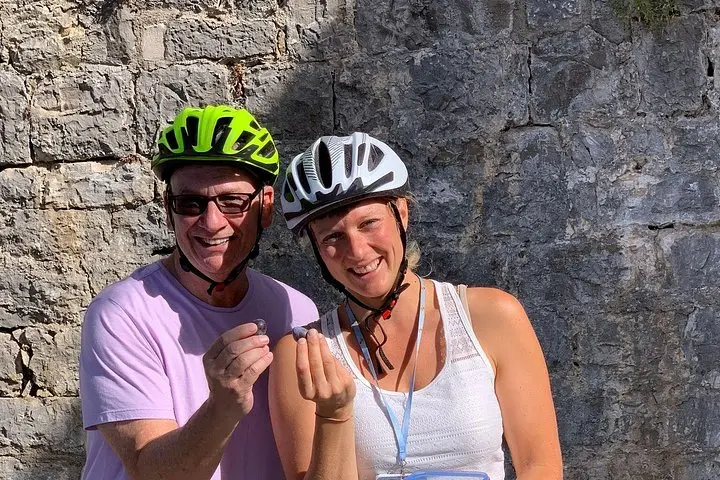
A salty wind from the Adriatic lifts as you clip into an upright city e-bike and push away from Split’s Riva. The city hums beneath you — fishermen stacking catch, the cathedral bell at noon — while the battery patiently does the heavy lifting. Gradually the paved seafront gives way to shaded lanes that climb toward Marjan Hill, and the city opens into the broad sweep of roofs and sea.
A salty wind from the Adriatic lifts as you clip into an upright city e-bike and push away from Split’s Riva. The city hums beneath you — fishermen stacking catch, the cathedral bell at noon — while the battery patiently does the heavy lifting. Gradually the paved seafront gives way to shaded lanes that climb toward Marjan Hill, and the city opens into the broad sweep of roofs and sea.
Split’s streets are Roman in plan and Dalmatian in practice. Diocletian’s palace frames the old town with Southern walls that have guarded mosaics and narrow alleys for seventeen centuries. Marjan Hill is capped in karst limestone and Mediterranean pine; its trails and viewpoints like Vidilica were long-used by locals for lookout and leisure. The route also passes Poljud stadium — an icon of modern Croatian sport — and the fish market where cultural life still plays out loudly and fresh.
Practically, expect 2–3 hours of rolling urban riding with short stops: a little hilltop church, Telegrin viewpoint, Vidilica, and downtown highlights. Terrain is paved or compact dirt with modest climbs; battery assist makes it accessible to most fitness levels, and you can turn it off for a real workout. Groups are capped at five; bikes are rated up to 100 kg. Bring water, sun protection, closed-toe shoes, and a light layer for the hilltop breeze. Start early for cooler air and softer light on the stone — the city will repay you with open views and the kind of local details a slower tour misses.