THE ADVENTURE COLLECTIVE® · Independent discovery and booking for outdoor travel

Watch the Milky Way dissolve into a pink-and-gold dawn on the Salar de Uyuni. This early-morning Stars+Sunrise tour delivers intense stargazing, mirror-like reflections after rains, and a fast, accessible intro to one of the world’s largest salt flats.
Watch the Milky Way dissolve into a pink-and-gold dawn on the Salar de Uyuni. This early-morning Stars+Sunrise tour delivers intense stargazing, mirror-like reflections after rains, and a fast, accessible intro to one of the world’s largest salt flats.
Before dawn the salt plain feels like an ocean of glass.
You step out of a low-lit vehicle onto a flat white horizon; the Milky Way hangs so bright it seems painted, and the wind carries a cold, clean bite that wakes your fingers. On this six-hour Stars+Sunrise tour you watch the night give way to pale gold, then to the surreal, glowing plain that only Salar de Uyuni can produce.
Verified experiences and guided adventures in the surrounding area.
Operated by Mapamundi Go · Uyuni, Potosí Department
Before dawn the salt plain feels like an ocean of glass.
You step out of a low-lit vehicle onto a flat white horizon; the Milky Way hangs so bright it seems painted, and the wind carries a cold, clean bite that wakes your fingers. On this six-hour Stars+Sunrise tour you watch the night give way to pale gold, then to the surreal, glowing plain that only Salar de Uyuni can produce.
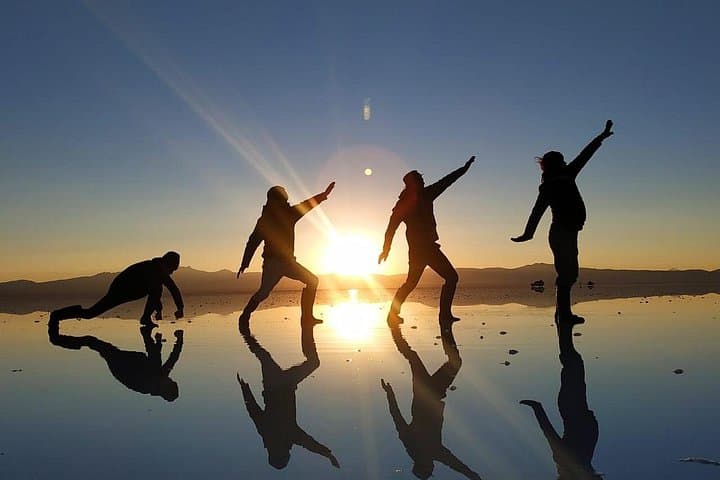
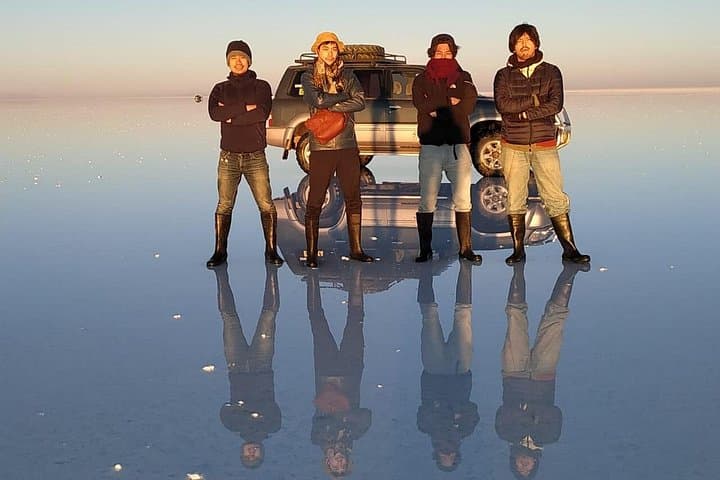
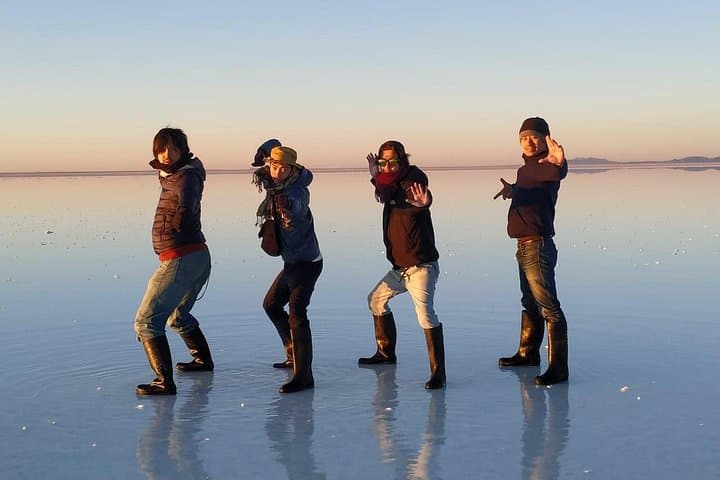
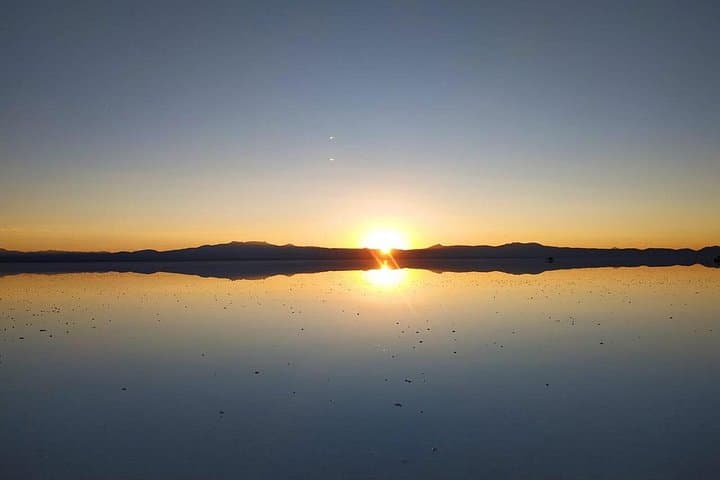
Geology here is blunt and vast: a crust of salt averaged from the evaporation of a Pleistocene lake, lying at roughly 3,650–3,660 m (about 12,000 ft). The scale flattens perspective—distant mountains shrink to thin lines, and after rain the surface becomes a mirror that multiplies the sky.
Locally, Uyuni is a gateway town with Aymara and Quechua heritage; salt has long been a material and trade resource for communities on the altiplano. Scattered features like Incahuasi (a cactus-covered island) and the nearby train cemetery add context to the plain’s human history.
Practical bits: tours depart around 02:00–03:30 for optimal stargazing, return by midmorning, and typically run in shared vehicles (this outing limits groups to ten). Expect severe cold—night temperatures can drop well below freezing. Altitude can affect breathing; take it slow, hydrate, and avoid heavy exertion on arrival day. Bring warm, windproof layers, sunglasses for the post-sunrise glare, a tripod for low-light photos, and extra batteries—the cold drains them fast.
The experience is straightforward but elemental: darkness, stars, sunrise, then the long, white plain. It’s brief, intense, and unmistakably Uyuni.
Departure is very early (typically between 02:00–03:30) to maximize stargazing and to reach the sunrise viewpoint; tours return by mid to late morning (around 07:30–09:00).
The activity is listed as physically easy, but infants must sit on laps and the cold/night conditions can be hard on very young children—plan accordingly and dress them warmly.
Do I need to bring food?
Tours may be canceled for safety in poor weather; refunds or rescheduling are typically offered if the operator cancels due to conditions.
Mapamundi Go operates guided outdoor trips and adventures with an emphasis on safety, stewardship, and memorable experiences.
Before dawn the salt plain feels like an ocean of glass.
You step out of a low-lit vehicle onto a flat white horizon; the Milky Way hangs so bright it seems painted, and the wind carries a cold, clean bite that wakes your fingers. On this six-hour Stars+Sunrise tour you watch the night give way to pale gold, then to the surreal, glowing plain that only Salar de Uyuni can produce.
Geology here is blunt and vast: a crust of salt averaged from the evaporation of a Pleistocene lake, lying at roughly 3,650–3,660 m (about 12,000 ft). The scale flattens perspective—distant mountains shrink to thin lines, and after rain the surface becomes a mirror that multiplies the sky.
Locally, Uyuni is a gateway town with Aymara and Quechua heritage; salt has long been a material and trade resource for communities on the altiplano. Scattered features like Incahuasi (a cactus-covered island) and the nearby train cemetery add context to the plain’s human history.
Practical bits: tours depart around 02:00–03:30 for optimal stargazing, return by midmorning, and typically run in shared vehicles (this outing limits groups to ten). Expect severe cold—night temperatures can drop well below freezing. Altitude can affect breathing; take it slow, hydrate, and avoid heavy exertion on arrival day. Bring warm, windproof layers, sunglasses for the post-sunrise glare, a tripod for low-light photos, and extra batteries—the cold drains them fast.
The experience is straightforward but elemental: darkness, stars, sunrise, then the long, white plain. It’s brief, intense, and unmistakably Uyuni.