THE ADVENTURE COLLECTIVE® · Independent discovery and booking for outdoor travel

Experience some of the clearest night skies on Earth with guided telescope viewing and a Milky Way photo shoot outside San Pedro de Atacama. This short, accessible tour pairs a talk and refreshments with high-powered telescopes and a desert photo stop.
Experience some of the clearest night skies on Earth with guided telescope viewing and a Milky Way photo shoot outside San Pedro de Atacama. This short, accessible tour pairs a talk and refreshments with high-powered telescopes and a desert photo stop.
You arrive in the high desert as the horizon cools and the last color drains from the sky. The tour gathers at Plaza Apacheta, a small town square in San Pedro de Atacama, then slips away from sodium streetlights into a black that feels almost physical. At the observatory, the air is thin and the domes stand like silent machines ready to open — the Milky Way climbing into view above salt flats and volcanic ridgelines.
Verified experiences and guided adventures in the surrounding area.
Operated by Atacama Deep sky · San Pedro de Atacama, Antofagasta Region
You arrive in the high desert as the horizon cools and the last color drains from the sky. The tour gathers at Plaza Apacheta, a small town square in San Pedro de Atacama, then slips away from sodium streetlights into a black that feels almost physical. At the observatory, the air is thin and the domes stand like silent machines ready to open — the Milky Way climbing into view above salt flats and volcanic ridgelines.
The Atacama is one of the driest places on Earth; geology here is a lesson in salt, wind and lava. Millennia of indigenous Atacameño presence and colonial routes leave stone ruins and petroglyphs nearby, and the region’s clear skies are the reason modern observatories colonize these plateaus. Culture in San Pedro is small-town and service-oriented: guides merge astronomical lore with scientific explanation, and local logistics still run on human scale.
Expect an audiovisual introduction, guided naked-eye constellation spotting and access to 14"–16" telescopes that resolve planets, nebulae and distant galaxies. The experience usually includes a short transfer to a dark bench of desert — often called Death Valley locally — for a group and personal Milky Way photo. Snacks and hot drinks are provided; a souvenir photograph is included.
Practical guidance: nights are often near or below freezing even in summer — bring insulating layers, closed shoes and a camera with manual-exposure capability if you want quality Milky Way shots. The tour is low-effort physically (short walks on flat desert) but high on altitude and temperature considerations. Plan for a 2–3 hour window of travel and sky time and confirm cancellations in poor weather.
Yes; the tour is family-friendly but long exposures and late night conditions may be uncomfortable for very young children—check age policies with the operator.
The operator will cancel or reschedule for a full refund if conditions prevent astronomical viewing; confirm the local cancellation window when booking.
Visibility depends on lunar phase and weather; guides choose nights with low moonlight and clear forecasts to maximize Milky Way visibility.
Guides operate the 14" and 16" telescopes and will point and explain targets—guests do not need technical skills to enjoy close-up views.
Atacama Deep sky operates guided outdoor trips and adventures with an emphasis on safety, stewardship, and memorable experiences.
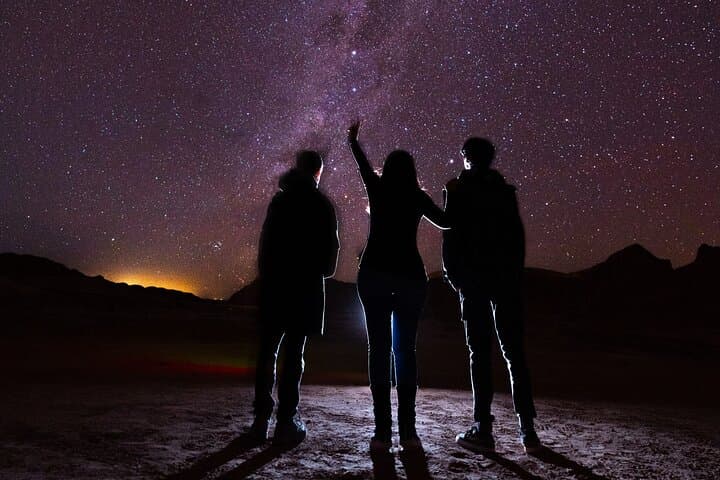


You arrive in the high desert as the horizon cools and the last color drains from the sky. The tour gathers at Plaza Apacheta, a small town square in San Pedro de Atacama, then slips away from sodium streetlights into a black that feels almost physical. At the observatory, the air is thin and the domes stand like silent machines ready to open — the Milky Way climbing into view above salt flats and volcanic ridgelines.
You arrive in the high desert as the horizon cools and the last color drains from the sky. The tour gathers at Plaza Apacheta, a small town square in San Pedro de Atacama, then slips away from sodium streetlights into a black that feels almost physical. At the observatory, the air is thin and the domes stand like silent machines ready to open — the Milky Way climbing into view above salt flats and volcanic ridgelines.
The Atacama is one of the driest places on Earth; geology here is a lesson in salt, wind and lava. Millennia of indigenous Atacameño presence and colonial routes leave stone ruins and petroglyphs nearby, and the region’s clear skies are the reason modern observatories colonize these plateaus. Culture in San Pedro is small-town and service-oriented: guides merge astronomical lore with scientific explanation, and local logistics still run on human scale.
Expect an audiovisual introduction, guided naked-eye constellation spotting and access to 14"–16" telescopes that resolve planets, nebulae and distant galaxies. The experience usually includes a short transfer to a dark bench of desert — often called Death Valley locally — for a group and personal Milky Way photo. Snacks and hot drinks are provided; a souvenir photograph is included.
Practical guidance: nights are often near or below freezing even in summer — bring insulating layers, closed shoes and a camera with manual-exposure capability if you want quality Milky Way shots. The tour is low-effort physically (short walks on flat desert) but high on altitude and temperature considerations. Plan for a 2–3 hour window of travel and sky time and confirm cancellations in poor weather.