THE ADVENTURE COLLECTIVE® · Independent discovery and booking for outdoor travel

Wake before dawn in Huaraz for a private drive to Punta Olímpica and a guided glacier ascent of Mateo Peak (5,150 m). This full‑day outing combines steep moraine approaches with technical glacier travel—ideal for acclimatized hikers ready for crampons and rope work.
Wake before dawn in Huaraz for a private drive to Punta Olímpica and a guided glacier ascent of Mateo Peak (5,150 m). This full‑day outing combines steep moraine approaches with technical glacier travel—ideal for acclimatized hikers ready for crampons and rope work.
Before dawn the van pulls away from Huaraz and the dark Andes compress around you—road lights cutting through chill air. By the time the sky paler than coal, you’re at Punta Olímpica watching a horizon that will harden into a sharp, cold light. The trail begins on loose moraine; rocks shift, and the mountain seems to test your attention. Higher up, the glacier takes over, its blue ice daring you forward beneath the crampons.
Verified experiences and guided adventures in the surrounding area.
Operated by Andean Summit Multiservicios S.R.L. · Huaraz, Ancash
Before dawn the van pulls away from Huaraz and the dark Andes compress around you—road lights cutting through chill air. By the time the sky paler than coal, you’re at Punta Olímpica watching a horizon that will harden into a sharp, cold light. The trail begins on loose moraine; rocks shift, and the mountain seems to test your attention. Higher up, the glacier takes over, its blue ice daring you forward beneath the crampons.
Mateo sits in the Cordillera Blanca, a range shaped by Andean uplift and sculpted by glaciation over millennia. Local Quechua communities long used these high passes for trade and ritual; today their history shows in cairns and seasonal herding patterns. Geologically, the climb moves from talus and scree to firn and glacial ice—expect sharp switchbacks, crevasse-spotted fields, and a final ridge that frames sunrise over neighboring peaks.
Practically, this is a morning-into-noon outing: a 3AM pickup, roughly 2½‑hour drive, an hour of steep moraine, 1½ hours on glacier with crampons and rope, a short summit stop at ~5,150m, then descent and return. Guides supply technical kit and rope systems; you supply acclimatized legs and sensible layering. Hydrate and eat before the drive, keep your pace measured on the glacier, and be ready for wind and rapid temperature swings. For many, the summit is less a conquest than a quiet, icy edge where the sun pushes shadows down the valley and the mountain simply keeps going.
Guides provide technical equipment and instruction, but prior high‑altitude hiking and comfort on loose scree and steep slopes are strongly recommended.
The tour includes certified guide services, private transport, and technical equipment (ropes, harnesses, shared crampons/ice tools when needed); bring personal boots, layers, and sunglasses.
Acclimatize in Huaraz for 48–72 hours, hydrate, avoid heavy alcohol the night before, and monitor for symptoms of AMS—turn back if you feel unwell.
This ascent is not recommended for pregnant travelers or people with serious heart or spinal conditions; check with the operator for specific age restrictions or medical clearance.
Andean Summit Multiservicios S.R.L. operates guided outdoor trips and adventures with an emphasis on safety, stewardship, and memorable experiences.
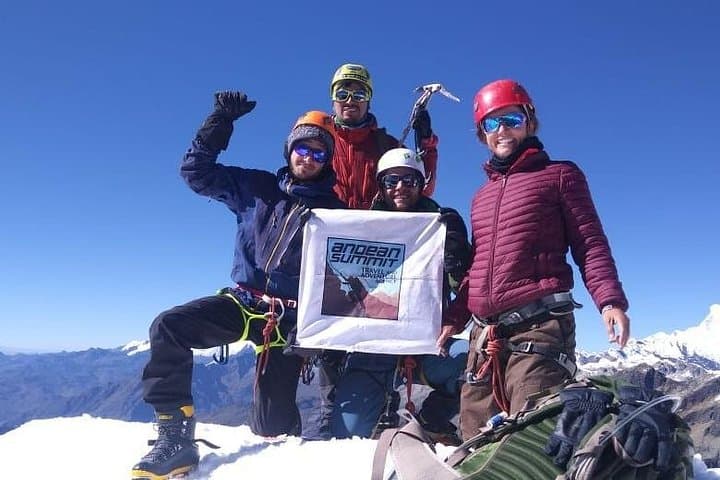


Before dawn the van pulls away from Huaraz and the dark Andes compress around you—road lights cutting through chill air. By the time the sky paler than coal, you’re at Punta Olímpica watching a horizon that will harden into a sharp, cold light. The trail begins on loose moraine; rocks shift, and the mountain seems to test your attention. Higher up, the glacier takes over, its blue ice daring you forward beneath the crampons.
Before dawn the van pulls away from Huaraz and the dark Andes compress around you—road lights cutting through chill air. By the time the sky paler than coal, you’re at Punta Olímpica watching a horizon that will harden into a sharp, cold light. The trail begins on loose moraine; rocks shift, and the mountain seems to test your attention. Higher up, the glacier takes over, its blue ice daring you forward beneath the crampons.
Mateo sits in the Cordillera Blanca, a range shaped by Andean uplift and sculpted by glaciation over millennia. Local Quechua communities long used these high passes for trade and ritual; today their history shows in cairns and seasonal herding patterns. Geologically, the climb moves from talus and scree to firn and glacial ice—expect sharp switchbacks, crevasse-spotted fields, and a final ridge that frames sunrise over neighboring peaks.
Practically, this is a morning-into-noon outing: a 3AM pickup, roughly 2½‑hour drive, an hour of steep moraine, 1½ hours on glacier with crampons and rope, a short summit stop at ~5,150m, then descent and return. Guides supply technical kit and rope systems; you supply acclimatized legs and sensible layering. Hydrate and eat before the drive, keep your pace measured on the glacier, and be ready for wind and rapid temperature swings. For many, the summit is less a conquest than a quiet, icy edge where the sun pushes shadows down the valley and the mountain simply keeps going.