THE ADVENTURE COLLECTIVE® · Independent discovery and booking for outdoor travel

Ascend Mount Sinai in the pre-dawn hours with a Bedouin guide, watch a luminous sunrise from the summit, then explore the 6th‑century St. Catherine's Monastery. This full‑day pilgrimage combines rugged night hiking, sweeping desert geology, and ancient religious history.
Ascend Mount Sinai in the pre-dawn hours with a Bedouin guide, watch a luminous sunrise from the summit, then explore the 6th‑century St. Catherine's Monastery. This full‑day pilgrimage combines rugged night hiking, sweeping desert geology, and ancient religious history.
A headlamp beam cuts a bright line across the dark Sinai slope as a Bedouin guide leads a small group upward. The air is thin and cold; above, a dense scatter of stars watches the slow procession toward the summit. By the time the eastern horizon blanches, you’ve traded night for a vast, serrated panorama—rock ridges and pale desert folding toward the Red Sea.
Verified experiences and guided adventures in the surrounding area.
Operated by PyramidsTrips.com · Saint Catherine, South Sinai Governorate
A headlamp beam cuts a bright line across the dark Sinai slope as a Bedouin guide leads a small group upward. The air is thin and cold; above, a dense scatter of stars watches the slow procession toward the summit. By the time the eastern horizon blanches, you’ve traded night for a vast, serrated panorama—rock ridges and pale desert folding toward the Red Sea.
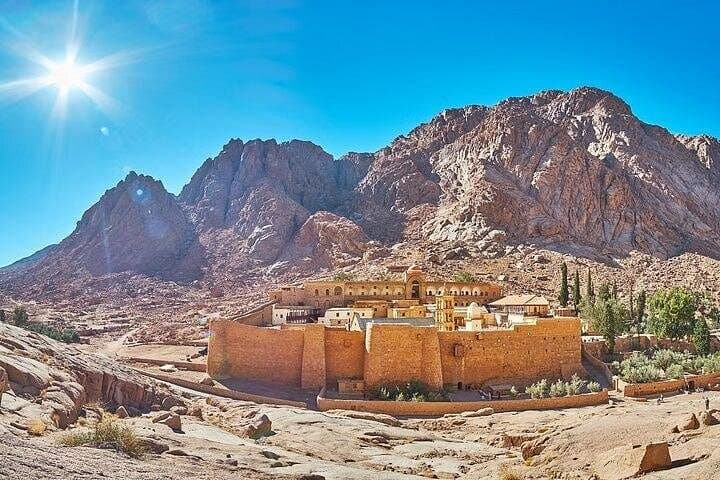
The route follows ancient stone steps and mule tracks to Jabal Musa (Mount Sinai), a granite peak rising to about 2,285 m and long associated with the Mosaic tradition. Below, St. Catherine's Monastery—founded in the 6th century and a UNESCO World Heritage site—houses early Christian icons, a chapel said to mark the Burning Bush, and a library that preserves medieval manuscripts. Geologically, the peninsula is composed of uplifted Precambrian granite and metamorphic rock, which creates the steep, blocky faces and loose scree you’ll encounter.
Culturally, Bedouin guides blend practical route knowledge with oral histories; the monastery remains a living religious community with clear visitor protocols. Practically, the climb is a 2–3 hour ascent beginning around 2:00 AM, followed by sunrise at the summit, descent, and a guided 1–2 hour visit of the monastery before returning to Sharm el-Sheikh by afternoon. Expect roughly 700–900 m of elevation change depending on your start, irregular stone steps, and cold summit winds.
Bring a reliable headlamp, layered clothing, sturdy boots, and at least 2 liters of water. Respect monastery rules, leave no trace, and plan for limited facilities en route.
The standard route is moderate: 2–3 hours of steady uphill on stone steps and loose rock, followed by a 1.5–2 hour descent; moderate fitness is recommended.
Yes—guided night ascents are common because the cool air and sunrise views are worth it; use a headlamp, follow your guide, and watch footing on uneven terrain.
Most guided tours include admission; if visiting independently, there is an entry fee—check current rates and opening hours beforehand.
Dress modestly (covered shoulders and knees). Comfortable shoes and a light scarf are useful; the interior can be cool.
PyramidsTrips.com operates guided outdoor trips and adventures with an emphasis on safety, stewardship, and memorable experiences.



A headlamp beam cuts a bright line across the dark Sinai slope as a Bedouin guide leads a small group upward. The air is thin and cold; above, a dense scatter of stars watches the slow procession toward the summit. By the time the eastern horizon blanches, you’ve traded night for a vast, serrated panorama—rock ridges and pale desert folding toward the Red Sea.
A headlamp beam cuts a bright line across the dark Sinai slope as a Bedouin guide leads a small group upward. The air is thin and cold; above, a dense scatter of stars watches the slow procession toward the summit. By the time the eastern horizon blanches, you’ve traded night for a vast, serrated panorama—rock ridges and pale desert folding toward the Red Sea.
The route follows ancient stone steps and mule tracks to Jabal Musa (Mount Sinai), a granite peak rising to about 2,285 m and long associated with the Mosaic tradition. Below, St. Catherine's Monastery—founded in the 6th century and a UNESCO World Heritage site—houses early Christian icons, a chapel said to mark the Burning Bush, and a library that preserves medieval manuscripts. Geologically, the peninsula is composed of uplifted Precambrian granite and metamorphic rock, which creates the steep, blocky faces and loose scree you’ll encounter.
Culturally, Bedouin guides blend practical route knowledge with oral histories; the monastery remains a living religious community with clear visitor protocols. Practically, the climb is a 2–3 hour ascent beginning around 2:00 AM, followed by sunrise at the summit, descent, and a guided 1–2 hour visit of the monastery before returning to Sharm el-Sheikh by afternoon. Expect roughly 700–900 m of elevation change depending on your start, irregular stone steps, and cold summit winds.
Bring a reliable headlamp, layered clothing, sturdy boots, and at least 2 liters of water. Respect monastery rules, leave no trace, and plan for limited facilities en route.