THE ADVENTURE COLLECTIVE® · Independent discovery and booking for outdoor travel

Time your visit for late afternoon light and the quiet sweep of the valley — a private tour to My Son delivers expert context, easy transport, and the best photographic hour at a UNESCO World Heritage site.
Time your visit for late afternoon light and the quiet sweep of the valley — a private tour to My Son delivers expert context, easy transport, and the best photographic hour at a UNESCO World Heritage site.
You arrive as the valley cools and the late light leans across broken red-brick towers — birds call from the surrounding ridges and the jungle seems to push its green fingers toward the ruins. The air carries dust and incense; the stones hold the quiet of rites performed a thousand years ago. This private afternoon tour times the visit for that slow, orange-tinted hour when shadows deepen the carvings and photos gain texture.
Verified experiences and guided adventures in the surrounding area.
Operated by Da Nang Hoi An Private Shore Excursion & Local Tours · Duy Phu (Duy Xuyen), Quang Nam
You arrive as the valley cools and the late light leans across broken red-brick towers — birds call from the surrounding ridges and the jungle seems to push its green fingers toward the ruins. The air carries dust and incense; the stones hold the quiet of rites performed a thousand years ago. This private afternoon tour times the visit for that slow, orange-tinted hour when shadows deepen the carvings and photos gain texture.
My Son was the religious heart of the Champa Kingdom from the 4th–13th centuries. The complex includes around 70 structures of brick and stone built without mortar, their faces carved with Hindu iconography and Cham script. Geologically the site sits in a narrow valley cut into sandstone and basalt outcrops; surrounding low mountains form a protective bowl that concentrates mist and rainforest growth. Culturally, My Son is a living archive — restored after war damage and recognized as a UNESCO World Heritage site — where local guides translate ritual, royal patronage, and community significance into accessible stories.
Practical notes: pickup from Hoi An or Da Nang in an air-conditioned vehicle usually departs early afternoon; travel time is about 45–75 minutes. The on-site visit is mostly flat walking with a few steps; an electric shuttle reduces distance from the drop-off point. Bring a camera with a telephoto option for carved reliefs, wear closed-toe shoes for uneven ground, and carry water and insect repellent. Respect marked barriers, avoid climbing on ruins, and plan for roughly 4–5 hours round trip including transfer time.
Expect 45–75 minutes from Hoi An and about 60–90 minutes from central Da Nang depending on traffic.
Yes—paths near the main groupings are stroller-friendly and an electric cart reduces longer walks, though some areas have steps.
Most private tour packages include entrance tickets and a private air-conditioned vehicle; confirm inclusions when booking.
Photography is allowed in most outdoor areas; avoid using flash around sensitive carvings and follow guide instructions about restricted zones.
Da Nang Hoi An Private Shore Excursion & Local Tours operates guided outdoor trips and adventures with an emphasis on safety, stewardship, and memorable experiences.

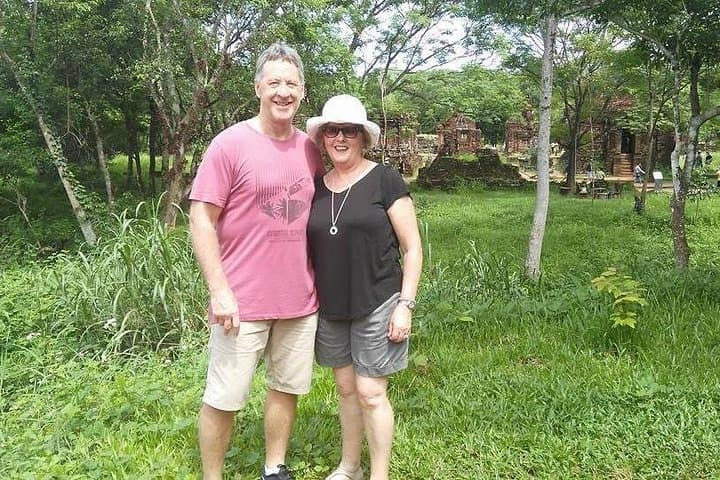


You arrive as the valley cools and the late light leans across broken red-brick towers — birds call from the surrounding ridges and the jungle seems to push its green fingers toward the ruins. The air carries dust and incense; the stones hold the quiet of rites performed a thousand years ago. This private afternoon tour times the visit for that slow, orange-tinted hour when shadows deepen the carvings and photos gain texture.
You arrive as the valley cools and the late light leans across broken red-brick towers — birds call from the surrounding ridges and the jungle seems to push its green fingers toward the ruins. The air carries dust and incense; the stones hold the quiet of rites performed a thousand years ago. This private afternoon tour times the visit for that slow, orange-tinted hour when shadows deepen the carvings and photos gain texture.
My Son was the religious heart of the Champa Kingdom from the 4th–13th centuries. The complex includes around 70 structures of brick and stone built without mortar, their faces carved with Hindu iconography and Cham script. Geologically the site sits in a narrow valley cut into sandstone and basalt outcrops; surrounding low mountains form a protective bowl that concentrates mist and rainforest growth. Culturally, My Son is a living archive — restored after war damage and recognized as a UNESCO World Heritage site — where local guides translate ritual, royal patronage, and community significance into accessible stories.
Practical notes: pickup from Hoi An or Da Nang in an air-conditioned vehicle usually departs early afternoon; travel time is about 45–75 minutes. The on-site visit is mostly flat walking with a few steps; an electric shuttle reduces distance from the drop-off point. Bring a camera with a telephoto option for carved reliefs, wear closed-toe shoes for uneven ground, and carry water and insect repellent. Respect marked barriers, avoid climbing on ruins, and plan for roughly 4–5 hours round trip including transfer time.