THE ADVENTURE COLLECTIVE® · Independent discovery and booking for outdoor travel

Join marine biologists at sunset for a 2.5‑hour boat cruise through Ria Formosa. Expect high sighting rates of Common and Bottlenose dolphins, an educational commentary, and active scientific data collection.
Join marine biologists at sunset for a 2.5‑hour boat cruise through Ria Formosa. Expect high sighting rates of Common and Bottlenose dolphins, an educational commentary, and active scientific data collection.
The boat slips from Faro’s marina as the sky begins to warm; the sea whispers and the estuary pushes you outward, as if the water itself is nudging you toward the horizon.
Verified experiences and guided adventures in the surrounding area.
Operated by Ocean Vibes Algarve · Faro, Algarve
The boat slips from Faro’s marina as the sky begins to warm; the sea whispers and the estuary pushes you outward, as if the water itself is nudging you toward the horizon.
On this 2.5‑hour sunset cruise, a team of marine biologists reads the ocean like a map — scanning for arcing fins and surfacing blows — and collecting data that feeds ongoing research in Ria Formosa Natural Park. The landscape you cross is young: a shifting ribbon of barrier islands, tidal channels and sandbanks formed after the last Ice Age as sea levels rose and sediments settled along the Algarve coast.
Ria Formosa has been central to local life for centuries — salt pans and artisanal fishing shaped Faro’s economy and culture — and the park’s designation in the late 20th century protects feeding grounds vital to dolphins, migratory birds and seasonal cetaceans.
Expect Common and Bottlenose dolphins most evenings; in late winter and spring guides sometimes locate Minke or Fin whales farther offshore. Seabirds wheel above the channel, curious and bold, while the boat crew explains species ID, behavior and the science behind sightings.
Practical guidance: bring layered wind protection and a small daypack, keep cameras ready with a short‑telephoto lens or binoculars, and take seasickness precautions if you’re prone. Tours are family‑friendly but move on open water—follow crew instructions and lifejacket policies.
This outing blends wildlife watching with genuine research: you’ll leave with sundown colors on your face, a clearer sense of how the Ria Formosa functions, and practical advice for minimizing disturbance on future trips.
The experience lasts about 150 minutes and normally departs from Faro marina or a nearby harbor within Ria Formosa; exact meeting details are provided at booking.
No tour can guarantee sightings, but this operator reports one of the highest local sighting rates and documents observations for research; sightings are most reliable near dusk and in certain seasons.
The trip is family‑friendly and rated physically easy, but boarding a small boat requires some mobility; specialized infant seats are available and staff can advise on accessibility.
Common and Bottlenose dolphins are most common; you may also see seabirds, occasional sharks, and in winter/spring rarer cetaceans like Minke or Fin whales further offshore.
Ocean Vibes Algarve operates guided outdoor trips and adventures with an emphasis on safety, stewardship, and memorable experiences.
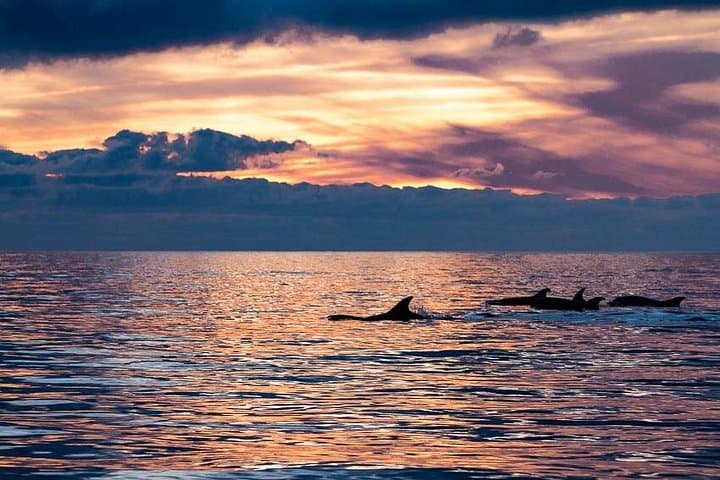


The boat slips from Faro’s marina as the sky begins to warm; the sea whispers and the estuary pushes you outward, as if the water itself is nudging you toward the horizon.
The boat slips from Faro’s marina as the sky begins to warm; the sea whispers and the estuary pushes you outward, as if the water itself is nudging you toward the horizon.
On this 2.5‑hour sunset cruise, a team of marine biologists reads the ocean like a map — scanning for arcing fins and surfacing blows — and collecting data that feeds ongoing research in Ria Formosa Natural Park. The landscape you cross is young: a shifting ribbon of barrier islands, tidal channels and sandbanks formed after the last Ice Age as sea levels rose and sediments settled along the Algarve coast.
Ria Formosa has been central to local life for centuries — salt pans and artisanal fishing shaped Faro’s economy and culture — and the park’s designation in the late 20th century protects feeding grounds vital to dolphins, migratory birds and seasonal cetaceans.
Expect Common and Bottlenose dolphins most evenings; in late winter and spring guides sometimes locate Minke or Fin whales farther offshore. Seabirds wheel above the channel, curious and bold, while the boat crew explains species ID, behavior and the science behind sightings.
Practical guidance: bring layered wind protection and a small daypack, keep cameras ready with a short‑telephoto lens or binoculars, and take seasickness precautions if you’re prone. Tours are family‑friendly but move on open water—follow crew instructions and lifejacket policies.
This outing blends wildlife watching with genuine research: you’ll leave with sundown colors on your face, a clearer sense of how the Ria Formosa functions, and practical advice for minimizing disturbance on future trips.