THE ADVENTURE COLLECTIVE® · Independent discovery and booking for outdoor travel

Spend a long day moving from temples to tide-slowed rivers: a morning at Hoa Lu’s ancient capital, a hand-rowed boat through Tam Coc’s three caves, and a relaxed afternoon cycling village lanes and rice paddies. Practical, scenic, and accessible from Hanoi.
Spend a long day moving from temples to tide-slowed rivers: a morning at Hoa Lu’s ancient capital, a hand-rowed boat through Tam Coc’s three caves, and a relaxed afternoon cycling village lanes and rice paddies. Practical, scenic, and accessible from Hanoi.
The day begins with a ribbon of highway folding away from Hanoi and, within an hour, you’re surrounded by low, green karsts—limestone towers that incline and watch like quiet giants.
Verified experiences and guided adventures in the surrounding area.
Operated by Hanoi Explore Travel · Tam Cốc, Ninh Bình Province
The day begins with a ribbon of highway folding away from Hanoi and, within an hour, you’re surrounded by low, green karsts—limestone towers that incline and watch like quiet giants.
At Hoa Lu, stone temples to Kings Dinh and Le sit on a compact plateau; their 17th-century reconstruction frames a much older story: Hoa Lu was Vietnam’s first imperial capital in the 10th–11th centuries and still echoes that era in carved altars and worn courtyards.
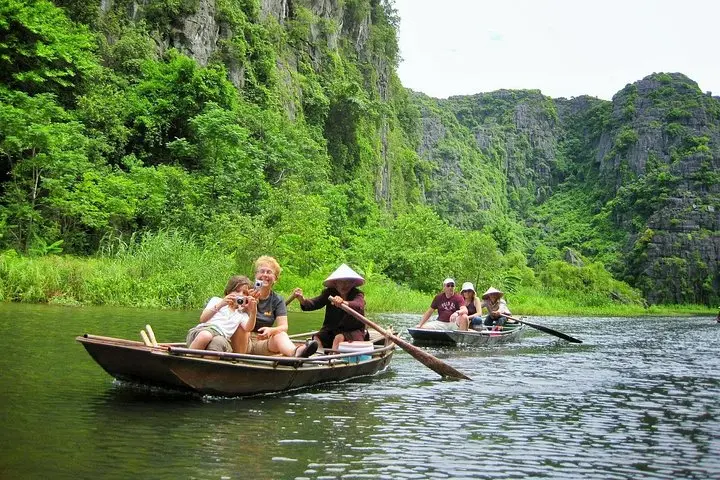
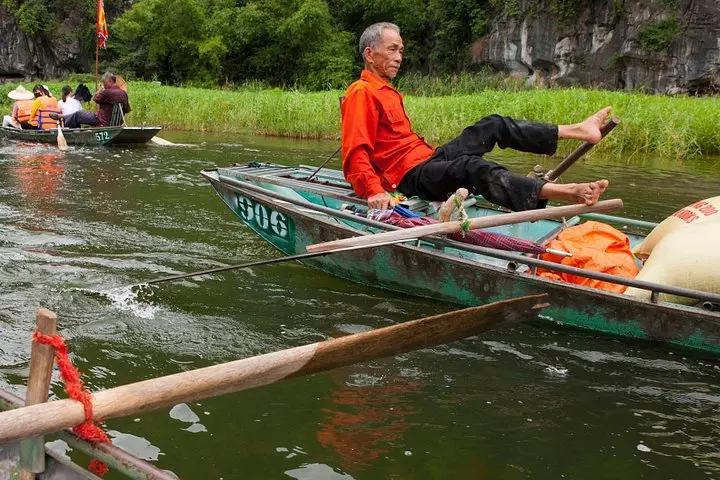
Downriver at Tam Coc the landscape changes into a living geological classroom. A 1.5–2 hour hand-rowed boat slips under three low cave mouths, threading a slow route through silted channels carved in Permian–Triassic limestone. The karst towers, rice paddies and seasonal wetlands make this one of northern Vietnam’s most photogenic lowland karst systems.
Afternoon cycling tacks along village lanes and dikes—expect 6–8 km of mostly flat, compacted earth and paved road with negligible elevation gain, punctuated by buffalo wallows and small family-run farms. Local guides weave cultural notes into stops: pagodas, family-run eateries and simple craft workshops.
Practical edge: this is a long but gentle day—departure and return are bus-based, and the itinerary runs about 10 hours, with most walking and cycling easy on the knees. Bring sun protection, insect repellent, comfortable shoes for wet boat decks, and a light rain layer in monsoon months. Respect boatmen’s techniques and local customs; pack out trash and favor locally sourced food choices to support rural livelihoods.
The hand-rowed boat portion lasts about 1.5–2 hours and visits three caves—Hang Ca, Hang Hai and Hang Ba—depending on water levels.
Cycling covers roughly 6–8 km on mostly flat, low-traffic rural roads; basic cycling ability is sufficient and pace is generally relaxed.
Yes—small purchases, optional tips for boatmen, and some restrooms require cash; carry small denominations of VND.
Yes—this is rated easy and stroller-friendly in parts, though boat access and bicycle comfort depend on age and mobility; check with the operator for special needs.
Hanoi Explore Travel operates guided outdoor trips and adventures with an emphasis on safety, stewardship, and memorable experiences.


The day begins with a ribbon of highway folding away from Hanoi and, within an hour, you’re surrounded by low, green karsts—limestone towers that incline and watch like quiet giants.
The day begins with a ribbon of highway folding away from Hanoi and, within an hour, you’re surrounded by low, green karsts—limestone towers that incline and watch like quiet giants.
At Hoa Lu, stone temples to Kings Dinh and Le sit on a compact plateau; their 17th-century reconstruction frames a much older story: Hoa Lu was Vietnam’s first imperial capital in the 10th–11th centuries and still echoes that era in carved altars and worn courtyards.
Downriver at Tam Coc the landscape changes into a living geological classroom. A 1.5–2 hour hand-rowed boat slips under three low cave mouths, threading a slow route through silted channels carved in Permian–Triassic limestone. The karst towers, rice paddies and seasonal wetlands make this one of northern Vietnam’s most photogenic lowland karst systems.
Afternoon cycling tacks along village lanes and dikes—expect 6–8 km of mostly flat, compacted earth and paved road with negligible elevation gain, punctuated by buffalo wallows and small family-run farms. Local guides weave cultural notes into stops: pagodas, family-run eateries and simple craft workshops.
Practical edge: this is a long but gentle day—departure and return are bus-based, and the itinerary runs about 10 hours, with most walking and cycling easy on the knees. Bring sun protection, insect repellent, comfortable shoes for wet boat decks, and a light rain layer in monsoon months. Respect boatmen’s techniques and local customs; pack out trash and favor locally sourced food choices to support rural livelihoods.