THE ADVENTURE COLLECTIVE® · Independent discovery and booking for outdoor travel

An evening that pairs geothermal spectacle with living Māori culture: guided valley tour, hāngī buffet, and a powerful cultural performance. Ideal for families and first-time visitors wanting geology, kiwi viewing, and traditional kapa haka in one night.
An evening that pairs geothermal spectacle with living Māori culture: guided valley tour, hāngī buffet, and a powerful cultural performance. Ideal for families and first-time visitors wanting geology, kiwi viewing, and traditional kapa haka in one night.
Steam curls up from the valley like a slow-breathing creature as dusk settles over Rotorua. Walkways creak underfoot, the air tastes faintly of minerals, and the ground hums with a warm, living heat — this is Te Puia at night, where geysers punctuate the dark and pōhiri welcomes the evening.
Verified experiences and guided adventures in the surrounding area.
Operated by Te Puia · Rotorua, Bay of Plenty
Steam curls up from the valley like a slow-breathing creature as dusk settles over Rotorua. Walkways creak underfoot, the air tastes faintly of minerals, and the ground hums with a warm, living heat — this is Te Puia at night, where geysers punctuate the dark and pōhiri welcomes the evening.
The site sits in the geothermal heart of Whakarewarewa; Pōhutu Geyser dominates the landscape as the largest active geyser in the Southern Hemisphere. The New Zealand Māori Arts and Crafts Institute, founded in the 1960s, preserves carving and weaving traditions visible in the meeting house and studios. Māori hospitality and storytelling stitch the evening together: guided valley tours explain the geology and native bush, the Kiwi Conservation Centre highlights nocturnal wildlife, and the cultural performance presents pōhiri, waiata, mōteatea, poi and haka.
Practical details are straightforward: the combo runs about 4.5 hours starting late afternoon, combining a guided tour, a hāngī buffet at Pātaka Kai overlooking the geothermal valley, and a 45-minute performance in Te Aronui a Rua. Paths are mostly boardwalks and suitable for strollers and wheelchairs, but wear closed-toe shoes for uneven sections and steam vents. Bring a warm layer — geothermal steam can mask chilly evening breezes — and a camera with a low-light setting. Book in advance: capacity is limited and the experience is popular with families and first-time visitors.
Expect sensory contrast: the warmth of earth and food, the cool of night air, and a cultural rhythm that connects geology, language and memory into a single evening.
The experience lasts about 4.5 hours, beginning in the late afternoon with a guided tour, then dinner and a 45-minute performance.
Yes—paths, terraces and facilities are designed to be wheelchair and stroller accessible; contact operators for any special assistance.
The buffet features traditional hāngī dishes and other options; indicate dietary needs when booking so staff can advise or prepare alternatives.
You may visit the Kiwi Conservation Centre on the tour; sightings are possible since birds are kept in a nocturnal viewing area designed for conservation.
Te Puia operates guided outdoor trips and adventures with an emphasis on safety, stewardship, and memorable experiences.


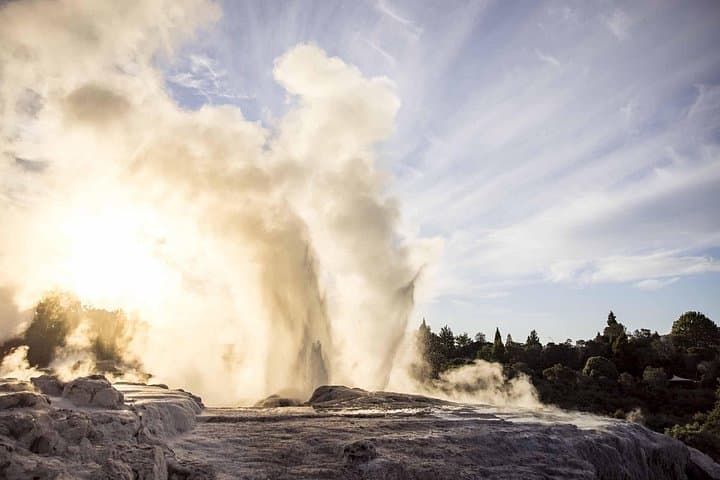

Steam curls up from the valley like a slow-breathing creature as dusk settles over Rotorua. Walkways creak underfoot, the air tastes faintly of minerals, and the ground hums with a warm, living heat — this is Te Puia at night, where geysers punctuate the dark and pōhiri welcomes the evening.
Steam curls up from the valley like a slow-breathing creature as dusk settles over Rotorua. Walkways creak underfoot, the air tastes faintly of minerals, and the ground hums with a warm, living heat — this is Te Puia at night, where geysers punctuate the dark and pōhiri welcomes the evening.
The site sits in the geothermal heart of Whakarewarewa; Pōhutu Geyser dominates the landscape as the largest active geyser in the Southern Hemisphere. The New Zealand Māori Arts and Crafts Institute, founded in the 1960s, preserves carving and weaving traditions visible in the meeting house and studios. Māori hospitality and storytelling stitch the evening together: guided valley tours explain the geology and native bush, the Kiwi Conservation Centre highlights nocturnal wildlife, and the cultural performance presents pōhiri, waiata, mōteatea, poi and haka.
Practical details are straightforward: the combo runs about 4.5 hours starting late afternoon, combining a guided tour, a hāngī buffet at Pātaka Kai overlooking the geothermal valley, and a 45-minute performance in Te Aronui a Rua. Paths are mostly boardwalks and suitable for strollers and wheelchairs, but wear closed-toe shoes for uneven sections and steam vents. Bring a warm layer — geothermal steam can mask chilly evening breezes — and a camera with a low-light setting. Book in advance: capacity is limited and the experience is popular with families and first-time visitors.
Expect sensory contrast: the warmth of earth and food, the cool of night air, and a cultural rhythm that connects geology, language and memory into a single evening.