THE ADVENTURE COLLECTIVE® · Independent discovery and booking for outdoor travel

A guided full-day hike through Tongariro National Park that pairs easy forest trails with exposed alpine ridges. Visit Taranaki Falls, push on to Tama Lakes if fit, and learn the geology and Māori history from an expert guide.
A guided full-day hike through Tongariro National Park that pairs easy forest trails with exposed alpine ridges. Visit Taranaki Falls, push on to Tama Lakes if fit, and learn the geology and Māori history from an expert guide.
Steam rises off a distant crater and the trail ahead crunches with pumice as you step into Tongariro National Park. The guide checks boots, points toward an escarpment, and the volcanic skyline—Ruapehu and Ngauruhoe—seems to lean in, watching. The first hour moves through beech forest, then opens to tussock-strewn slopes where the wind pushes like a curious hand.
Verified experiences and guided adventures in the surrounding area.
Steam rises off a distant crater and the trail ahead crunches with pumice as you step into Tongariro National Park. The guide checks boots, points toward an escarpment, and the volcanic skyline—Ruapehu and Ngauruhoe—seems to lean in, watching. The first hour moves through beech forest, then opens to tussock-strewn slopes where the wind pushes like a curious hand.
This full-day route stitches natural history and Māori significance: lava flows and explosive eruptions carved the ridges you cross, while iwi (local Māori) regard these mountains as taonga with names and stories tied to the land. Geology is visible in the red and black scoria, in the carved bowl of Tama Lakes and the plunge of Taranaki Falls. Cultural context is threaded into the walk by guides who explain the area’s role in local tradition and conservation.
Expect roughly 10–14 km of walking depending on route choices, with intermittent climbs and 300–500 m cumulative elevation gain if you continue to Tama Lakes. Terrain varies—firm forest tracks, exposed alpine tussock, and rocky saddle sections—so conditions can change fast.
Practical takeaways: start early to avoid afternoon weather shifts, carry 2–3 L of water and warm, windproof layers, and be prepared to swap footwear if the route is wet. Photography windows open at ridge viewpoints and the Tama basin; give yourself time at Taranaki Falls and Lake Rotopounamu. With an experienced guide and a steady pace, this is a day that pairs geology, culture, and clear-sky panoramas into a compact—and memorable—Alpine plateau experience.
The standard full-day option is moderate: expect 6–8 hours, uneven terrain and up to several hundred metres of elevation gain; guides can shorten the route to suit the group.
Pick-ups are offered from Rotorua (≈1h45) and Taupo (≈1h) with pickup times around 8:00–9:00 depending on the meeting location.
There’s no individual permit required for day walks, but Tongariro National Park has access rules—follow signage, stay on marked tracks, and heed guide instructions for restricted zones.
Late spring through autumn offers more stable conditions; winter brings snow and requires alpine experience or guided-specific winter gear.
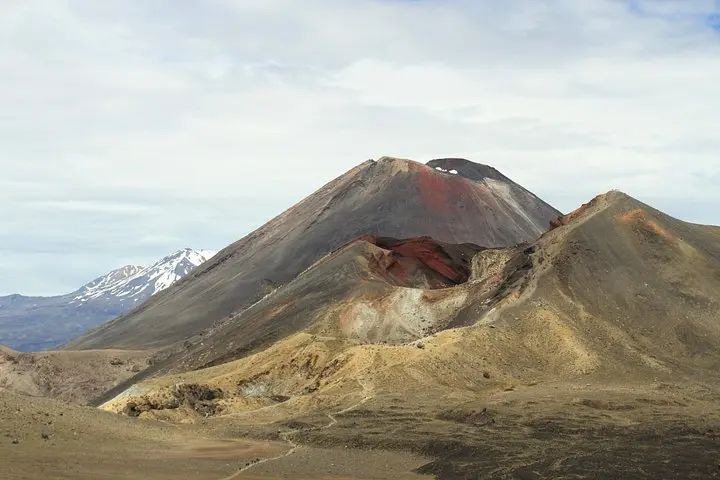
Steam rises off a distant crater and the trail ahead crunches with pumice as you step into Tongariro National Park. The guide checks boots, points toward an escarpment, and the volcanic skyline—Ruapehu and Ngauruhoe—seems to lean in, watching. The first hour moves through beech forest, then opens to tussock-strewn slopes where the wind pushes like a curious hand.
Steam rises off a distant crater and the trail ahead crunches with pumice as you step into Tongariro National Park. The guide checks boots, points toward an escarpment, and the volcanic skyline—Ruapehu and Ngauruhoe—seems to lean in, watching. The first hour moves through beech forest, then opens to tussock-strewn slopes where the wind pushes like a curious hand.
This full-day route stitches natural history and Māori significance: lava flows and explosive eruptions carved the ridges you cross, while iwi (local Māori) regard these mountains as taonga with names and stories tied to the land. Geology is visible in the red and black scoria, in the carved bowl of Tama Lakes and the plunge of Taranaki Falls. Cultural context is threaded into the walk by guides who explain the area’s role in local tradition and conservation.
Expect roughly 10–14 km of walking depending on route choices, with intermittent climbs and 300–500 m cumulative elevation gain if you continue to Tama Lakes. Terrain varies—firm forest tracks, exposed alpine tussock, and rocky saddle sections—so conditions can change fast.
Practical takeaways: start early to avoid afternoon weather shifts, carry 2–3 L of water and warm, windproof layers, and be prepared to swap footwear if the route is wet. Photography windows open at ridge viewpoints and the Tama basin; give yourself time at Taranaki Falls and Lake Rotopounamu. With an experienced guide and a steady pace, this is a day that pairs geology, culture, and clear-sky panoramas into a compact—and memorable—Alpine plateau experience.