THE ADVENTURE COLLECTIVE® · Independent discovery and booking for outdoor travel

Two days gives you sunrise at Angkor Wat, the carved faces of Bayon, and the jungle-entwined chambers of Ta Prohm. This private tour covers the major circuits with a local guide, practical pacing, and hotel transfers so you can focus on the temples and avoid logistics.
Two days gives you sunrise at Angkor Wat, the carved faces of Bayon, and the jungle-entwined chambers of Ta Prohm. This private tour covers the major circuits with a local guide, practical pacing, and hotel transfers so you can focus on the temples and avoid logistics.
You step from the minivan before dawn and the western moat mirrors a pale horizon. The drive from Siem Reap gives way to a low, humid light; the heat and humidity press softly against your jacket while the silhouette of Angkor Wat sharpens into towers. Sunrise at the west causeway is the first short, essential triumph—crowds thin only at the earliest hour, and the temple’s reflection pushes the eye forward.
Verified experiences and guided adventures in the surrounding area.
Operated by SARUS Co., Ltd · Siem Reap, Siem Reap Province
You step from the minivan before dawn and the western moat mirrors a pale horizon. The drive from Siem Reap gives way to a low, humid light; the heat and humidity press softly against your jacket while the silhouette of Angkor Wat sharpens into towers. Sunrise at the west causeway is the first short, essential triumph—crowds thin only at the earliest hour, and the temple’s reflection pushes the eye forward.
Over two days the tour moves like a measured circuit: Angkor Thom’s South Gate and the carved faces of the Bayon, the steep terraces of Baphuon, the elephant-lined platform of the Terrace of the Elephants, and the root-entwined galleries of Ta Prohm. Geologically, the temples are sandstone and laterite laid over quarried basins; the low reliefs and towering basements reflect both the Khmer empire’s hydraulic engineering and a city built on reclaimed wetlands. Culturally the sites mark Jayavarman VII’s shift to Mahayana Buddhism and earlier Hindu layers; inscriptions and bas-reliefs narrate kingship, war, and irrigation.
Expect a lot of walking—roughly 8–12 kilometers per day on packed earth, uneven stone and stairways—minimal elevation gain but many steps. Practical notes: aim for first-light Angkor Wat to avoid heat and crowds, bring a lightweight rain jacket in the wet season, wear supportive shoes with good traction, and carry 1–2 liters of water. Respect temple etiquette: shoulders and knees covered, no climbing on bas-reliefs, and follow your guide for ticketing and routing. In two days you’ll cover the classic sunrise, Bayon’s carved faces, Ta Prohm’s root-wrapped chambers, and smaller island temples—an efficient, intimate way to read Angkor’s stone and landscape.
Angkor Park admission is required; the tour typically assists with ticket purchase at the official counters but confirm with the operator whether it’s included or provided on arrival.
Expect 8–12 km of walking per day across packed earth, temple terraces, and stairways; pacing varies with stops for photography and interpretation.
The itinerary is listed as physically easy and private, but older travelers should be prepared for uneven ground and steps; request relaxed pacing or vehicle access to skip longer walks.
Early morning at sunrise captures reflections and softer light; late afternoon can be good for lower crowds in certain temples but harsher shadows at Angkor Wat.
SARUS Co., Ltd operates guided outdoor trips and adventures with an emphasis on safety, stewardship, and memorable experiences.

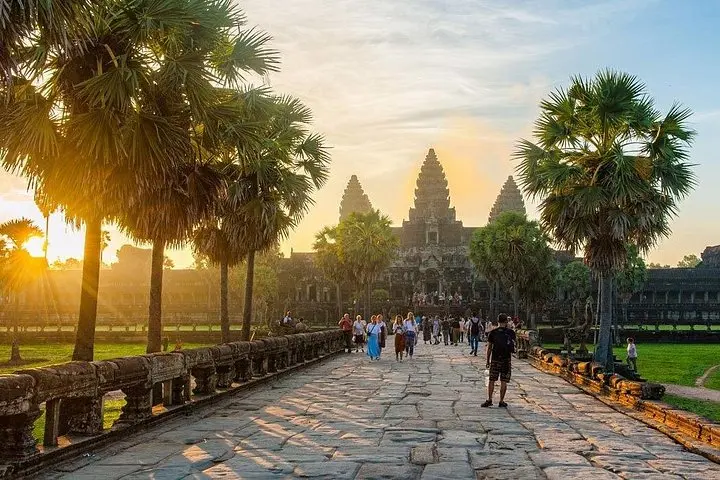

You step from the minivan before dawn and the western moat mirrors a pale horizon. The drive from Siem Reap gives way to a low, humid light; the heat and humidity press softly against your jacket while the silhouette of Angkor Wat sharpens into towers. Sunrise at the west causeway is the first short, essential triumph—crowds thin only at the earliest hour, and the temple’s reflection pushes the eye forward.
You step from the minivan before dawn and the western moat mirrors a pale horizon. The drive from Siem Reap gives way to a low, humid light; the heat and humidity press softly against your jacket while the silhouette of Angkor Wat sharpens into towers. Sunrise at the west causeway is the first short, essential triumph—crowds thin only at the earliest hour, and the temple’s reflection pushes the eye forward.
Over two days the tour moves like a measured circuit: Angkor Thom’s South Gate and the carved faces of the Bayon, the steep terraces of Baphuon, the elephant-lined platform of the Terrace of the Elephants, and the root-entwined galleries of Ta Prohm. Geologically, the temples are sandstone and laterite laid over quarried basins; the low reliefs and towering basements reflect both the Khmer empire’s hydraulic engineering and a city built on reclaimed wetlands. Culturally the sites mark Jayavarman VII’s shift to Mahayana Buddhism and earlier Hindu layers; inscriptions and bas-reliefs narrate kingship, war, and irrigation.
Expect a lot of walking—roughly 8–12 kilometers per day on packed earth, uneven stone and stairways—minimal elevation gain but many steps. Practical notes: aim for first-light Angkor Wat to avoid heat and crowds, bring a lightweight rain jacket in the wet season, wear supportive shoes with good traction, and carry 1–2 liters of water. Respect temple etiquette: shoulders and knees covered, no climbing on bas-reliefs, and follow your guide for ticketing and routing. In two days you’ll cover the classic sunrise, Bayon’s carved faces, Ta Prohm’s root-wrapped chambers, and smaller island temples—an efficient, intimate way to read Angkor’s stone and landscape.