THE ADVENTURE COLLECTIVE® · Independent discovery and booking for outdoor travel

Drive across open plains and toward a reservoir ringed with elephants: Udawalawe’s openness makes wildlife watching unusually reliable. This full-day safari from the southwest coast combines long transfers with a focused 3‑hour game drive that puts you close to herds, wetlands and open-country birds.
Drive across open plains and toward a reservoir ringed with elephants: Udawalawe’s openness makes wildlife watching unusually reliable. This full-day safari from the southwest coast combines long transfers with a focused 3‑hour game drive that puts you close to herds, wetlands and open-country birds.
The jeep eases onto a dusty track and the reservoir uncurls ahead—flat water, low scrub and a horizon of elephants moving like slow punctuation. Early light picks out mud-scarred hides and the drip of warning calls; here the landscape leans open, making animals easier to spot than in dense jungle.
Verified experiences and guided adventures in the surrounding area.
Operated by Apple Vacations Pvt Ltd · Udawalawe, Sabaragamuwa Province
The jeep eases onto a dusty track and the reservoir uncurls ahead—flat water, low scrub and a horizon of elephants moving like slow punctuation. Early light picks out mud-scarred hides and the drip of warning calls; here the landscape leans open, making animals easier to spot than in dense jungle.
Udawalawe National Park centers on the 308.2 sq km reservoir created to store the Walawe River. The park sits in Sri Lanka’s dry zone and its geology is dominated by weathered metamorphic rock and broad floodplains that support grassland, thorn scrub and scattered trees. British-era irrigation works and modern conservation efforts shaped the area's access and water management, while local communities around Udawalawe town maintain livelihoods tied to rice, cattle and small-scale tourism.
On a typical 3‑hour game drive you’ll scan for herds of Asian elephants, water buffalo, sambar and spotted deer, and watch kingfishers and raptors over the reservoir. Occasional leopards are reported but shy; birdwatchers will find wetland species and open-country feeders.
Practicalities: tours from Kalutara, Bentota or Hikkaduwa include long transfers—expect a 12–14 hour day—so bring sun protection, plenty of water and a charged camera. Morning drives offer cooler temperatures and active animals; follow your guide’s distance rules around elephants and keep noise low. Vehicles are open-sided jeeps on rough tracks, so stable footwear and a basic level of mobility to climb in and out are sensible. Respect local rules, carry insect repellent, and be ready for sudden light and shadow—the park’s openness makes every sighting visible and immediate.
Udawalawe is famous for very high elephant encounter rates and many operators advertise guaranteed sightings; check the operator’s specific policy and what they offer if no elephant is seen.
Most itineraries include a roughly 3‑hour game drive inside Udawalawe National Park, with the overall tour day including transfers to/from the pickup location.
The jeep ride is family-friendly but the full day is long; infants must sit on laps and those with spinal or serious heart conditions are not recommended to join.
This tour typically includes an English-speaking chauffeur, bottled water, private vehicle transport and jeep hire; confirm details with the operator before booking.
Apple Vacations Pvt Ltd operates guided outdoor trips and adventures with an emphasis on safety, stewardship, and memorable experiences.
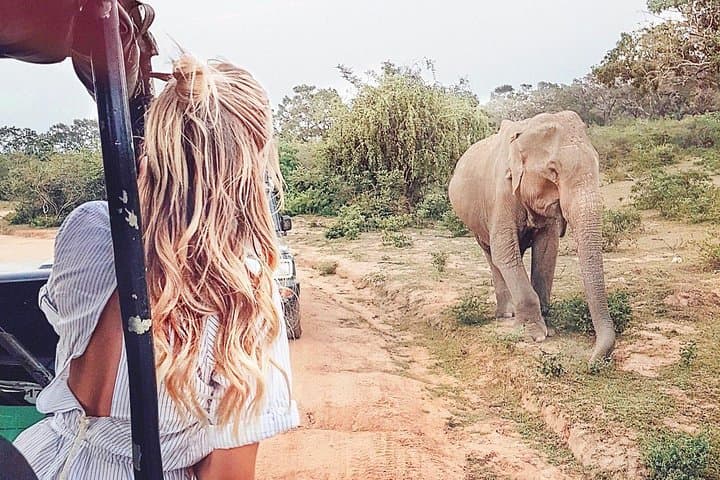


The jeep eases onto a dusty track and the reservoir uncurls ahead—flat water, low scrub and a horizon of elephants moving like slow punctuation. Early light picks out mud-scarred hides and the drip of warning calls; here the landscape leans open, making animals easier to spot than in dense jungle.
The jeep eases onto a dusty track and the reservoir uncurls ahead—flat water, low scrub and a horizon of elephants moving like slow punctuation. Early light picks out mud-scarred hides and the drip of warning calls; here the landscape leans open, making animals easier to spot than in dense jungle.
Udawalawe National Park centers on the 308.2 sq km reservoir created to store the Walawe River. The park sits in Sri Lanka’s dry zone and its geology is dominated by weathered metamorphic rock and broad floodplains that support grassland, thorn scrub and scattered trees. British-era irrigation works and modern conservation efforts shaped the area's access and water management, while local communities around Udawalawe town maintain livelihoods tied to rice, cattle and small-scale tourism.
On a typical 3‑hour game drive you’ll scan for herds of Asian elephants, water buffalo, sambar and spotted deer, and watch kingfishers and raptors over the reservoir. Occasional leopards are reported but shy; birdwatchers will find wetland species and open-country feeders.
Practicalities: tours from Kalutara, Bentota or Hikkaduwa include long transfers—expect a 12–14 hour day—so bring sun protection, plenty of water and a charged camera. Morning drives offer cooler temperatures and active animals; follow your guide’s distance rules around elephants and keep noise low. Vehicles are open-sided jeeps on rough tracks, so stable footwear and a basic level of mobility to climb in and out are sensible. Respect local rules, carry insect repellent, and be ready for sudden light and shadow—the park’s openness makes every sighting visible and immediate.