THE ADVENTURE COLLECTIVE® · Independent discovery and booking for outdoor travel

Lift off from Skaftafell and cross Vatnajökull, Landmannalaugar’s colorful rhyolite hills and the moss-clad scars of Lakagígar on a 90-minute sightseeing flight. This aerial tour condenses Iceland’s volcanic and glacial drama into one spectacular loop.
Lift off from Skaftafell and cross Vatnajökull, Landmannalaugar’s colorful rhyolite hills and the moss-clad scars of Lakagígar on a 90-minute sightseeing flight. This aerial tour condenses Iceland’s volcanic and glacial drama into one spectacular loop.
You taxi down a narrow private airstrip at dawn and the plane’s engine becomes the only sound for a long moment. Outside, Skaftafell’s outbuildings shrink; inside, the cabin windows frame a raw Iceland — an expanse of ice, fire-scarred highlands and braided rivers that seem to have their own pulse.
Verified experiences and guided adventures in the surrounding area.
Operated by Atlantsflug/Flightseeing · Skaftafell, Suðurland
You taxi down a narrow private airstrip at dawn and the plane’s engine becomes the only sound for a long moment. Outside, Skaftafell’s outbuildings shrink; inside, the cabin windows frame a raw Iceland — an expanse of ice, fire-scarred highlands and braided rivers that seem to have their own pulse.
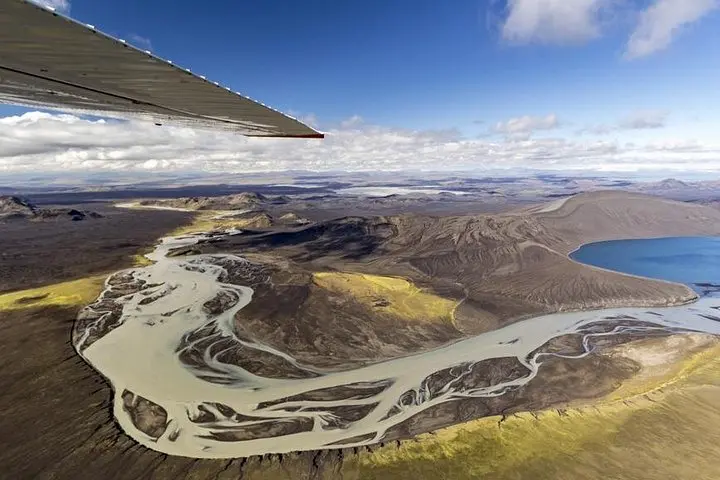
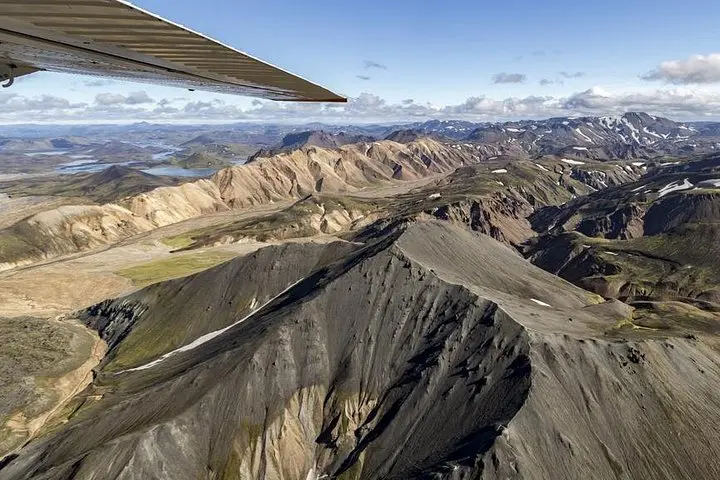
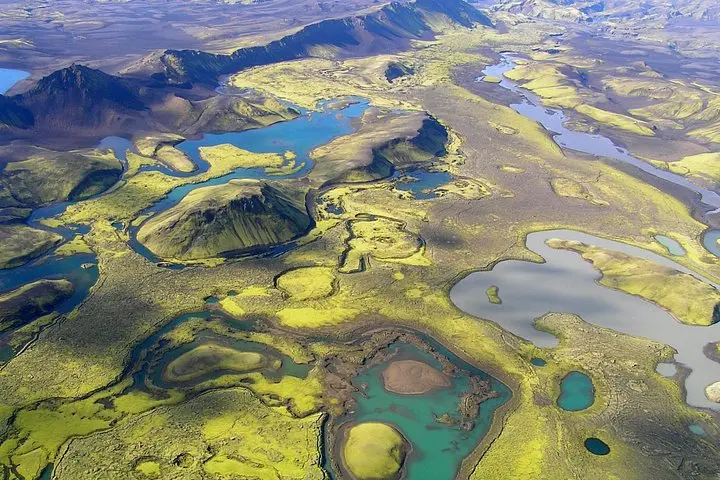
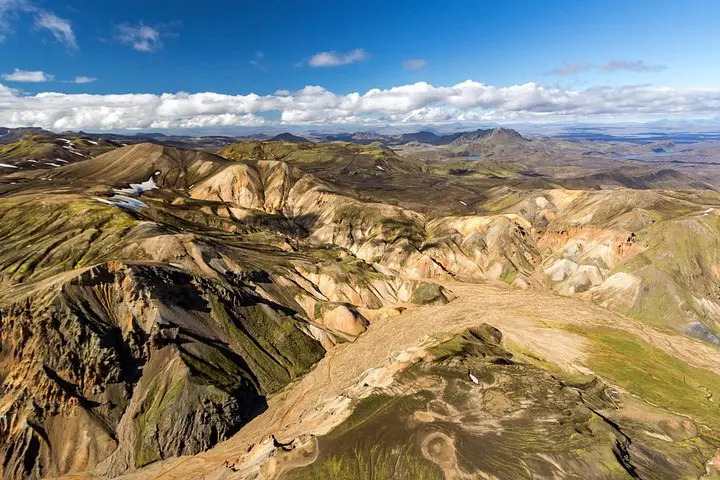
The 90-minute sightseeing flight peels open the southern Highlands and the vast tongue of Vatnajökull, Europe’s largest glacier. From the air, the glacier reads like a pale, creased map, its crevasses and moulins carving a language of pressure and time. You swing inland to Landmannalaugar where rhyolite hills flare with ochre, pink and green — a volcanic palette that formed under steam and slow cooling. Further north the flight skirts Grímsvötn, a basaltic volcano notorious for frequent eruptions, then drops toward the moss-softened scars of Lakagígar, the Laki fissure that reshaped Iceland — and climate — after the 1783 eruption.
Geology is the dominant script here: ice pressing and releasing, lava fields frozen mid-flow, rivers like Tungnáa daring you with their braided channels. Culturally, this landscape has long tested islanders — and inspired them. Roads that thread the Highlands are relatively recent; for centuries, travel was by foot, horse and patience.
Local pilots tailor the route to weather and photographic light. Expect a mix of low passes for detail and higher cruise segments to give scale: the 20-km-long stretch of Langisjór lake, perched 670 meters above sea level, reads as a deep, solemn ribbon between black ridges. The operator meets you at the Skaftafell terminal beside the private airstrip; boarding is straightforward and staff brief on safety and best window sides for shooting.
Practical notes matter: flights are weather-dependent and can be canceled at short notice, so plan flexibility into your schedule. You’ll want a camera with a fast lens and good stabilization, warm windproof layers, and a window seat — the photo opportunities are constant and the light shifts quickly. The tour accepts infants on laps and is physically easy, but weight disclosure is required for safe aircraft balance, so be ready to provide passenger weights at booking.
For photographers, aim for morning or late-afternoon flights when contrast and color pop; midday can flatten volcanic hues but still offers dramatic glacier detail.
This flight is less about speed and more about reorienting your sense of scale: islands of basalt, rivers that decide where to go, ice that moves like a slow decision. It’s a concentrated lesson in Iceland’s volatility and beauty — brief, precise and unforgettable if you come prepared.
The tour is approximately 90 minutes from takeoff to landing, including pre-flight briefing at the Skaftafell terminal.
Flights may be canceled for weather or weight restrictions; the operator allows a full refund if canceled at least 24 hours before departure and will rebook or refund for weather cancellations.
Yes — passenger weights are requested at booking to ensure proper aircraft balance; you must provide accurate weights when asked.
Infants are allowed but must sit on an adult’s lap; check seatbelt configurations with staff during booking.
Yes, but space is limited in a small plane—keep equipment compact and have straps secured; larger tripods are not recommended.
No — this is a sightseeing flight with no ground stops; the route offers aerial views of glaciers, volcanoes and highland lakes.
Atlantsflug/Flightseeing operates guided outdoor trips and adventures with an emphasis on safety, stewardship, and memorable experiences.
You taxi down a narrow private airstrip at dawn and the plane’s engine becomes the only sound for a long moment. Outside, Skaftafell’s outbuildings shrink; inside, the cabin windows frame a raw Iceland — an expanse of ice, fire-scarred highlands and braided rivers that seem to have their own pulse.
You taxi down a narrow private airstrip at dawn and the plane’s engine becomes the only sound for a long moment. Outside, Skaftafell’s outbuildings shrink; inside, the cabin windows frame a raw Iceland — an expanse of ice, fire-scarred highlands and braided rivers that seem to have their own pulse.
The 90-minute sightseeing flight peels open the southern Highlands and the vast tongue of Vatnajökull, Europe’s largest glacier. From the air, the glacier reads like a pale, creased map, its crevasses and moulins carving a language of pressure and time. You swing inland to Landmannalaugar where rhyolite hills flare with ochre, pink and green — a volcanic palette that formed under steam and slow cooling. Further north the flight skirts Grímsvötn, a basaltic volcano notorious for frequent eruptions, then drops toward the moss-softened scars of Lakagígar, the Laki fissure that reshaped Iceland — and climate — after the 1783 eruption.
Geology is the dominant script here: ice pressing and releasing, lava fields frozen mid-flow, rivers like Tungnáa daring you with their braided channels. Culturally, this landscape has long tested islanders — and inspired them. Roads that thread the Highlands are relatively recent; for centuries, travel was by foot, horse and patience.
Local pilots tailor the route to weather and photographic light. Expect a mix of low passes for detail and higher cruise segments to give scale: the 20-km-long stretch of Langisjór lake, perched 670 meters above sea level, reads as a deep, solemn ribbon between black ridges. The operator meets you at the Skaftafell terminal beside the private airstrip; boarding is straightforward and staff brief on safety and best window sides for shooting.
Practical notes matter: flights are weather-dependent and can be canceled at short notice, so plan flexibility into your schedule. You’ll want a camera with a fast lens and good stabilization, warm windproof layers, and a window seat — the photo opportunities are constant and the light shifts quickly. The tour accepts infants on laps and is physically easy, but weight disclosure is required for safe aircraft balance, so be ready to provide passenger weights at booking.
For photographers, aim for morning or late-afternoon flights when contrast and color pop; midday can flatten volcanic hues but still offers dramatic glacier detail.
This flight is less about speed and more about reorienting your sense of scale: islands of basalt, rivers that decide where to go, ice that moves like a slow decision. It’s a concentrated lesson in Iceland’s volatility and beauty — brief, precise and unforgettable if you come prepared.