THE ADVENTURE COLLECTIVE® · Independent discovery and booking for outdoor travel

A full-day blend of hiking, soaking in mineral pools and a hands-on look at Zapotec weaving. Explore Hierve el Agua’s petrified falls, then visit Teotitlán del Valle to watch centuries-old textile craft.
A full-day blend of hiking, soaking in mineral pools and a hands-on look at Zapotec weaving. Explore Hierve el Agua’s petrified falls, then visit Teotitlán del Valle to watch centuries-old textile craft.
The morning sun cuts across the cliffs as you step onto the rim above Hierve el Agua, the calcified falls that seem to freeze water mid-descent. The air is thin, dry and scented with sage; beneath you the mineral terraces glint, and small natural pools dare you to soak while the valley stretches away toward the Sierra Sur.
Verified experiences and guided adventures in the surrounding area.
The morning sun cuts across the cliffs as you step onto the rim above Hierve el Agua, the calcified falls that seem to freeze water mid-descent. The air is thin, dry and scented with sage; beneath you the mineral terraces glint, and small natural pools dare you to soak while the valley stretches away toward the Sierra Sur.
Geology here reads like slow motion: mineral-rich springs have deposited travertine for thousands of years to create the ‘petrified’ waterfalls—vertical faces formed by steady precipitation rather than a single collapse. Culturally, the route threads into Teotitlán del Valle, a Zapotec village famed for wool weaving and natural dyes; generations of weavers still use foot-operated looms to turn wool into geometric rugs.
Expect a full day: a hike across limestone surfaces and scrubby hills, time at thermal pools, and a guided stop at a family workshop where you’ll see backstrap looms and taste regional mole or tlayudas. Terrain ranges from firm dirt tracks to loose scree on short ascents; elevation hovers near 1,800–1,900 m, so sun and altitude both matter.
Practical edge: wear grippy shoes for uneven calcified rock, carry 2–3 liters of water, and bring sun protection and a light layer for wind on exposed viewpoints. Respect posted paths—the travertine is fragile—and plan for a long day with steady walking interspersed by cultural stops. The combination of geology, soakable pools and living textile craft makes this a balanced day trip from Oaxaca City.
Trails around the main overlook and pools are typically 2–5 km total depending on chosen viewpoints; allow 1–2 hours for the walking sections plus time for soaking and photos.
Yes—small natural pools formed by mineral springs are popular for soaking; avoid using soaps and respect any posted limits to protect water quality.
Yes, many families sell rugs and handicrafts directly; bargaining is common but do so respectfully and carry cash for purchases.
Families and older travelers can enjoy the site if they are steady on uneven ground and prepared for a full-day schedule; shorter, less strenuous route options exist near the main pools.
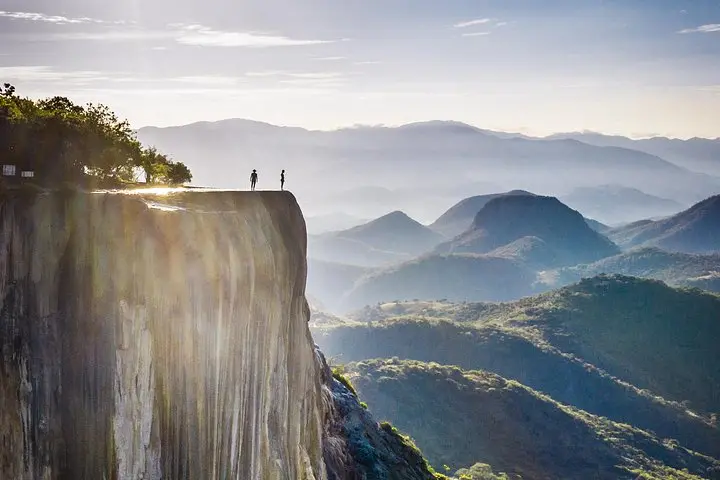
The morning sun cuts across the cliffs as you step onto the rim above Hierve el Agua, the calcified falls that seem to freeze water mid-descent. The air is thin, dry and scented with sage; beneath you the mineral terraces glint, and small natural pools dare you to soak while the valley stretches away toward the Sierra Sur.
The morning sun cuts across the cliffs as you step onto the rim above Hierve el Agua, the calcified falls that seem to freeze water mid-descent. The air is thin, dry and scented with sage; beneath you the mineral terraces glint, and small natural pools dare you to soak while the valley stretches away toward the Sierra Sur.
Geology here reads like slow motion: mineral-rich springs have deposited travertine for thousands of years to create the ‘petrified’ waterfalls—vertical faces formed by steady precipitation rather than a single collapse. Culturally, the route threads into Teotitlán del Valle, a Zapotec village famed for wool weaving and natural dyes; generations of weavers still use foot-operated looms to turn wool into geometric rugs.
Expect a full day: a hike across limestone surfaces and scrubby hills, time at thermal pools, and a guided stop at a family workshop where you’ll see backstrap looms and taste regional mole or tlayudas. Terrain ranges from firm dirt tracks to loose scree on short ascents; elevation hovers near 1,800–1,900 m, so sun and altitude both matter.
Practical edge: wear grippy shoes for uneven calcified rock, carry 2–3 liters of water, and bring sun protection and a light layer for wind on exposed viewpoints. Respect posted paths—the travertine is fragile—and plan for a long day with steady walking interspersed by cultural stops. The combination of geology, soakable pools and living textile craft makes this a balanced day trip from Oaxaca City.