THE ADVENTURE COLLECTIVE® · Independent discovery and booking for outdoor travel

Walk through carpets of alpine flowers, cross glacier-fed streams and finish at the reflective Hemkund Sahib lake. This practical 6-day guide explains what to expect on the Valley of Flowers and Hemkund trek—from terrain and history to permits and packing.
Walk through carpets of alpine flowers, cross glacier-fed streams and finish at the reflective Hemkund Sahib lake. This practical 6-day guide explains what to expect on the Valley of Flowers and Hemkund trek—from terrain and history to permits and packing.
A high meadow opens like a living painting—sheets of alpine blooms brushing against a thin, cold sky while a clear stream dares you to cross on stones slick with glacier melt. On this six-day circuit visitors move from the river valley up into floral pastures and then higher still to the glacial bowl of Hemkund Sahib, where granite slopes keep watch and the lake reflects a sky that changes by the hour.
Verified experiences and guided adventures in the surrounding area.
Operated by Yeti Outdoors · Govindghat, Uttarakhand
A high meadow opens like a living painting—sheets of alpine blooms brushing against a thin, cold sky while a clear stream dares you to cross on stones slick with glacier melt. On this six-day circuit visitors move from the river valley up into floral pastures and then higher still to the glacial bowl of Hemkund Sahib, where granite slopes keep watch and the lake reflects a sky that changes by the hour.
Discovered by British mountaineers in 1931, the Valley of Flowers became globally known for its concentrated biodiversity and was later inscribed with the Nanda Devi region as a UNESCO World Heritage site. Geologically the valley is a classic U-shaped glacial hollow—about 8 km long and 2 km wide—carved by ice and fed by streams that braid across meadows. Culturally the trek links Tibetan-influenced pilgrimage at Hemkund Sahib with local Bhotia hamlets; pilgrims and shepherds still share the same trails.
Practically: the route is considered moderate, reaching roughly 4,390 m at Hemkund. Expect long days of ascent, uneven stone steps, and wet meadows in the monsoon. Organized groups provide tents, sleeping bags, meals, and porters; permits and park fees are enforced at the park entrance. Acclimatize in Govindghat or Ghangaria, bring layered insulation for cold nights, and plan a buffer day for weather or AMS symptoms. Footwear should handle mud and scree; trekking poles reduce strain on knees.
Timing matters: July–September brings peak bloom but also afternoon storms. Respect fragile alpine meadows—stay on trail, pack out waste, and keep noise low to preserve the wildlife and silence that define this high valley.
Yes—entry permits and park fees are collected at the park entrance near Govindghat; organized tours typically handle permits for groups.
July through early September is peak bloom and best overall weather window, though expect more crowds and rain during the monsoon.
The trek is rated moderate: sustained uphill sections to Hemkund at high altitude require good fitness and acclimatization, but no technical climbing skills.
Basic facilities exist in Ghangaria and some campsites; expect minimal facilities on trail and practice leave-no-trace for human waste where necessary.
Yeti Outdoors operates guided outdoor trips and adventures with an emphasis on safety, stewardship, and memorable experiences.
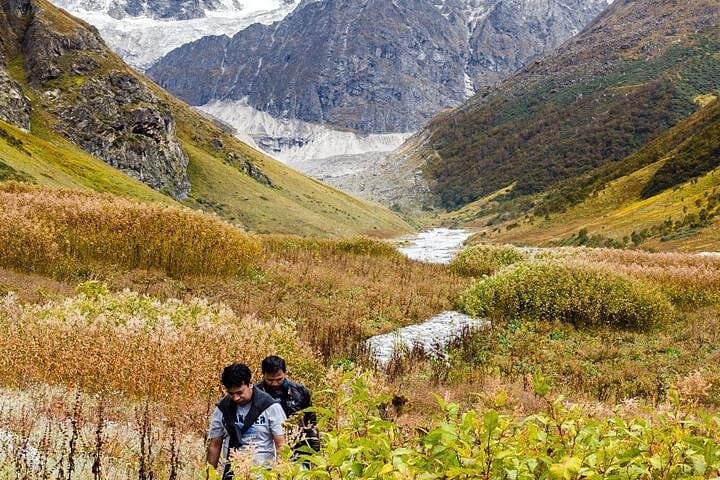


A high meadow opens like a living painting—sheets of alpine blooms brushing against a thin, cold sky while a clear stream dares you to cross on stones slick with glacier melt. On this six-day circuit visitors move from the river valley up into floral pastures and then higher still to the glacial bowl of Hemkund Sahib, where granite slopes keep watch and the lake reflects a sky that changes by the hour.
A high meadow opens like a living painting—sheets of alpine blooms brushing against a thin, cold sky while a clear stream dares you to cross on stones slick with glacier melt. On this six-day circuit visitors move from the river valley up into floral pastures and then higher still to the glacial bowl of Hemkund Sahib, where granite slopes keep watch and the lake reflects a sky that changes by the hour.
Discovered by British mountaineers in 1931, the Valley of Flowers became globally known for its concentrated biodiversity and was later inscribed with the Nanda Devi region as a UNESCO World Heritage site. Geologically the valley is a classic U-shaped glacial hollow—about 8 km long and 2 km wide—carved by ice and fed by streams that braid across meadows. Culturally the trek links Tibetan-influenced pilgrimage at Hemkund Sahib with local Bhotia hamlets; pilgrims and shepherds still share the same trails.
Practically: the route is considered moderate, reaching roughly 4,390 m at Hemkund. Expect long days of ascent, uneven stone steps, and wet meadows in the monsoon. Organized groups provide tents, sleeping bags, meals, and porters; permits and park fees are enforced at the park entrance. Acclimatize in Govindghat or Ghangaria, bring layered insulation for cold nights, and plan a buffer day for weather or AMS symptoms. Footwear should handle mud and scree; trekking poles reduce strain on knees.
Timing matters: July–September brings peak bloom but also afternoon storms. Respect fragile alpine meadows—stay on trail, pack out waste, and keep noise low to preserve the wildlife and silence that define this high valley.