THE ADVENTURE COLLECTIVE® · Independent discovery and booking for outdoor travel

A brisk 90-minute guided walk through Venice’s essentials—St. Mark’s, Doge’s Palace, Rialto—perfect for first-time visitors who want historical context and orientation. Expect narrow alleys, cobbled bridges, and a practical primer on navigating the lagoon city.
A brisk 90-minute guided walk through Venice’s essentials—St. Mark’s, Doge’s Palace, Rialto—perfect for first-time visitors who want historical context and orientation. Expect narrow alleys, cobbled bridges, and a practical primer on navigating the lagoon city.
You step off the vaporetto into a maze of stone and water. The air carries the salt of the lagoon and the faint clatter of café spoons; pigeons claim the wide pavement of Piazza San Marco while a guide’s voice threads through the crowd, pointing out the carved capitals on a high cornice. In 90 minutes, this express walking tour asks you to move quickly but thoughtfully—through alleys that open onto hidden campos, across bridges that curve over canals, and up to the façades that made Venice the medieval queen of maritime trade.
Verified experiences and guided adventures in the surrounding area.
You step off the vaporetto into a maze of stone and water. The air carries the salt of the lagoon and the faint clatter of café spoons; pigeons claim the wide pavement of Piazza San Marco while a guide’s voice threads through the crowd, pointing out the carved capitals on a high cornice. In 90 minutes, this express walking tour asks you to move quickly but thoughtfully—through alleys that open onto hidden campos, across bridges that curve over canals, and up to the façades that made Venice the medieval queen of maritime trade.
Venice’s architecture is a record of commerce and conquest. Byzantine mosaics in St. Mark’s basilica, Gothic ogee arches on private palazzi, and Renaissance palaces along the Grand Canal show how trade with Constantinople, the Levant and Europe shaped the city. Built on a lagoon of silts and clays, Venice rises almost imperceptibly from the water; the city’s stone is largely imported and the wooden piles beneath every structure are part of a unique engineering story that keeps it standing despite tides that still test it.
Culturally, the walking tour translates centuries of Venetian life into legible stops: the ducal power of the Doge’s Palace, the whisper of the Bridge of Sighs, the commercial pulse of Rialto Market. Local guides weave anecdotes—how merchants kept notebooks of exchange rates, where mask-makers plied their trade, why certain calle are named for professions—so the monuments gain teeth and context.
Practical guidance: expect roughly 1–1.5 miles (1.5–2.5 km) of walking on uneven cobblestones and dozens of bridge steps; cumulative elevation gain is negligible but there are many short flights of steps. The pace is brisk: good for travelers who want an efficient orientation to the city’s essentials without lingering inside museums. Morning departures reduce crowds and heat; late afternoons light the façades for photographs but can be busy, especially near Rialto.
Tips for comfort: wear sturdy, flat-soled shoes that grip wet stone; bring a small refillable water bottle (fountains with potable water are available); carry a lightweight rain jacket—weather can shift quickly on the lagoon. If you’re coming from a cruise ship, give extra time for transport to the meeting point—vaporetto lines can be long.
What this tour gives you is the scaffolding: historical frames, route memory, and a guide’s map of the city’s best viewing angles. Stay after the tour to explore a back-campagna or to sit at a quiet café; Venice reveals most of its secrets when you let the narrow streets slow you down.
The tour is approximately 90 minutes and typically includes St. Mark’s Square (exterior), Doge’s Palace (exterior), the Bridge of Sighs, and the Rialto area with its bridges and market.
Yes—it's family-friendly and suitable for active seniors, though participants should be able to walk 1–2 miles on cobblestones and climb short stairways.
This express format focuses on exterior highlights and historical interpretation; museum entries are generally not included—check the booking to confirm any exceptions.
Meeting points vary—confirm at booking. Arrive 10–15 minutes early to check in and account for vaporetto or foot traffic delays.
Venice’s many bridges and steps limit accessibility; some central areas are manageable but full wheelchair access is unlikely—contact the operator to discuss specific needs.
Guided tours are commonly offered in English and other major languages; verify the language option at booking to ensure availability.
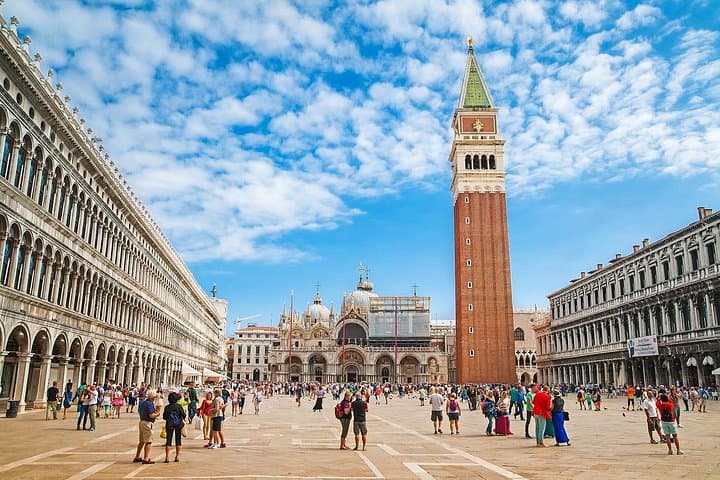
You step off the vaporetto into a maze of stone and water. The air carries the salt of the lagoon and the faint clatter of café spoons; pigeons claim the wide pavement of Piazza San Marco while a guide’s voice threads through the crowd, pointing out the carved capitals on a high cornice. In 90 minutes, this express walking tour asks you to move quickly but thoughtfully—through alleys that open onto hidden campos, across bridges that curve over canals, and up to the façades that made Venice the medieval queen of maritime trade.
You step off the vaporetto into a maze of stone and water. The air carries the salt of the lagoon and the faint clatter of café spoons; pigeons claim the wide pavement of Piazza San Marco while a guide’s voice threads through the crowd, pointing out the carved capitals on a high cornice. In 90 minutes, this express walking tour asks you to move quickly but thoughtfully—through alleys that open onto hidden campos, across bridges that curve over canals, and up to the façades that made Venice the medieval queen of maritime trade.
Venice’s architecture is a record of commerce and conquest. Byzantine mosaics in St. Mark’s basilica, Gothic ogee arches on private palazzi, and Renaissance palaces along the Grand Canal show how trade with Constantinople, the Levant and Europe shaped the city. Built on a lagoon of silts and clays, Venice rises almost imperceptibly from the water; the city’s stone is largely imported and the wooden piles beneath every structure are part of a unique engineering story that keeps it standing despite tides that still test it.
Culturally, the walking tour translates centuries of Venetian life into legible stops: the ducal power of the Doge’s Palace, the whisper of the Bridge of Sighs, the commercial pulse of Rialto Market. Local guides weave anecdotes—how merchants kept notebooks of exchange rates, where mask-makers plied their trade, why certain calle are named for professions—so the monuments gain teeth and context.
Practical guidance: expect roughly 1–1.5 miles (1.5–2.5 km) of walking on uneven cobblestones and dozens of bridge steps; cumulative elevation gain is negligible but there are many short flights of steps. The pace is brisk: good for travelers who want an efficient orientation to the city’s essentials without lingering inside museums. Morning departures reduce crowds and heat; late afternoons light the façades for photographs but can be busy, especially near Rialto.
Tips for comfort: wear sturdy, flat-soled shoes that grip wet stone; bring a small refillable water bottle (fountains with potable water are available); carry a lightweight rain jacket—weather can shift quickly on the lagoon. If you’re coming from a cruise ship, give extra time for transport to the meeting point—vaporetto lines can be long.
What this tour gives you is the scaffolding: historical frames, route memory, and a guide’s map of the city’s best viewing angles. Stay after the tour to explore a back-campagna or to sit at a quiet café; Venice reveals most of its secrets when you let the narrow streets slow you down.