THE ADVENTURE COLLECTIVE® · Independent discovery and booking for outdoor travel

Stand at the true southern tip of Africa where the Indian and Atlantic Oceans meet. This full-day tour from Cape Town combines coastal geology, lighthouse lore, and seaside villages for a crisp, accessible outdoor experience.
Stand at the true southern tip of Africa where the Indian and Atlantic Oceans meet. This full-day tour from Cape Town combines coastal geology, lighthouse lore, and seaside villages for a crisp, accessible outdoor experience.
Step onto the hard, wind-cut promontory and the world shifts: the surf on one side is colder, the roll on the other warmer, and the line where they meet seems to argue for attention. Visitors arrive at Cape Agulhas by road through rolling wheat country, then walk the short, salt-scented path to the official southernmost point of Africa and the squat, red-and-white lighthouse that keeps a steady eye on both oceans.
Verified experiences and guided adventures in the surrounding area.
Operated by Santacruise Tours · L'Agulhas, Western Cape
Step onto the hard, wind-cut promontory and the world shifts: the surf on one side is colder, the roll on the other warmer, and the line where they meet seems to argue for attention. Visitors arrive at Cape Agulhas by road through rolling wheat country, then walk the short, salt-scented path to the official southernmost point of Africa and the squat, red-and-white lighthouse that keeps a steady eye on both oceans.
This shoreline is defined by geology — a mosaic of rounded sandstone reefs and wave-polished platforms formed as the Agulhas Bank meets the continental shelf. Mariners used the lighthouse from the 1840s to navigate one of the world’s most treacherous ocean junctions; shipwrecks are part of local history and museums around Bredasdorp preserve those stories. The nearby villages reflect Cape Agulhas’ working coastal culture: small-scale fishing, oyster farms, and a growing eco-tourism scene.
Practical guidance: the site is exposed to strong winds — pack a windbreaker and sturdy shoes for the rocky walking. A typical day tour from Cape Town runs about nine hours round-trip with stops in Caledon and Bredasdorp; expect several short walks rather than long hikes. Wildlife watchers might spot seabirds, seals, and (seasonally) migrating whales offshore. Lunch and basic services are available near the lighthouse but bring water and sun protection — shade is limited.
Timing matters: mornings are calmer for photography, afternoons bring dramatic light and stronger winds. Respect marked paths and marine rules: the reefs are fragile and intertidal life recovers slowly from trampling.
It’s roughly a 2.5–3 hour drive (about 200–220 km) one way, depending on traffic and stops en route.
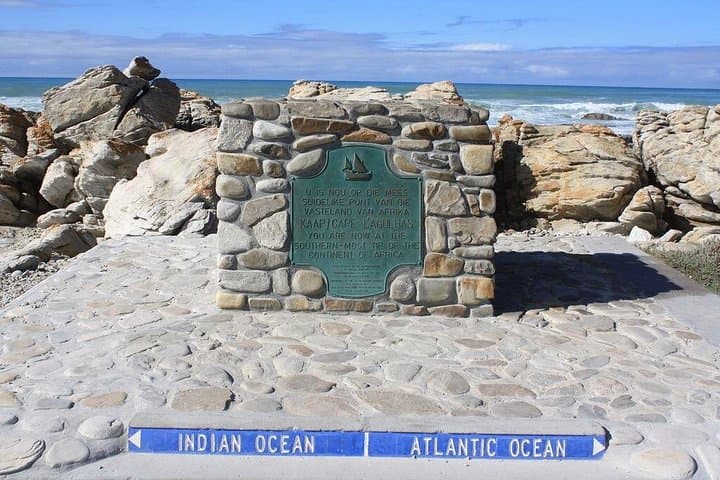
There’s a marked spot at the point that indicates the conventional meeting of the oceans—it's a symbolic place to observe the currents and surf patterns.
The lighthouse often has visiting hours and a small museum nearby, but hours can vary seasonally—check local listings before you go.
Yes—paths around the lighthouse and point are short and generally manageable, though some rocky sections are uneven; infant seats and strollers are possible with care.
Santacruise Tours operates guided outdoor trips and adventures with an emphasis on safety, stewardship, and memorable experiences.
Step onto the hard, wind-cut promontory and the world shifts: the surf on one side is colder, the roll on the other warmer, and the line where they meet seems to argue for attention. Visitors arrive at Cape Agulhas by road through rolling wheat country, then walk the short, salt-scented path to the official southernmost point of Africa and the squat, red-and-white lighthouse that keeps a steady eye on both oceans.
Step onto the hard, wind-cut promontory and the world shifts: the surf on one side is colder, the roll on the other warmer, and the line where they meet seems to argue for attention. Visitors arrive at Cape Agulhas by road through rolling wheat country, then walk the short, salt-scented path to the official southernmost point of Africa and the squat, red-and-white lighthouse that keeps a steady eye on both oceans.
This shoreline is defined by geology — a mosaic of rounded sandstone reefs and wave-polished platforms formed as the Agulhas Bank meets the continental shelf. Mariners used the lighthouse from the 1840s to navigate one of the world’s most treacherous ocean junctions; shipwrecks are part of local history and museums around Bredasdorp preserve those stories. The nearby villages reflect Cape Agulhas’ working coastal culture: small-scale fishing, oyster farms, and a growing eco-tourism scene.
Practical guidance: the site is exposed to strong winds — pack a windbreaker and sturdy shoes for the rocky walking. A typical day tour from Cape Town runs about nine hours round-trip with stops in Caledon and Bredasdorp; expect several short walks rather than long hikes. Wildlife watchers might spot seabirds, seals, and (seasonally) migrating whales offshore. Lunch and basic services are available near the lighthouse but bring water and sun protection — shade is limited.
Timing matters: mornings are calmer for photography, afternoons bring dramatic light and stronger winds. Respect marked paths and marine rules: the reefs are fragile and intertidal life recovers slowly from trampling.