THE ADVENTURE COLLECTIVE® · Independent discovery and booking for outdoor travel

Spend a working day at Dujiangyan Giant Panda Center helping keepers record behavior, prepare diets and maintain enclosures. This private day program combines close-up learning with practical conservation work, including hotel transport from Chengdu.
Spend a working day at Dujiangyan Giant Panda Center helping keepers record behavior, prepare diets and maintain enclosures. This private day program combines close-up learning with practical conservation work, including hotel transport from Chengdu.
The day begins before the gate opens: a cool Sichuan morning, bamboo leaves rattling like a slow applause as the minivan returns from Chengdu and the keepers unlock the enclosures.
Verified experiences and guided adventures in the surrounding area.
Operated by Samtour of Chengdu OTC Travel · Dujiangyan, Sichuan
The day begins before the gate opens: a cool Sichuan morning, bamboo leaves rattling like a slow applause as the minivan returns from Chengdu and the keepers unlock the enclosures.
At Dujiangyan Giant Panda Center you step into an operational conservation facility where the animals have routines and the landscape—the low hills carved by the Min River—frames each viewing window. The center is part of the China Conservation and Research Center for the Giant Panda, a network that grew from government and scientific efforts in the 1980s to bring captive-breeding and habitat protection into a coordinated program.
Geologically, you’re in the eastern edge of the Tibetan Plateau’s influence: rolling ridges, river-cut valleys and thick bamboo belts that sustain both giant and red pandas. Locals in Dujiangyan point to the ancient irrigation works nearby—an engineering landmark that shaped the fertile basin and human-panda coexistence over centuries.
Practically, the day blends hands-on tasks with observation. Expect to record behavior, help prepare measured diets, and assist with enclosure tidying under supervision; direct physical contact with pandas is strictly controlled. The itinerary includes hotel pickup in Chengdu, roughly 7–8 hours total including transfer, with about six hours at the center.
Bring closed-toe shoes, comfortable layers, and a small daypack; follow keeper instructions on biosecurity—no strong scents, no stray food, and keep your distance unless explicitly guided. The experience supports conservation funding and offers a rare view into daily captive care: the keepers’ routines, the animals’ rhythms, and the pragmatic science behind recovery of a species that still depends on people to survive.
Direct contact is generally not permitted; interaction is supervised and limited to keeper-directed activities to protect both visitors and animals.
Yes—private round-trip hotel pickup and drop-off in Chengdu by air-conditioned vehicle is included in the program.
No special vaccinations are typically required for the visit, but you must provide passport details at booking and carry your ID for pickup.
A buffet lunch is included as part of the full-day program.
Samtour of Chengdu OTC Travel operates guided outdoor trips and adventures with an emphasis on safety, stewardship, and memorable experiences.
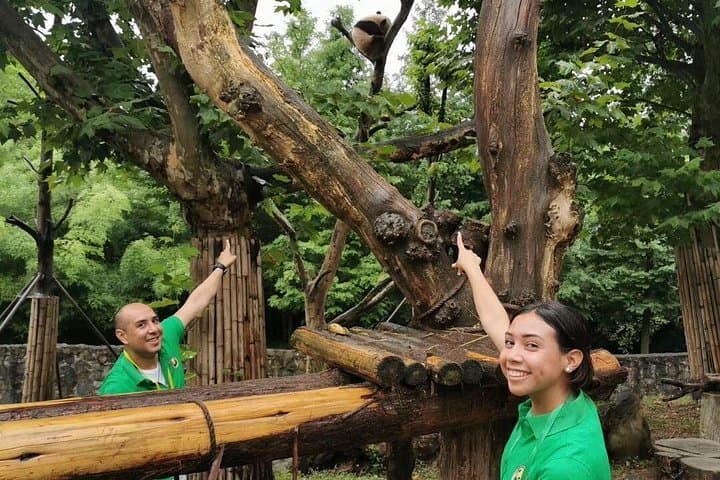


The day begins before the gate opens: a cool Sichuan morning, bamboo leaves rattling like a slow applause as the minivan returns from Chengdu and the keepers unlock the enclosures.
The day begins before the gate opens: a cool Sichuan morning, bamboo leaves rattling like a slow applause as the minivan returns from Chengdu and the keepers unlock the enclosures.
At Dujiangyan Giant Panda Center you step into an operational conservation facility where the animals have routines and the landscape—the low hills carved by the Min River—frames each viewing window. The center is part of the China Conservation and Research Center for the Giant Panda, a network that grew from government and scientific efforts in the 1980s to bring captive-breeding and habitat protection into a coordinated program.
Geologically, you’re in the eastern edge of the Tibetan Plateau’s influence: rolling ridges, river-cut valleys and thick bamboo belts that sustain both giant and red pandas. Locals in Dujiangyan point to the ancient irrigation works nearby—an engineering landmark that shaped the fertile basin and human-panda coexistence over centuries.
Practically, the day blends hands-on tasks with observation. Expect to record behavior, help prepare measured diets, and assist with enclosure tidying under supervision; direct physical contact with pandas is strictly controlled. The itinerary includes hotel pickup in Chengdu, roughly 7–8 hours total including transfer, with about six hours at the center.
Bring closed-toe shoes, comfortable layers, and a small daypack; follow keeper instructions on biosecurity—no strong scents, no stray food, and keep your distance unless explicitly guided. The experience supports conservation funding and offers a rare view into daily captive care: the keepers’ routines, the animals’ rhythms, and the pragmatic science behind recovery of a species that still depends on people to survive.