THE ADVENTURE COLLECTIVE® · Independent discovery and booking for outdoor travel

A compact, 3-hour circuit through Wadi Rum that pairs off-road 4x4 runs with short canyon walks, camel rides and dune climbs. Perfect for travelers who want a focused taste of the desert’s rock bridges, Nabatean inscriptions and Bedouin hospitality.
A compact, 3-hour circuit through Wadi Rum that pairs off-road 4x4 runs with short canyon walks, camel rides and dune climbs. Perfect for travelers who want a focused taste of the desert’s rock bridges, Nabatean inscriptions and Bedouin hospitality.
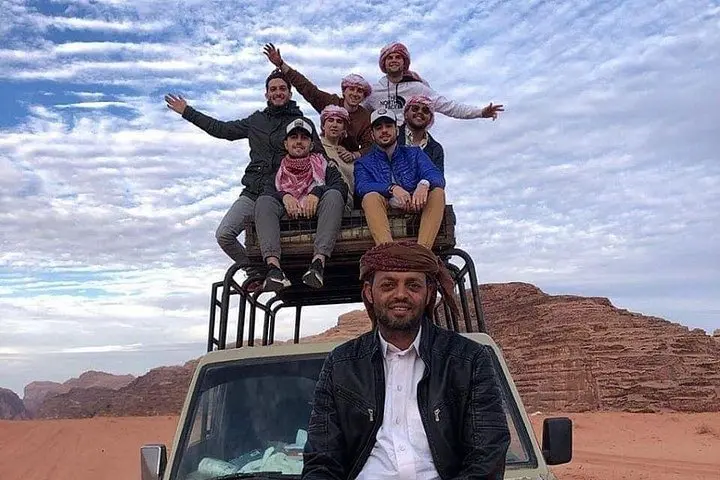
You climb out of the 4x4 and the desert exhales: a warm, mineral-scented wind that lifts grains of red sand and irons the light across a field of towering sandstone ribs. The guide points to a faint spring tucked at the base of a cliff — Lawrence's Spring — where water still trickles through rock older than most maps. From the vehicle, Bedouin camels sway into view, patient and deliberate, waiting to carry you across a landscape that moves in slow, cinematic frames.
Verified experiences and guided adventures in the surrounding area.
Operated by Bedouin Life Style Day Tour · Wadi Rum Village, Ma'an Governorate
You climb out of the 4x4 and the desert exhales: a warm, mineral-scented wind that lifts grains of red sand and irons the light across a field of towering sandstone ribs. The guide points to a faint spring tucked at the base of a cliff — Lawrence's Spring — where water still trickles through rock older than most maps. From the vehicle, Bedouin camels sway into view, patient and deliberate, waiting to carry you across a landscape that moves in slow, cinematic frames.
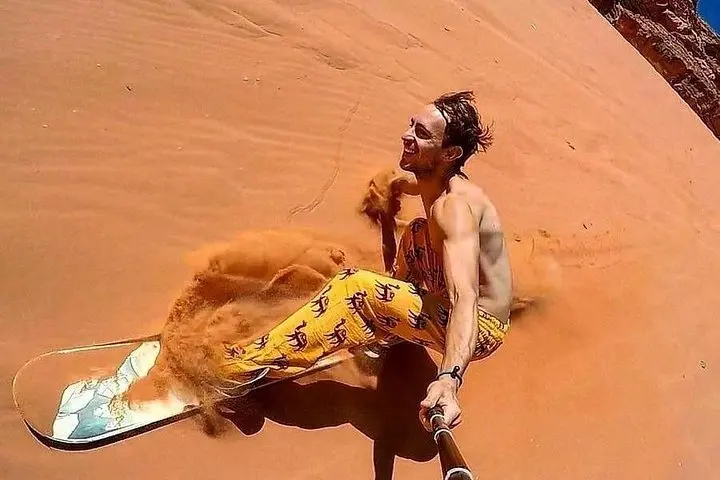
The half-day loop compresses Wadi Rum into three hours of motion: a mix of off-road stretches, short canyon walks, dune climbs and photo stops. Khazali Canyon is a cool corridor of shade where Nabatean and early-Arab rock inscriptions peer from shadowed walls; here you walk rather than ride, the sandstone underfoot giving way to flat slabs and narrow steps. At the sand dunes, the desert dares you to run down its face or strap on a sandboard and carve a line of your own. Natural arches — the Little Bridge and the larger Um Fruth — offer viewpoints that reward a short scramble with broad panoramas of ochre plains and broken ridgelines.
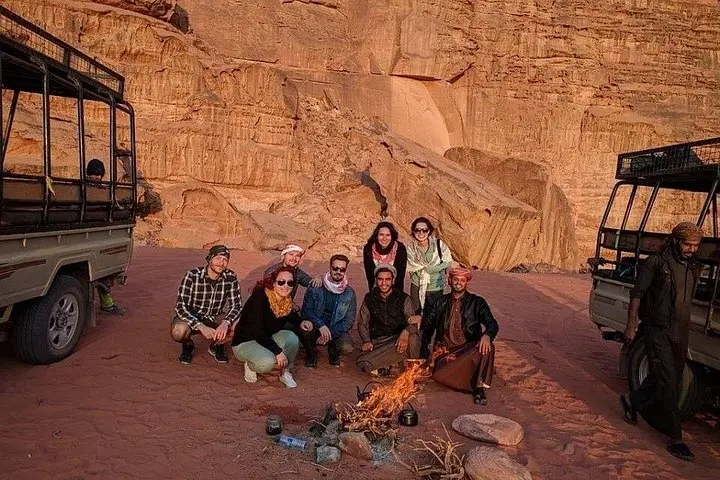
Geologically, Wadi Rum is a palimpsest of Cambrian sandstone and granite intrusions shaped by wind and flash floods. Culturally, it has been a crossroads for Nabateans, Bedouin tribes and, in modern myth, T.E. Lawrence — his name lingers in place-names and in a small, simple ruin known locally as Lawrence's House. Bedouin hospitality threads the tour: a stop for sweet tea and dates at a tented café reinforces that this landscape isn't a backdrop but a lived, working environment.
Practicals: expect about three hours total with short walks at each stop—typically 10–30 minutes of walking per site and dune climbs of 30–120 vertical meters, on soft sand or broken rock. Terrain alternates between deep sand, flat desert tracks and narrow canyon floors. Wear sturdy, closed-toe shoes you don’t mind getting sandy, bring at least 1–1.5 liters of water per person (more in summer), and use high-SPF sunscreen and a wide-brim hat; the sun is relentless and shade is scarce between canyons.
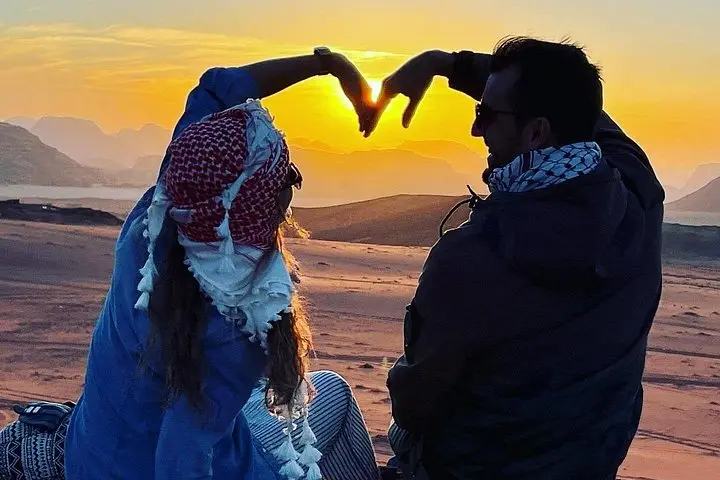
Timing matters: early morning or late afternoon light makes the colors sing and keeps temperatures pleasant. If you want sharper cultural context, ask about the inscriptions in Khazali and the Bedouin family histories that many guides will share. The trip is low-impact if you follow local guidance—stay on marked routes, avoid climbing fragile rock art, and pack out plastics. In three hours, Wadi Rum can feel like an immersive primer: a place that moves you slowly, then leaves you with a clear sense of why people have lived here for millennia.
The tour lasts about 3 hours total with short walks of 10–30 minutes at each stop; dune climbs are optional and generally 30–120 vertical meters.
Yes—this tour includes a guided camel ride over a short section; guides manage saddling and loading, and animals are handled by experienced Bedouin handlers.
The tour is listed as physically easy and suitable for most ages, but camel rides and dune climbs may be difficult for those with mobility limitations—check with the operator for special accommodations.
Closed-toe shoes, sun protection, at least 1 L of water, and a light layer for wind or cooler mornings are recommended.
Yes—stops include Khazali Canyon for inscriptions and a visit to the site known as Lawrence’s House; follow the guide’s instructions to protect fragile sites.
Shade is limited to canyon areas and tented cafés; the tour provides bottled water, snacks and Bedouin tea, but toilet facilities are minimal—plan accordingly.
Bedouin Life Style Day Tour operates guided outdoor trips and adventures with an emphasis on safety, stewardship, and memorable experiences.
You climb out of the 4x4 and the desert exhales: a warm, mineral-scented wind that lifts grains of red sand and irons the light across a field of towering sandstone ribs. The guide points to a faint spring tucked at the base of a cliff — Lawrence's Spring — where water still trickles through rock older than most maps. From the vehicle, Bedouin camels sway into view, patient and deliberate, waiting to carry you across a landscape that moves in slow, cinematic frames.
You climb out of the 4x4 and the desert exhales: a warm, mineral-scented wind that lifts grains of red sand and irons the light across a field of towering sandstone ribs. The guide points to a faint spring tucked at the base of a cliff — Lawrence's Spring — where water still trickles through rock older than most maps. From the vehicle, Bedouin camels sway into view, patient and deliberate, waiting to carry you across a landscape that moves in slow, cinematic frames.
The half-day loop compresses Wadi Rum into three hours of motion: a mix of off-road stretches, short canyon walks, dune climbs and photo stops. Khazali Canyon is a cool corridor of shade where Nabatean and early-Arab rock inscriptions peer from shadowed walls; here you walk rather than ride, the sandstone underfoot giving way to flat slabs and narrow steps. At the sand dunes, the desert dares you to run down its face or strap on a sandboard and carve a line of your own. Natural arches — the Little Bridge and the larger Um Fruth — offer viewpoints that reward a short scramble with broad panoramas of ochre plains and broken ridgelines.
Geologically, Wadi Rum is a palimpsest of Cambrian sandstone and granite intrusions shaped by wind and flash floods. Culturally, it has been a crossroads for Nabateans, Bedouin tribes and, in modern myth, T.E. Lawrence — his name lingers in place-names and in a small, simple ruin known locally as Lawrence's House. Bedouin hospitality threads the tour: a stop for sweet tea and dates at a tented café reinforces that this landscape isn't a backdrop but a lived, working environment.
Practicals: expect about three hours total with short walks at each stop—typically 10–30 minutes of walking per site and dune climbs of 30–120 vertical meters, on soft sand or broken rock. Terrain alternates between deep sand, flat desert tracks and narrow canyon floors. Wear sturdy, closed-toe shoes you don’t mind getting sandy, bring at least 1–1.5 liters of water per person (more in summer), and use high-SPF sunscreen and a wide-brim hat; the sun is relentless and shade is scarce between canyons.
Timing matters: early morning or late afternoon light makes the colors sing and keeps temperatures pleasant. If you want sharper cultural context, ask about the inscriptions in Khazali and the Bedouin family histories that many guides will share. The trip is low-impact if you follow local guidance—stay on marked routes, avoid climbing fragile rock art, and pack out plastics. In three hours, Wadi Rum can feel like an immersive primer: a place that moves you slowly, then leaves you with a clear sense of why people have lived here for millennia.