THE ADVENTURE COLLECTIVE® · Independent discovery and booking for outdoor travel

Spend a day driving across ochre plains, scrambling short canyons, and finish under Bedouin hospitality with dinner and stargazing. This private jeep tour covers key viewpoints in Wadi Rum and includes an overnight Bedouin camp or cave stay.
Spend a day driving across ochre plains, scrambling short canyons, and finish under Bedouin hospitality with dinner and stargazing. This private jeep tour covers key viewpoints in Wadi Rum and includes an overnight Bedouin camp or cave stay.
The jeep rolls over the lip of a dune and the desert opens—flat, ochre plain punctuated by vast towers of sandstone and granite. Wind scours each face into ribs and hollows; sunlight slides down cliffs and the driver kills the engine. In the silence, a Bedouin host sets a low table while the sky cools from white to molten gold, and you understand why people come out here to watch the world switch off.
Verified experiences and guided adventures in the surrounding area.
The jeep rolls over the lip of a dune and the desert opens—flat, ochre plain punctuated by vast towers of sandstone and granite. Wind scours each face into ribs and hollows; sunlight slides down cliffs and the driver kills the engine. In the silence, a Bedouin host sets a low table while the sky cools from white to molten gold, and you understand why people come out here to watch the world switch off.
Wadi Rum is a geologist’s playground and a human archive. The bowl-shaped valleys and mushroom rocks were carved by millennia of wind and flash floods cutting through Cambrian sandstone and older igneous intrusions. Human traces run deep: Nabatean inscriptions and petroglyphs hide in narrow canyons, and T.E. Lawrence left an outsized mark on the place during the Arab Revolt—routes and springs still carry his name.
The tour organizes this landscape into readable moments: a 30–45 minute canyon hike—roughly 1–2 km with short sections of scrambling and 50–150 m of elevation change—Khazali Canyon’s ancient graffiti, panoramic overlooks like Um Sabatah at sunset, and quieter corners where Lawrence’s Spring and less-trafficked rock bridges sit. In the evening the Bedouin camp becomes a classroom in hospitality: flatbread baked over coals, slow-cooked lamb, cardamom tea, and stories that link the stars to seasonal migration and water sources.
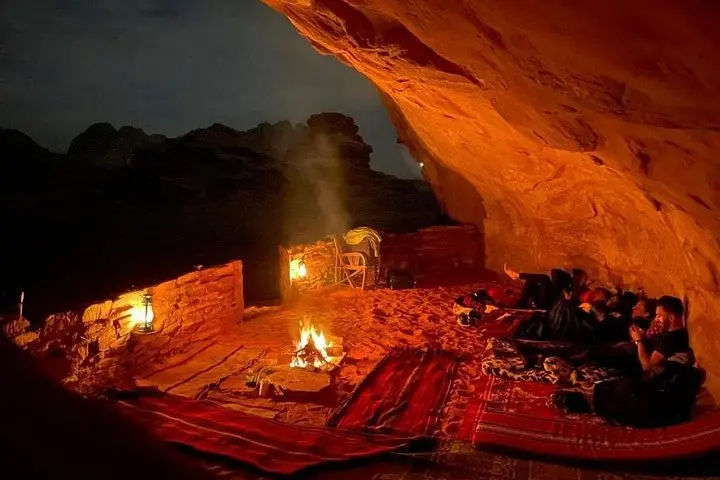
Practicalities are unglamorous but decisive. Expect a full day of driving and short hikes inside the protected area, followed by an overnight in a traditional tent or a sheltered cave—both offer simple bedding, a communal fire, and basic wash facilities. Bring at least 2–3 liters of water per person for the daytime, sturdy shoes for rocky, uneven terrain, and warm layers for night temperatures that can drop quickly. Mobile coverage is intermittent; the guide is your map and radio. The tour typically departs from Rum Village (or collects from Aqaba and Petra by arrangement) and returns the next morning after breakfast.
For photographers, the drama lives at sunrise and sunset and after dark when the Milky Way floods the sky. For travelers, the reward is not only the view but the pace: a jeep stitches together viewpoints, a short hike presses the senses, and an overnight under the stars fixes the landscape in memory.
Whether you want the comfort of a private jeep and a guided route through the site’s top features or the smaller discoveries tucked behind a dune, this overnight in Wadi Rum gives both—raw geology, layered human history, and the peculiar quiet of desert night.
Yes—the advertised itinerary runs as a private jeep tour, so the vehicle and guide are dedicated to your group.
Typical inclusions are private transport within Wadi Rum, a local Bedouin guide, lunch, dinner, overnight accommodation in a tent or cave, and breakfast; confirm specifics with the operator before booking.
Hikes are short (30–45 minutes) with occasional scrambling; they require steady footing but no technical climbing gear.
Many operators offer the option to sleep outdoors; request this in advance so the camp can prepare appropriate bedding and wind protection.
Wadi Rum Village is about 1 hour from Aqaba and roughly 1.5–2 hours from Petra by car; many tours offer pickup from either location.
Coverage is intermittent across the protected area—expect low or no signal in many spots; guides carry radios for communication.
The jeep rolls over the lip of a dune and the desert opens—flat, ochre plain punctuated by vast towers of sandstone and granite. Wind scours each face into ribs and hollows; sunlight slides down cliffs and the driver kills the engine. In the silence, a Bedouin host sets a low table while the sky cools from white to molten gold, and you understand why people come out here to watch the world switch off.
The jeep rolls over the lip of a dune and the desert opens—flat, ochre plain punctuated by vast towers of sandstone and granite. Wind scours each face into ribs and hollows; sunlight slides down cliffs and the driver kills the engine. In the silence, a Bedouin host sets a low table while the sky cools from white to molten gold, and you understand why people come out here to watch the world switch off.
Wadi Rum is a geologist’s playground and a human archive. The bowl-shaped valleys and mushroom rocks were carved by millennia of wind and flash floods cutting through Cambrian sandstone and older igneous intrusions. Human traces run deep: Nabatean inscriptions and petroglyphs hide in narrow canyons, and T.E. Lawrence left an outsized mark on the place during the Arab Revolt—routes and springs still carry his name.
The tour organizes this landscape into readable moments: a 30–45 minute canyon hike—roughly 1–2 km with short sections of scrambling and 50–150 m of elevation change—Khazali Canyon’s ancient graffiti, panoramic overlooks like Um Sabatah at sunset, and quieter corners where Lawrence’s Spring and less-trafficked rock bridges sit. In the evening the Bedouin camp becomes a classroom in hospitality: flatbread baked over coals, slow-cooked lamb, cardamom tea, and stories that link the stars to seasonal migration and water sources.
Practicalities are unglamorous but decisive. Expect a full day of driving and short hikes inside the protected area, followed by an overnight in a traditional tent or a sheltered cave—both offer simple bedding, a communal fire, and basic wash facilities. Bring at least 2–3 liters of water per person for the daytime, sturdy shoes for rocky, uneven terrain, and warm layers for night temperatures that can drop quickly. Mobile coverage is intermittent; the guide is your map and radio. The tour typically departs from Rum Village (or collects from Aqaba and Petra by arrangement) and returns the next morning after breakfast.
For photographers, the drama lives at sunrise and sunset and after dark when the Milky Way floods the sky. For travelers, the reward is not only the view but the pace: a jeep stitches together viewpoints, a short hike presses the senses, and an overnight under the stars fixes the landscape in memory.
Whether you want the comfort of a private jeep and a guided route through the site’s top features or the smaller discoveries tucked behind a dune, this overnight in Wadi Rum gives both—raw geology, layered human history, and the peculiar quiet of desert night.