THE ADVENTURE COLLECTIVE® · Independent discovery and booking for outdoor travel

Circle Lucca on foot along its iconic Renaissance walls and discover Roman remains, medieval gates, and lively piazzas. This two-hour walking tour balances panoramic wall-top views with detailed stops on the city’s architectural history.
Circle Lucca on foot along its iconic Renaissance walls and discover Roman remains, medieval gates, and lively piazzas. This two-hour walking tour balances panoramic wall-top views with detailed stops on the city’s architectural history.
You step onto a wide, tree-lined boulevard that crowns Lucca’s circular ramparts — a walking promenade where locals cycle past and chestnut trees throw dappled shade over cobblestones.
Verified experiences and guided adventures in the surrounding area.
Operated by Anna Romani · Lucca, Tuscany
You step onto a wide, tree-lined boulevard that crowns Lucca’s circular ramparts — a walking promenade where locals cycle past and chestnut trees throw dappled shade over cobblestones.
The two-hour walk threads the city’s layers: Roman foundations tucked into medieval fabric, Renaissance bastions rebuilt as promenades, and churches where marble and brick meet. Guides point out the Roman wall remnants at street level, then lead the group up to the earthen ramparts for sweeping views of red-tiled roofs and the cathedral spire. Inside the walls, narrow lanes open onto piazzas where cafés hum and bas-reliefs mark ancient gates.
Geology is subtle here: compacted earth and stone walls built from local sandstone and river cobbles, later reinforced in Renaissance times to resist artillery. Culturally, Lucca is proud of its independent past — once a republic — and its music heritage, with Puccini’s birthplace within easy reach.
Practical guidance: the route is flat and fully accessible, with short stair sections at some bulwarks; comfortable walking shoes are enough. Spring and fall are the most pleasant for heat-sensitive walkers; summer mornings beat the midday sun. Bring a refillable water bottle and a light layer for breezes atop the walls. Groups are small, typically under 15, so questions about architecture and city life are part of the experience.
Expect steady narration of history and architecture, quick stops at gates and platforms, and a mix of street-level archaeology and panoramic wall-top walking — a compact, informative way to read Lucca’s urban story on foot.
The tour lasts about two hours and covers the ring of the walls in short sections with stops; total walking distance is moderate and mostly flat.
Yes—the walls promenade is wheelchair accessible, though some historic basements and stair-only viewpoints are not accessible.
Tours are commonly offered in English and Italian; check the booking page for available times and languages.
Tours generally run in light rain; in heavy weather organizers may offer rescheduling or cancellation per the booking policy (full refund if canceled 24+ hours prior).
Anna Romani operates guided outdoor trips and adventures with an emphasis on safety, stewardship, and memorable experiences.
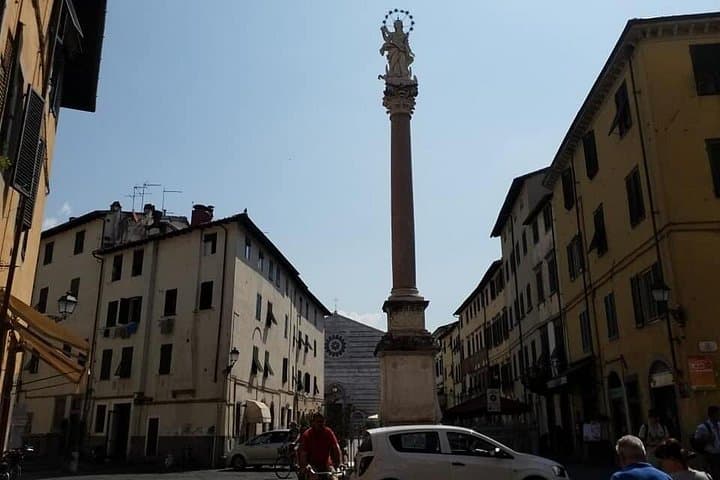


You step onto a wide, tree-lined boulevard that crowns Lucca’s circular ramparts — a walking promenade where locals cycle past and chestnut trees throw dappled shade over cobblestones.
You step onto a wide, tree-lined boulevard that crowns Lucca’s circular ramparts — a walking promenade where locals cycle past and chestnut trees throw dappled shade over cobblestones.
The two-hour walk threads the city’s layers: Roman foundations tucked into medieval fabric, Renaissance bastions rebuilt as promenades, and churches where marble and brick meet. Guides point out the Roman wall remnants at street level, then lead the group up to the earthen ramparts for sweeping views of red-tiled roofs and the cathedral spire. Inside the walls, narrow lanes open onto piazzas where cafés hum and bas-reliefs mark ancient gates.
Geology is subtle here: compacted earth and stone walls built from local sandstone and river cobbles, later reinforced in Renaissance times to resist artillery. Culturally, Lucca is proud of its independent past — once a republic — and its music heritage, with Puccini’s birthplace within easy reach.
Practical guidance: the route is flat and fully accessible, with short stair sections at some bulwarks; comfortable walking shoes are enough. Spring and fall are the most pleasant for heat-sensitive walkers; summer mornings beat the midday sun. Bring a refillable water bottle and a light layer for breezes atop the walls. Groups are small, typically under 15, so questions about architecture and city life are part of the experience.
Expect steady narration of history and architecture, quick stops at gates and platforms, and a mix of street-level archaeology and panoramic wall-top walking — a compact, informative way to read Lucca’s urban story on foot.