THE ADVENTURE COLLECTIVE® · Independent discovery and booking for outdoor travel

Drive west from Doha into a landscape of racing camels, wind-carved Mushroom Rocks and Richard Serra’s monumental steel sculptures. This 3–4 hour tour blends natural geology, living cultural practice and bold public art into a compact desert adventure.
Drive west from Doha into a landscape of racing camels, wind-carved Mushroom Rocks and Richard Serra’s monumental steel sculptures. This 3–4 hour tour blends natural geology, living cultural practice and bold public art into a compact desert adventure.
The morning air in western Qatar is flat and bright, the desert stretching low and luminous toward the Persian Gulf. You leave Doha behind and the asphalt thins; soon the road gives way to scrub and wind-carved stone. At Al Shahaniya the thud of hooves and the blur of racing camels pulls you into a living tradition—racing lines traced in sand, handlers tuning speed and stamina beneath the sun.
Verified experiences and guided adventures in the surrounding area.
Operated by Al Annabi Tourism · Zekreet, Al-Shahaniya
The morning air in western Qatar is flat and bright, the desert stretching low and luminous toward the Persian Gulf. You leave Doha behind and the asphalt thins; soon the road gives way to scrub and wind-carved stone. At Al Shahaniya the thud of hooves and the blur of racing camels pulls you into a living tradition—racing lines traced in sand, handlers tuning speed and stamina beneath the sun.
Further west the landscape alters: Mushroom Rocks rise from a plain of baked sandstone, their thin stems and broad caps shaped by millennia of wind. Nearby, the austere geometry of Richard Serra’s East–West/West–East slides into view—weathered steel planes that reframe scale and horizon against the same desert that carved the rocks.
This corridor holds layers of history: 20th-century defensive forts built of beach rock, Bedouin grazing routes, and a modern cultural push to place art in remote space. Geologically, the region is coastal sedimentary plain—soft sandstone and calcrete sculpted by wind and occasional saline runoff.
Practical guide: tours run 3–4 hours and require low fitness but high sun awareness. Leave early or late to avoid peak heat, carry at least 1.5–2 liters of water, and wear closed shoes for rocky beaches and dune edges. Respect fenced or signposted archaeological sites and follow your guide’s routes—the desert recovers slowly from vehicle tracks.
Expect open skies, abrupt shadows from Serra’s plates, and a surprising intimacy with a landscape that alternates between stillness and the quick, rhythmic life of camel racing.
The sites lie roughly 1–1.5 hours west of central Doha by car; Al Shahaniya camel track is commonly reached within that drive time.
Yes—if a race or training session is scheduled you may observe from designated areas; access varies by event and operator.
Walking is limited and informal—expect short 10–20 minute walks at each stop over uneven desert and rock surfaces.
Facilities are basic: some visitor areas and the camel track have restrooms and shaded viewing; remote sites like Mushroom Rocks have no services, so plan accordingly.
Al Annabi Tourism operates guided outdoor trips and adventures with an emphasis on safety, stewardship, and memorable experiences.
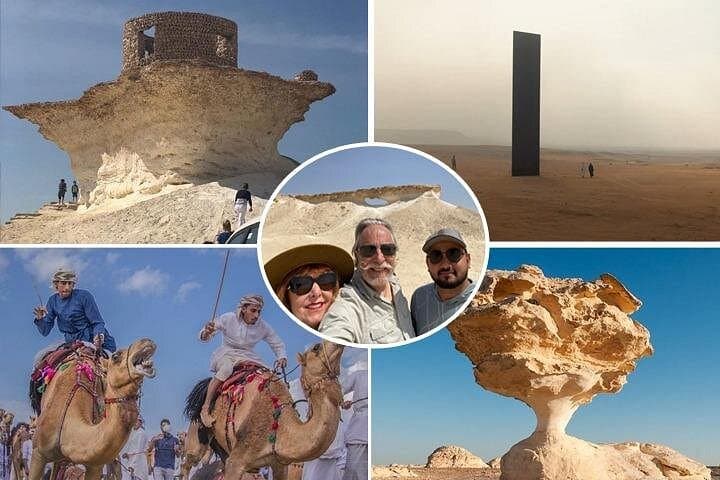


The morning air in western Qatar is flat and bright, the desert stretching low and luminous toward the Persian Gulf. You leave Doha behind and the asphalt thins; soon the road gives way to scrub and wind-carved stone. At Al Shahaniya the thud of hooves and the blur of racing camels pulls you into a living tradition—racing lines traced in sand, handlers tuning speed and stamina beneath the sun.
The morning air in western Qatar is flat and bright, the desert stretching low and luminous toward the Persian Gulf. You leave Doha behind and the asphalt thins; soon the road gives way to scrub and wind-carved stone. At Al Shahaniya the thud of hooves and the blur of racing camels pulls you into a living tradition—racing lines traced in sand, handlers tuning speed and stamina beneath the sun.
Further west the landscape alters: Mushroom Rocks rise from a plain of baked sandstone, their thin stems and broad caps shaped by millennia of wind. Nearby, the austere geometry of Richard Serra’s East–West/West–East slides into view—weathered steel planes that reframe scale and horizon against the same desert that carved the rocks.
This corridor holds layers of history: 20th-century defensive forts built of beach rock, Bedouin grazing routes, and a modern cultural push to place art in remote space. Geologically, the region is coastal sedimentary plain—soft sandstone and calcrete sculpted by wind and occasional saline runoff.
Practical guide: tours run 3–4 hours and require low fitness but high sun awareness. Leave early or late to avoid peak heat, carry at least 1.5–2 liters of water, and wear closed shoes for rocky beaches and dune edges. Respect fenced or signposted archaeological sites and follow your guide’s routes—the desert recovers slowly from vehicle tracks.
Expect open skies, abrupt shadows from Serra’s plates, and a surprising intimacy with a landscape that alternates between stillness and the quick, rhythmic life of camel racing.