THE ADVENTURE COLLECTIVE® · Independent discovery and booking for outdoor travel

Go below Kraków’s streets to a nine-century-old salt labyrinth where chapels, carvings and saline pools await. This 3-hour skip-the-line tour moves through 135 meters of underground history with practical tips on stairs, temperature and timing.
Go below Kraków’s streets to a nine-century-old salt labyrinth where chapels, carvings and saline pools await. This 3-hour skip-the-line tour moves through 135 meters of underground history with practical tips on stairs, temperature and timing.
You descend into cool, mineral-scented air and the daylight thins to a distant memory; stair after stair drops you into a carved underworld where chambers are lit like chapels and the floor sometimes glints with salt.
Verified experiences and guided adventures in the surrounding area.
You descend into cool, mineral-scented air and the daylight thins to a distant memory; stair after stair drops you into a carved underworld where chambers are lit like chapels and the floor sometimes glints with salt.
The Wieliczka Salt Mine has been worked for roughly nine centuries. What began as medieval salt extraction evolved into a network of tunnels, chapels and sculptures hewn entirely from halite. The public tourist route sits about 135 meters below ground and passes the rock-cut Chapel of St. Kinga, chapels, saline lakes and carved reliefs that reflect both miners’ devotion and local craft.
Geologically, the salt deposit formed from evaporated Permian seas; the mine’s striated walls and salt stalactites illustrate long processes of mineral deposition and human modification. Culturally the site ties to Kraków’s economic history — salt was once called “white gold” — and the mine today is a UNESCO World Heritage site and a local landmark of mining heritage.
Practical guide: the standard visit runs roughly three hours and includes steep stair sections—over 800 steps across the route—so plan for steady footing and energy. Temperatures underground are constant, usually around 14–16°C (57–61°F), and humidity is high; wear closed shoes with grip and a light layer. Tickets marked skip-the-line save waiting time but expect guided groups in multiple languages. Follow marked routes, don’t touch carvings, and save flash photography for open areas; the mine is fragile and managed to balance access with conservation.
On clear days above, combine the visit with a short trip into Wieliczka town or a tram ride back to Kraków for evening museums or pierogi.
The typical guided route lasts about 2–3 hours and involves several hundred stone steps (the full visitor route includes roughly 800 steps both down and up across multiple levels).
Access is by stairwell but there is an elevator available on special request for certain sections—contact the operator in advance to arrange accessibility options and confirm suitability.
Photography is generally allowed in most chambers but flash is discouraged or prohibited in some areas to protect salt sculptures and lighting; follow guide instructions in restricted rooms.
The mine’s air is saline and stable in temperature and humidity; some visitors report respiratory relief, but any therapeutic claims should be discussed with a medical professional if you have health concerns.
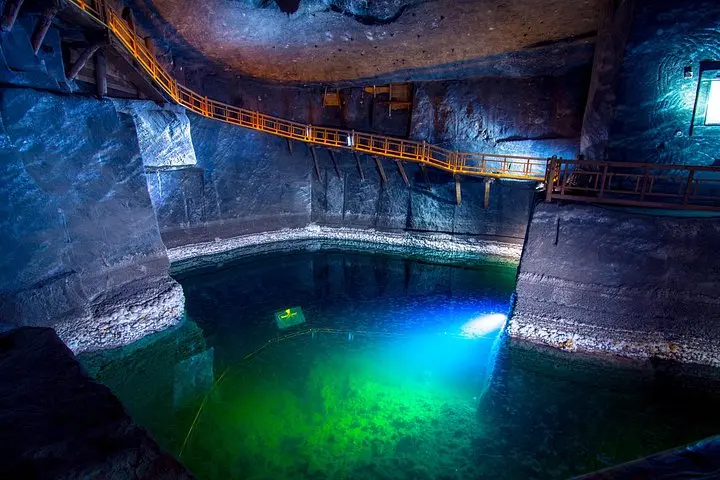
You descend into cool, mineral-scented air and the daylight thins to a distant memory; stair after stair drops you into a carved underworld where chambers are lit like chapels and the floor sometimes glints with salt.
You descend into cool, mineral-scented air and the daylight thins to a distant memory; stair after stair drops you into a carved underworld where chambers are lit like chapels and the floor sometimes glints with salt.
The Wieliczka Salt Mine has been worked for roughly nine centuries. What began as medieval salt extraction evolved into a network of tunnels, chapels and sculptures hewn entirely from halite. The public tourist route sits about 135 meters below ground and passes the rock-cut Chapel of St. Kinga, chapels, saline lakes and carved reliefs that reflect both miners’ devotion and local craft.
Geologically, the salt deposit formed from evaporated Permian seas; the mine’s striated walls and salt stalactites illustrate long processes of mineral deposition and human modification. Culturally the site ties to Kraków’s economic history — salt was once called “white gold” — and the mine today is a UNESCO World Heritage site and a local landmark of mining heritage.
Practical guide: the standard visit runs roughly three hours and includes steep stair sections—over 800 steps across the route—so plan for steady footing and energy. Temperatures underground are constant, usually around 14–16°C (57–61°F), and humidity is high; wear closed shoes with grip and a light layer. Tickets marked skip-the-line save waiting time but expect guided groups in multiple languages. Follow marked routes, don’t touch carvings, and save flash photography for open areas; the mine is fragile and managed to balance access with conservation.
On clear days above, combine the visit with a short trip into Wieliczka town or a tram ride back to Kraków for evening museums or pierogi.