THE ADVENTURE COLLECTIVE® · Independent discovery and booking for outdoor travel

Set an alarm for the small hours and head from Guilin to Xianggong Mountain for a short half-day sunrise tour. Expect dramatic karst silhouettes, a possible sea of clouds, and a concentrated photography window ideal for early risers.
Set an alarm for the small hours and head from Guilin to Xianggong Mountain for a short half-day sunrise tour. Expect dramatic karst silhouettes, a possible sea of clouds, and a concentrated photography window ideal for early risers.
A pale-blue pre-dawn gathers over the Li River as a private van snakes out of Guilin toward Xianggong Mountain. By torchlight, walkers climb a short, stepped trail and the peaks around them begin to wake—ridges first catching light, clouds pooling low like a slow-moving sea. Photographers quiet their breathing; the river below glints and the karst towers take on a sharp, sculpted profile.
Verified experiences and guided adventures in the surrounding area.
Operated by happychinatours · Yangshuo, Guangxi
A pale-blue pre-dawn gathers over the Li River as a private van snakes out of Guilin toward Xianggong Mountain. By torchlight, walkers climb a short, stepped trail and the peaks around them begin to wake—ridges first catching light, clouds pooling low like a slow-moving sea. Photographers quiet their breathing; the river below glints and the karst towers take on a sharp, sculpted profile.
Xianggong (Xianggong) Hill sits where the Lijiang River threads through classic southern China karst. The exposed limestone has been shaped over millions of years into steep cones and ridges; human history here is marked by river trade and riverside villages that long photographed this stretch of river. Locals still guide boats and farms dot the floodplain, a cultural backdrop to the sunrise ritual.
Practically, this is a short but early outing: pickup from Guilin around 3:30 a.m., a 45–90 minute drive depending on traffic, and roughly 90 minutes at the viewpoint for sunrise and photos before returning. The ascent is short but stepped, with uneven stone and some handrails. Expect cool, damp mornings and the possibility of a sea of clouds between July and December when temperature inversions are common.
Bring a headlamp, sturdy shoes, a tripod if photographing, and layered clothing—temperatures can drop before dawn. Allow time for cobbled paths and small crowds at the main viewing platforms. The reward is immediate: a vantage that lets you watch light claim the karst, the river answering in silver, and the landscape behaving like an audience to the sun.
Pickup from downtown Guilin hotels is typically around 3:30 a.m. to reach Xianggong in time for sunrise.
The ascent at Xianggong is short but involves uneven steps and stone paths; it’s classified as moderately easy but requires steady footing.
Local guides recommend July through December for the best chance of morning fog and a sea of clouds, though clear sunrises can occur year-round.
This private tour generally includes the mountain entrance ticket, private car, and guide—confirm details with the operator at booking.
happychinatours operates guided outdoor trips and adventures with an emphasis on safety, stewardship, and memorable experiences.
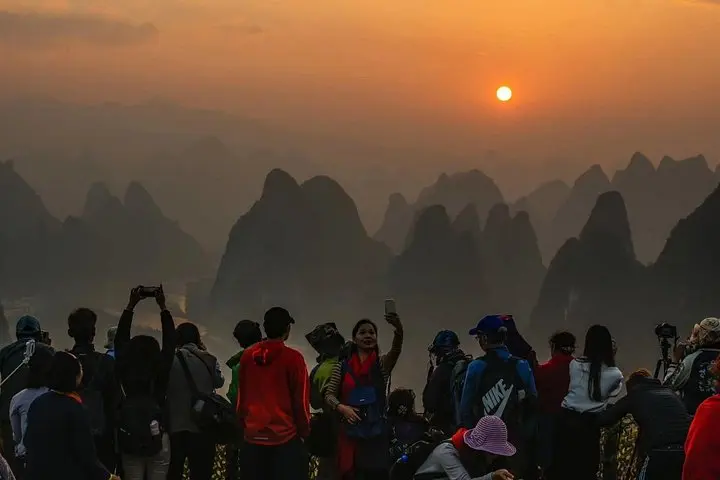



A pale-blue pre-dawn gathers over the Li River as a private van snakes out of Guilin toward Xianggong Mountain. By torchlight, walkers climb a short, stepped trail and the peaks around them begin to wake—ridges first catching light, clouds pooling low like a slow-moving sea. Photographers quiet their breathing; the river below glints and the karst towers take on a sharp, sculpted profile.
A pale-blue pre-dawn gathers over the Li River as a private van snakes out of Guilin toward Xianggong Mountain. By torchlight, walkers climb a short, stepped trail and the peaks around them begin to wake—ridges first catching light, clouds pooling low like a slow-moving sea. Photographers quiet their breathing; the river below glints and the karst towers take on a sharp, sculpted profile.
Xianggong (Xianggong) Hill sits where the Lijiang River threads through classic southern China karst. The exposed limestone has been shaped over millions of years into steep cones and ridges; human history here is marked by river trade and riverside villages that long photographed this stretch of river. Locals still guide boats and farms dot the floodplain, a cultural backdrop to the sunrise ritual.
Practically, this is a short but early outing: pickup from Guilin around 3:30 a.m., a 45–90 minute drive depending on traffic, and roughly 90 minutes at the viewpoint for sunrise and photos before returning. The ascent is short but stepped, with uneven stone and some handrails. Expect cool, damp mornings and the possibility of a sea of clouds between July and December when temperature inversions are common.
Bring a headlamp, sturdy shoes, a tripod if photographing, and layered clothing—temperatures can drop before dawn. Allow time for cobbled paths and small crowds at the main viewing platforms. The reward is immediate: a vantage that lets you watch light claim the karst, the river answering in silver, and the landscape behaving like an audience to the sun.