THE ADVENTURE COLLECTIVE® · Independent discovery and booking for outdoor travel

Drive the High Atlas, walk the ancient streets of Aït Ben Haddou and ride camels into the Zagora dunes before sleeping under a clear Saharan sky. This two-day tour blends UNESCO sites, palm-lined valleys and a night in a desert bivouac.
Drive the High Atlas, walk the ancient streets of Aït Ben Haddou and ride camels into the Zagora dunes before sleeping under a clear Saharan sky. This two-day tour blends UNESCO sites, palm-lined valleys and a night in a desert bivouac.
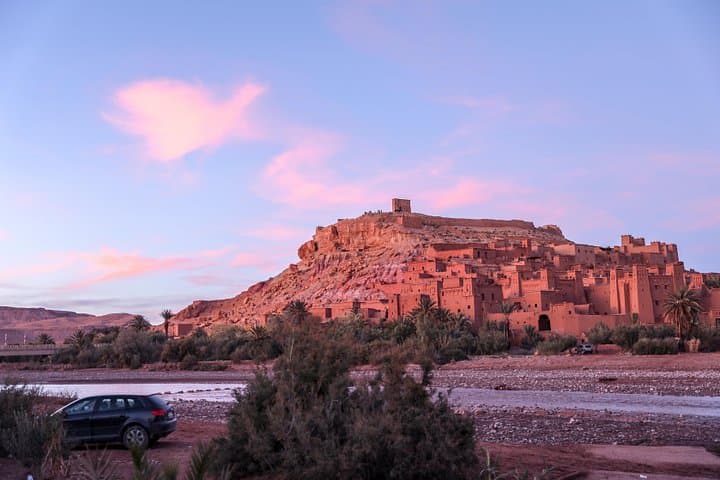
The road peels away from Marrakech before dawn, climbing switchbacks across the High Atlas where wind and rock rearrange the sky. By midday the red clay of Aït Ben Haddou appears—its mud-brick walls catching light like an old camera lens—then the route drops into the charted green of the Draa Valley and finally into the sand, where Zagora’s low dunes press against the horizon.
Verified experiences and guided adventures in the surrounding area.
Operated by Marrakech Desert Line · Zagora, Drâa-Tafilalet
The road peels away from Marrakech before dawn, climbing switchbacks across the High Atlas where wind and rock rearrange the sky. By midday the red clay of Aït Ben Haddou appears—its mud-brick walls catching light like an old camera lens—then the route drops into the charted green of the Draa Valley and finally into the sand, where Zagora’s low dunes press against the horizon.
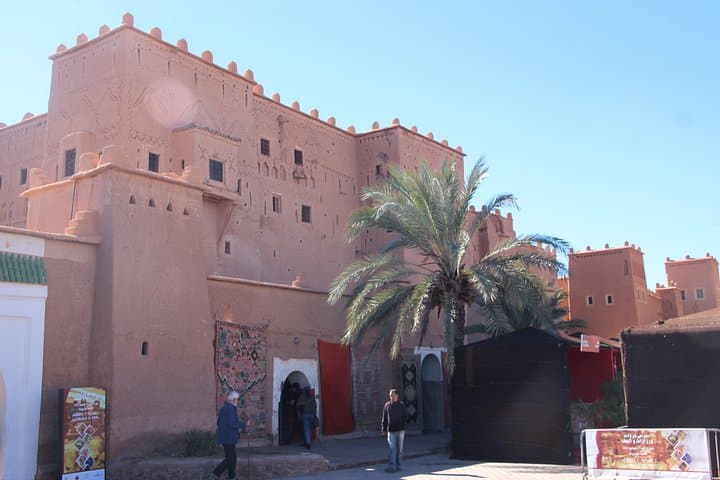
This two-day loop threads geology and human history: the Tizi n’Tichka pass (about 2,260 m) slices the Atlas with folded metamorphic rock; Aït Ben Haddou is a living example of southern Moroccan ksar architecture and a UNESCO site; the Draa Valley’s palm-lined oases mark ancient caravan routes that once carried salt and dates across the Sahara.
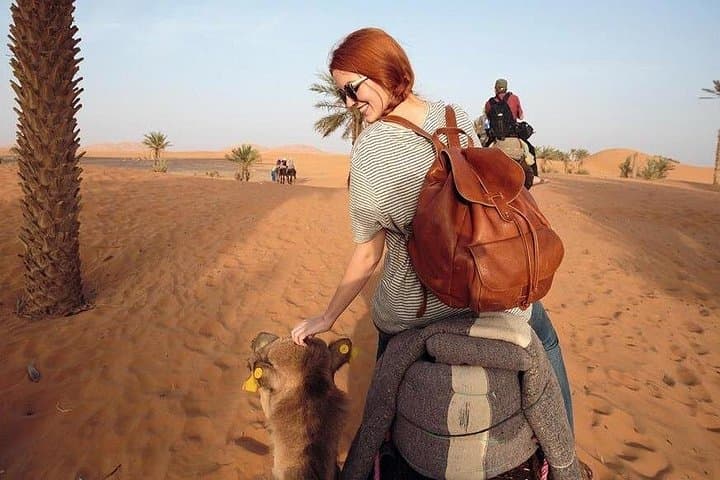
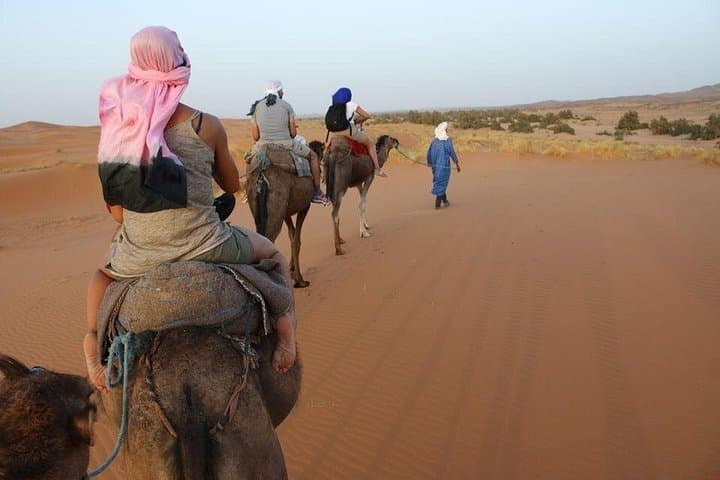
Expect terrain to shift rapidly—tarmac to gravel tracks to wind-scoured sand. The camel ride across Zagora’s dunes is roughly an hour at sunset, and sunrise returns a different color palette. Evening in the bivouac means sleeping in individual tents on desert sand, dinner by a campfire with local music and drums, and a sky that pushes its stars forward like a tide.
Practical guide: rides total many hours on paved and rural roads—prepare for two long driving segments (Marrakech→Aït Ben Haddou ~3–4 hours; Aït Ben Haddou→Zagora ~4–5 hours). Dress in layers for hot days and cold nights; bring a broad-brim hat, high-SPF sunscreen, reusable water bottle, and comfortable closed shoes for rocky stops. If you’re prone to motion sickness, sit near the front of the minibus and take antiemetics. Sunrise and sunset are the best photo windows; plan rest and hydration around those times.
The camel trek provided by the tour is about one hour, timed to coincide with sunset; a morning ride at sunrise is typically available the next day.
Accommodations are in a standard Berber desert camp with individual tents; private tents are often available as an optional upgrade.
The itinerary notes it’s suitable for most fitness levels, but camel riding and sleeping on sand are not recommended for travelers with serious spinal issues—check with the operator for accommodations for children or mobility concerns.
Expect about 7–9 hours of driving spread over two days: Marrakech to Aït Ben Haddou (~3–4 hours) and onward to Zagora (~4–5 hours), plus the return via Ouarzazate and Tizi n’Tichka.
Marrakech Desert Line operates guided outdoor trips and adventures with an emphasis on safety, stewardship, and memorable experiences.
The road peels away from Marrakech before dawn, climbing switchbacks across the High Atlas where wind and rock rearrange the sky. By midday the red clay of Aït Ben Haddou appears—its mud-brick walls catching light like an old camera lens—then the route drops into the charted green of the Draa Valley and finally into the sand, where Zagora’s low dunes press against the horizon.
The road peels away from Marrakech before dawn, climbing switchbacks across the High Atlas where wind and rock rearrange the sky. By midday the red clay of Aït Ben Haddou appears—its mud-brick walls catching light like an old camera lens—then the route drops into the charted green of the Draa Valley and finally into the sand, where Zagora’s low dunes press against the horizon.
This two-day loop threads geology and human history: the Tizi n’Tichka pass (about 2,260 m) slices the Atlas with folded metamorphic rock; Aït Ben Haddou is a living example of southern Moroccan ksar architecture and a UNESCO site; the Draa Valley’s palm-lined oases mark ancient caravan routes that once carried salt and dates across the Sahara.
Expect terrain to shift rapidly—tarmac to gravel tracks to wind-scoured sand. The camel ride across Zagora’s dunes is roughly an hour at sunset, and sunrise returns a different color palette. Evening in the bivouac means sleeping in individual tents on desert sand, dinner by a campfire with local music and drums, and a sky that pushes its stars forward like a tide.
Practical guide: rides total many hours on paved and rural roads—prepare for two long driving segments (Marrakech→Aït Ben Haddou ~3–4 hours; Aït Ben Haddou→Zagora ~4–5 hours). Dress in layers for hot days and cold nights; bring a broad-brim hat, high-SPF sunscreen, reusable water bottle, and comfortable closed shoes for rocky stops. If you’re prone to motion sickness, sit near the front of the minibus and take antiemetics. Sunrise and sunset are the best photo windows; plan rest and hydration around those times.