THE ADVENTURE COLLECTIVE® · Independent discovery and booking for outdoor travel

A concise two-hour guided walk through Zermatt’s historic lanes, barns, and viewpoints offering classic Matterhorn views. This small-group tour emphasizes local history, architecture, and quieter alleys away from the busiest streets.
A concise two-hour guided walk through Zermatt’s historic lanes, barns, and viewpoints offering classic Matterhorn views. This small-group tour emphasizes local history, architecture, and quieter alleys away from the busiest streets.
Arrive at Zermatt’s car-free train station and the mountain town opens like a map: cobbled lanes, wooden barns, and the Matterhorn keeping a slow, immovable watch above the rooftops.
Verified experiences and guided adventures in the surrounding area.
Operated by SwissTravelGuide.ch · Zermatt, Valais
Arrive at Zermatt’s car-free train station and the mountain town opens like a map: cobbled lanes, wooden barns, and the Matterhorn keeping a slow, immovable watch above the rooftops.
This two-hour small-group walk threads through the village’s oldest alleys, passes century-old stone barns and flat-stone roofs, and climbs to a compact viewpoint where the Matterhorn fills the frame. Guides point out architectural details unique to Valais — heavy timber beams, engraved lintels — and recount the era when mule trains and early alpine climbers shaped Zermatt’s identity.
Geologically, Zermatt sits at the toe of dramatic uplift: the Matterhorn’s horned ridge is a remnant of continental collision, its flanks of gneiss and schist weathered into sharp faces. Culturally, the village mixes alpine farming roots with international mountaineering lore; the mountaineers’ cemetery is a quiet chapter in that story, honoring early climbers who pushed the limits here.
Practical guidance: the route is short, mostly paved or compact gravel, suitable for all fitness levels but with uneven alleys and a few steps. Expect crowds on the main shopping street; the guide deliberately diverts to quieter lanes to show hidden features. Wear sturdy walking shoes, dress in layers for rapid alpine weather shifts, and carry water—shops are frequent but queues can be long in summer. Aim for morning or late afternoon to avoid peak tour groups and to catch cleaner light on the Matterhorn. Photography is a highlight; binoculars reward glimpses of glacier crevasses and distant ridgelines. Respect signs at the cemetery and private properties—Zermatt’s charm depends on careful stewardship.
The walk starts and ends at Zermatt train station; it’s timed to meet incoming travelers and to make the most of the village layout.
Yes—stroller-accessible streets are used on this route, but expect some cobbles and short steps; children must be accompanied by an adult.
Guides take you to a viewpoint designed for the classic Matterhorn photo, but visibility depends on weather; mornings and late afternoons often give the clearest views.
Portions of Zermatt are flat and accessible, but some older alleys and viewpoints have steps—check with the operator about specific accessibility needs before booking.
SwissTravelGuide.ch operates guided outdoor trips and adventures with an emphasis on safety, stewardship, and memorable experiences.
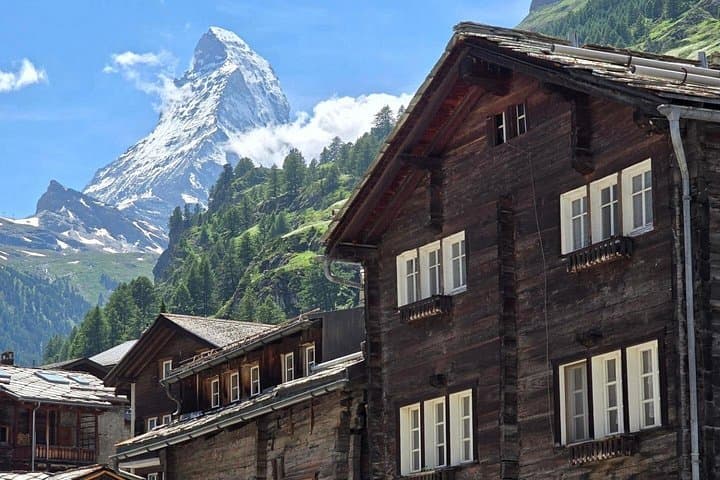


Arrive at Zermatt’s car-free train station and the mountain town opens like a map: cobbled lanes, wooden barns, and the Matterhorn keeping a slow, immovable watch above the rooftops.
Arrive at Zermatt’s car-free train station and the mountain town opens like a map: cobbled lanes, wooden barns, and the Matterhorn keeping a slow, immovable watch above the rooftops.
This two-hour small-group walk threads through the village’s oldest alleys, passes century-old stone barns and flat-stone roofs, and climbs to a compact viewpoint where the Matterhorn fills the frame. Guides point out architectural details unique to Valais — heavy timber beams, engraved lintels — and recount the era when mule trains and early alpine climbers shaped Zermatt’s identity.
Geologically, Zermatt sits at the toe of dramatic uplift: the Matterhorn’s horned ridge is a remnant of continental collision, its flanks of gneiss and schist weathered into sharp faces. Culturally, the village mixes alpine farming roots with international mountaineering lore; the mountaineers’ cemetery is a quiet chapter in that story, honoring early climbers who pushed the limits here.
Practical guidance: the route is short, mostly paved or compact gravel, suitable for all fitness levels but with uneven alleys and a few steps. Expect crowds on the main shopping street; the guide deliberately diverts to quieter lanes to show hidden features. Wear sturdy walking shoes, dress in layers for rapid alpine weather shifts, and carry water—shops are frequent but queues can be long in summer. Aim for morning or late afternoon to avoid peak tour groups and to catch cleaner light on the Matterhorn. Photography is a highlight; binoculars reward glimpses of glacier crevasses and distant ridgelines. Respect signs at the cemetery and private properties—Zermatt’s charm depends on careful stewardship.