
What the day feels like
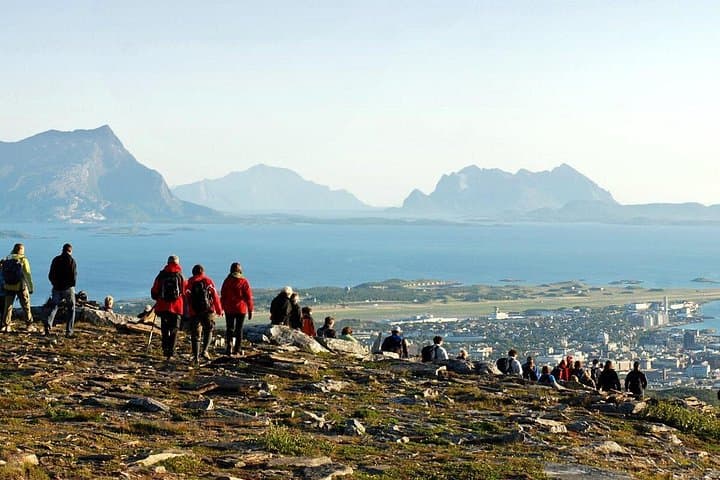
The stairs rise like a quiet challenge, each slab set with the care of hands that know mountains. Wind slips over the ridge and dares you forward. Below, Bodø is a bright scatter of streets and harbor light; ahead, the plateau of Keiservarden leans into an endless sky. In summer, the sun refuses to set, an orange coin rolling along the horizon while the sea below breathes and the islands hold their silhouettes. It’s simple, efficient, and deeply satisfying—a climb anyone with a little grit can manage, rewarded with a panorama that reads like a compass for Northern Norway.
Keiservarden’s numbers are modest—366 meters above sea level with roughly 300–350 meters of elevation gain and a round-trip distance that ranges from 4 to 6 kilometers depending on route. But its personality is large. The mountain sits in Bodømarka, the city’s green belt of trails and bogs and blueberry thickets, where weather always has the last word and the wind plays messenger between fjord and sky. The standard path follows Sherpa-built stone steps installed in 2016, a durable staircase that has saved the hillside from the erosion of countless boots. Each flat tread turns your effort into rhythm—no knee-high lunges, no loose scree—just a steady ascent past scrubby birch, heather, and the kind of clean coastal air you only get this far north.
There’s history tucked into the name. Keiservarden translates to “the Emperor’s cairn,” a nod to Kaiser Wilhelm II, who visited Bodø in the late 19th century and allegedly climbed to this vantage point. You can see why he would. To the west is the dark, distinct line of the Lofoten archipelago; on exceptional days you might even pick out far-flung Værøy and Røst standing guard on the Atlantic’s edge. To the east, the serrated skyline of the Børvasstindan range, sculpted by ice and time, rises in a serried rank of peaks running toward the Swedish border. Landegode Island anchors the view like a granite ship.
Geology does the talking up here. The coast around Bodø is a collage of gneiss and granite shaped by glaciers that raked this land into smooth rock, shallow tarns, and skerries. The sea pushes forward; the islands hold their ground. On the summit, you stand at 67 degrees north, inside the Arctic Circle, where the earth’s tilt writes the rules for light. From early June to mid-July, the Midnight Sun glides around the horizon without ever sinking—an all-night golden hour that can turn a casual hike into a quiet, luminous epic. By September, the tables turn: darkness returns and the northern lights sometimes sweep over the plateau in neon brushstrokes.
Culturally, this is Bodø’s backyard classic. Families, trail runners, and first-time visitors share the path. Bodø itself buzzes with creative momentum; it was the European Capital of Culture in 2024, a year that amplified the city’s music, art, and food scenes. Locals come up here for the head-clearing view and bring thermoses to linger. It’s a climb that gets under your skin because it’s so straightforward—stone, wind, water, horizon—an honest progression of elements.
Most visitors start at Turisthytta on Rønvikfjellet or the Maskinisten parking area. Both routes are well-marked and quick to gain height. You’ll step from mossy forest into open heath, then onto rock slabs where the wind finds you and doesn’t let go. The summit plateau opens like a deck. A cairn and trig point mark the high spot, but the real reward is the 360-degree sweep of coastline and range. Bring an extra layer even on warm days; the wind has its own agenda.
The hike’s practicality is part of its charm. You don’t need alpine experience, just sturdy footwear, weather-aware layers, and water. The stairs make the ascent friendly to steady walkers and families with patient kids. On wet days, the stone can be slick; in winter, ice demands traction devices. Otherwise, the trail is a model of smart, sustainable design—the Sherpa craftsmanship disperses foot traffic and protects the hillside, a lesson in how to invite more people outside without loving a place to death.
Time your visit to the weather and the light. On clear summer evenings, start late and catch the midnight glow. In shoulder seasons, aim for morning or early afternoon when winds can be gentler. Winter is absolutely possible with microspikes, headlamp, and respect for ice; the payoff is a deep-blue Arctic dusk and the chance of aurora if the clouds lift. Whatever the season, the city is never far—ten minutes’ drive from central Bodø and you’re on the steps, a rare blend of urban convenience and wild horizon.
The broader region deepens the experience. A short drive from Bodø, the world’s strongest tidal current, Saltstraumen, roars to life every six hours, a reminder that water rules here. Beaches like Mjelle—a patchwork of red and white sand—offer a softer counterpoint to the rock. And everywhere, sea eagles ride the wind. Keiservarden ties it all together from a single, accessible vantage point. Come for the view; stay for the way the place resets your sense of scale.
In the end, the mountain asks only for your attention and your care. Stay on the stone to protect the delicate heather. Pack out what you bring. Let the wind push your thoughts clean. Up here, the city is a quiet geometry and the ocean is a steady pulse—the kind of perspective you’ll carry home, long after your boots have cleaned of the Arctic grit.
Trail wisdom
Small choices, better day.
Time it for the Midnight Sun
From early June to mid-July, begin your hike after 9 p.m. to catch all-night golden light and fewer crowds.
Windproof is Non-Negotiable
Even in summer, the summit can be gusty—pack a shell and light gloves to enjoy the views longer.
Use the Sherpa Steps
Stick to the stone staircase to reduce erosion and avoid slick moss on side paths, especially after rain.
Park Smart at Maskinisten or Turisthytta
These are the easiest access points with clear signage; arrive early on sunny days as spaces fill quickly.
Local knowledge
Read the place, not just the route.
Watch for native species including White-tailed sea eagle, Willow ptarmigan.
Keep an eye out for wildlife during the transition between areas and habitats. Respect distance guidelines.
Stick to the stone staircase and marked paths to protect fragile heather and crowberry mats; pack out all trash and minimize noise during bird nesting season.
Follow the guide's instructions on size limits, ethical handling, and leave-no-trace practices.
Mjelle Beach’s red-and-white sands north of Bodø for a post-hike stroll. Hovdsundet cove, a lesser-known turquoise inlet reachable by a short coastal hike
Locally recommended viewpoints and quiet spots known best to local operators.
Keiservarden—“the Emperor’s cairn”—is named after Kaiser Wilhelm II, who visited Bodø in the late 19th century; the stone steps were built by Nepali Sherpas in 2016 to curb erosion.
Maritime roots and regional tradition shape the waterways and working coasts.
Seasonal guide
Four versions of the same landscape.
Spring
Best forQuieter trails · Crisp visibility
ChallengesLingering snow patches · Unpredictable wind
April–May brings thaw and clear views; expect mixed surfaces with occasional ice in shaded sections.
Summer
Best forMidnight Sun hikes · Longest daylight
ChallengesCrowds on fair-weather evenings · Persistent wind
June–August delivers endless light and the cleanest vistas—pack layers and plan for late-night starts.
Fall
Best forNorthern Lights chances · Colorful tundra
ChallengesSlippery rock after rain · Rapidly shortening days
September–October offers rich color and aurora potential; bring headlamp and traction if temps drop.
Winter
Best forBlue-hour photography · Snowy solitude
ChallengesIce on steps · Cold, gusty conditions
November–March can be stark and beautiful; microspikes and warm layers make the hike realistic and safe.
Pack with intention
What to bring.
Good to know
Common questions.
Most routes take 2–3 hours round-trip for steady walkers, but plan 3–4 hours with breaks and photos.
Plan the edges
The details that make the day easier.
Bodø lies just north of the Arctic Circle and was the European Capital of Culture in 2024—the first city above the Arctic Circle to hold the title.
Celebrate the summit with a harborfront meal at Bryggerikaia or craft beer at Hundholmen Brygghus. Coffee at Melkebaren fuels early starts, while Bådin Brewery pours local favorites. If you’ve got extra time, catch a concert at Stormen Konserthus and watch the coastal light change through its glass façade.
- Closest airport
- Bodø (BOO), 2 km from city center. Trailheads: Turisthytta or Maskinisten (about 10 minutes’ drive from central Bodø). Cell service: Generally good the entire route. Permits: None required. Parking: Free but limited on good-weather days—arrive early or late.
The Sherpa steps were built to protect fragile tundra—keep to the stone, avoid shortcutting switchbacks, and give nesting birds space. Pack out everything, including food scraps.
Explore by topic
Follow the threads.
Keep exploring
Make the story part of the trip.
 Related story
Less than two hours from Nairobi, Kereita Forest pairs hands-on canopy adventure with quiet montane trails and a sobering colonial history—perfect for families, teams, and curious travelers seeking a full-day pulse of nature.
Set out from Bass Harbor for a private, customizable day on Blue Hill Bay — lighthouses, puffins, seals, and the chance to feel Acadia from the water. Small groups, local captains, unforgettable views.
In four hours you can move from shaded canyon ferns to wind-scoured coastal ridgelines, guided by someone who knows where the light—and the hidden views—live. This private half-day hike on the Monterey Peninsula or Big Sur is compact, curated, and perfect for travelers who want depth without a multiday commitment.