
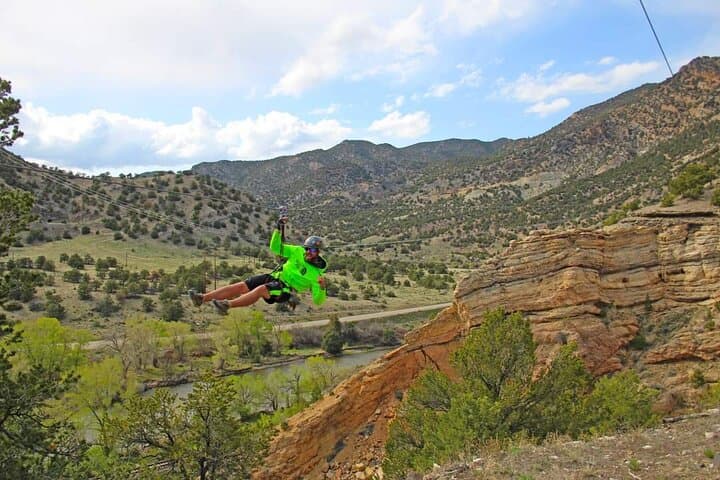
What the day feels like
The guide clips your harness and asks a simple question: ready to fly? The canyon answers with wind—dry, cold, and insistent at eight thousand feet—slipping between pines and stone. You step onto a wooden launch platform that hangs like a porch on the rim of an ancient cut in the earth. Below, the canyon floor narrows into a braided ribbon of shadow; ahead, steel cable fades into distance. Then gravity takes over and the world contracts into speed, view, and the steady voice of a guide. Forty seconds later you land at a treetop station, palms pounding, grin locked in place. This is Buena Vista’s Lost Canyon Zipline Tour: short in duration but calibrated to make you feel like you’ve stolen a stretch of sky.
The zipline’s adrenaline is the headline, but the story around it is geological and human. You are in the Arkansas River Valley, where the Sawatch Range lifts the Collegiate Peaks—Mounts Harvard, Yale, Princeton—into Colorado’s spine. Millennia of glacial carving and river incision gave the canyon its bones; human history added texture. The valley’s mining and ranching past still hums in town centers and backroad fences. Today, adventure tourism is part of the economy, and operators frame the thrills with interpretation: guides point out wildflower patterns, nest sites, and the telltale scars of ancient floods on canyon walls.
Aerial travel in Buena Vista feels distinct from merely ‘doing a zipline.’ The route is designed for variety—short bursts that rattle the legs, a few long runs that let you settle into speed, and tree-to-tree landings that require a steady step. Guides are educators as much as safety managers; expect concise natural-history briefings about conifers, the role of alpine runoff, and the drama of sedimentary layering visible in canyon walls. The operation leans into eco-adventure ideals—a relatively low-impact activity that gets you into sensitive areas without building roads or congesting popular trails.
Logistics are tidy: the tour is a two-hour block from check-in to finish, with an advertised starting price from $120 and instant confirmation available at booking. It’s family-friendly in tone, though physical requirements and any age/weight restrictions vary by operator and should be verified at reservation. The experience is easy to participate in—harnessed safety equipment, guided instruction, and mostly short walks between platforms—but it’s also a concentrated exposure to elevation and sun. Even if the mechanics feel simple, altitude and temperature swings change the equation.
Why travelers choose this slice of Colorado is practical as much as picturesque. Buena Vista is compact and earnest—an outdoors-friendly town with outfitters, a good brewery, and proximity to river rafting and alpine trails. You can pair a morning on the cables with an afternoon float on the Arkansas or a soak at Cottonwood Hot Springs. For photographers, the zipline offers frames that mix scale with intimacy: long lines against mountain skyline, candid faces mid-flight, and the textured geology of canyon walls framed by pine.
Planning advice is straightforward. Book early in summer and early fall; weekends fill, and the company offers private or small-group options. Dress in layers—the sun can be fierce on the platforms, while shade in the canyon brings a hard, cool wind. Closed-toe shoes that grip and stay on during a run are essential. Bring a small hydration bladder or water bottle, and leave phone pockets zipped; many operators allow small cameras but not unsecured phones. Morning slots tend to have calmer winds and softer light for photos; late afternoon can be dramatic but occasionally gustier.
The experience is accessible to a wide range of travelers. If you’re a first-timer, the low-stress instruction and guided nature of the tour make it a natural introduction to aerial adventure. If you’re a seasoned adrenaline junkie, the combination of speed, set against the Rockies’ scale, will satisfy that appetite without requiring technical climbing skills. And for families or mixed-ability groups, the staggered platform design and attentive guides make it possible to share the moment even if members choose different comfort levels.
On the conservation front, the Lost Canyon Tour’s footprint is small relative to bigger infrastructure projects, but it sits in a delicate watershed. Guides will often request that guests stick to platforms and marked approaches to avoid trampling understory and disrupting nesting birds. Responsible operators also use brief interpretive moments to explain local ecology—how mountain runoff shapes river systems downstream, and why native plant communities are fragile at high elevation.
When you step back into Buena Vista after the tour—boots dusty, adrenaline settling into a pleased ache—there’s a short list of local rituals. Buy a pint at Eddyline Brewery, whose taproom vibes with outdoorsy locals and travelers swapping beta on runs downstream. If you’ve got time, head to Cottonwood Hot Springs or take a river float near Salida the next day. The zipline is best understood not as a stand-alone thrill but as an access point: a way to map the larger landscape of the Arkansas Valley in a compact, high-energy two hours.
Practical bottom line: the Lost Canyon Zipline Tour distills Colorado’s big-sky drama into a contained, safe, and interpretive adventure. It’s not a mountaineering expedition or a multi-day backcountry quest, but it will alter your perspective—literally—and give you a new way to read the landscape. Whether you come for the rush, the views, or the ease of a guided, nature-forward outing, the cables here are a good investment of an afternoon in Buena Vista’s outdoor calendar.
Trail wisdom
Small choices, better day.
Layer for altitude
Temperatures can swing dramatically between sunlit platforms and shaded canyon steps—bring a light insulating layer you can stash in a small pack.
Secure loose items
Use zippered pockets or an approved strap for cameras; unsecured phones and hats are easy to lose at speed.
Hydrate before you fly
High elevation and excitement increase dehydration risk—drink water before arrival and carry a small bottle if allowed.
Choose morning runs for calmer winds
Morning slots typically offer steadier winds and softer light for photos; afternoons can be windier and cooler in the canyon.
Local knowledge
Read the place, not just the route.
Watch for native species including Mule deer, Red-tailed hawk.
Keep an eye out for wildlife during the transition between areas and habitats. Respect distance guidelines.
Operators emphasize low-impact access—stay on marked approaches, avoid trampling understory, and pack out waste to protect sensitive high-elevation plant communities.
Follow the guide's instructions on size limits, ethical handling, and leave-no-trace practices.
Cottonwood Hot Springs – natural pools for a post-flight soak. Arkansas River overlooks just outside town for sunset photography
Locally recommended viewpoints and quiet spots known best to local operators.
Buena Vista grew as a supply and transit hub during Colorado’s mining era and later evolved into an outdoor-recreation gateway for the Arkansas River Valley.
Maritime roots and regional tradition shape the waterways and working coasts.
Seasonal guide
Four versions of the same landscape.
Spring
Best forEarly wildflower viewing · Avoiding peak crowds
ChallengesPossible snow at high-elevation platforms · Unpredictable spring winds
Late spring offers melting snow and early green-up, but runs can be affected by lingering cold and variable winds—dress warmly and check conditions.
Summer
Best forWarm weather comfort · Extended daylight · Family visits
ChallengesAfternoon thunderstorms · High daytime temps and sun exposure
Summer is peak season with reliable operations and long days; expect busy tours and plan for sun protection and early starts to avoid storms.
Fall
Best forClear skies and stable winds · Fall color in the valley
ChallengesCooler temperatures · Shorter daylight hours
Early fall provides crisp air, clearer views, and fewer crowds—layer up for cool mornings and savor the golden valley light.
Winter
Best forOff-season tranquility · Unique snowy vistas
ChallengesCold, potential closures from snow/ice · Limited schedule and availability
Winter operations vary; when open, the snowy landscape makes for dramatic flights but expect colder conditions and reduced frequency.
Operator details
What the booking data adds.
Included
- ✓Helmets and harnesses are provided
Good to know
- ✓Not recommended for travelers with spinal injuries
- ✓Not recommended for pregnant travelers
- ✓Not recommended for travelers with poor cardiovascular health
- ✓Suitable for all physical fitness levels
Pack with intention
What to bring.
Good to know
Common questions.
The advertised total duration is approximately 2 hours, which includes safety briefings, gearing up, and multiple zipline runs.
Plan the edges
The details that make the day easier.
The Arkansas River, which runs through Buena Vista, is one of the major rivers that begins in Colorado’s Sawatch Range and is a primary tributary of the Mississippi River system.
After the tour, head to Eddyline Brewery for a post-flight pint and local chatter; for a restorative soak, drive a short way to Cottonwood Hot Springs. Dinner options in town tend toward hearty mountain fare and fresh, locally driven menus.
- Closest major airports
- Colorado Springs (approx. 2–2.5 hours) or Denver (approx. 3 hours). Meeting point: Buena Vista central area; driving distances vary by operator. Cell service: generally available in town, patchier in the canyon. Permits: none required for the zipline itself; check guide notes for access details.
This zipline emphasizes low-impact access—respect marked paths, avoid disturbing wildlife or nesting sites, and pack out all trash to preserve high-elevation habitat.
Explore by topic
Follow the threads.
Keep exploring
Make the story part of the trip.
 Related story
Less than two hours from Nairobi, Kereita Forest pairs hands-on canopy adventure with quiet montane trails and a sobering colonial history—perfect for families, teams, and curious travelers seeking a full-day pulse of nature.
Set out from Bass Harbor for a private, customizable day on Blue Hill Bay — lighthouses, puffins, seals, and the chance to feel Acadia from the water. Small groups, local captains, unforgettable views.
In four hours you can move from shaded canyon ferns to wind-scoured coastal ridgelines, guided by someone who knows where the light—and the hidden views—live. This private half-day hike on the Monterey Peninsula or Big Sur is compact, curated, and perfect for travelers who want depth without a multiday commitment.