
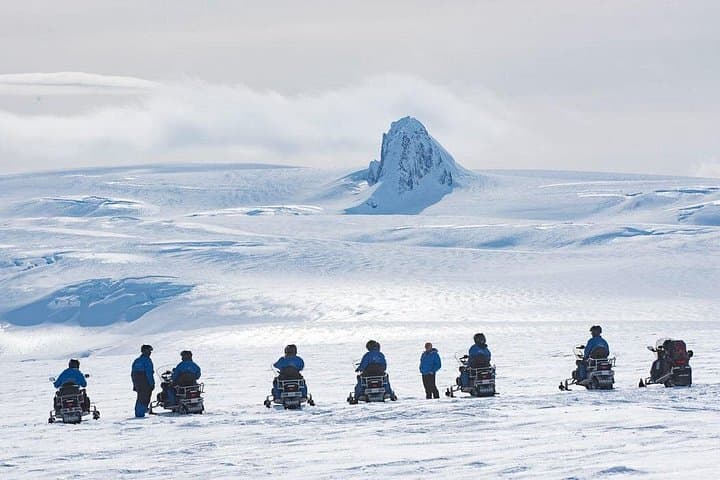
What the day feels like
The first time the skis bite into the silence of Vatnajökull, it feels like stepping into a world that has been waiting, patient and indifferent. Engines cough to life, and the white expanse answers with a hiss—snow flung in ridged arcs, a cold wind that seems to test your layering. You pull a glove tighter, lift your chin against a spray of diamond flakes, and the guide nods: forward. For three hours you ride across Europe’s largest ice cap, perched on a snowmobile that turns the vastness into a terrain of immediate choices—sweep left into a basin, crest a wind-polished ridge, slow and listen to the glacier’s distant groan.
This is the kind of adventure that feels both elemental and engineered. The route used by local operators carves through moraines and ancient flows, giving drivers short bursts where speed sings and quieter stretches where the landscape reveals the layered history of fire and ice. Vatnajökull is not a featureless sheet; crevasses lace the surface, ice has folded and been pushed into ridgelines by the convulsions of subterranean volcanoes, and dust brought from the highlands gives some slopes a bronze sheen beneath the snow. An experienced guide reads those signs the way a mountaineer reads weather.
History and geology lend texture to the ride. The glacier sits atop a dozen active volcanoes—Grímsvötn and Bárðarbunga among them—so what looks like a serene field carries the memory of eruptions that have reshaped ice and coastline. The name Vatnajökull itself translates to “water glacier,” a reminder that beneath the white is constant motion. Local fishing and farming communities in the Höfn area learned generations ago to pattern their seasons around the glacier’s moods; today, tourism blends with those rhythms, and guided snowmobile tours offer an access point that is both thrilling and interpretive.
Culture here is compact and direct. Höfn, the town that acts as gateway, lives by the sea and the skerries, famous for langoustine plates you’ll want after a long day of cold. Guides are often born in these fjords or have lived here long enough to tell stories about volcanic winters, about roads cut by floodwater, and about the stubborn hospitality that greets exhausted travelers—hot soup, fresh rye, and a local beer shared over a map of the next day’s route.
Practicality sits next to romance in any decent glacier story. This snowmobile tour is a three-hour, guided experience—long enough to feel like a short expedition, short enough that fatigue is never a real hazard. A valid driver’s license is required; tours typically pair riders two-to-a-sled, and the combined weight limit for two riders is 180 kg (390 lbs). If you’re traveling solo or have an odd-numbered group, plan for at least one solo rider—operators charge an additional fee for single riders, paid at the base camp. Safety gear, including helmets and guide briefings, come standard, and experienced guides set the route with crevasses and weather in mind.
If you’re thinking of booking, a sensible plan will make the outing better. Book early in winter months—this tour is popular and labeled as likely to sell out. Dress in layers: a windproof outer shell, insulated mid-layers, and a moisture-wicking base layer; bring goggles and a balaclava for windburn; and keep a small pack with snacks and an insulated water bottle. Guides will tell you to keep phone batteries warm—cold drains them fast—and to arrive with full camera memory cards; Vatnajökull’s light is cinematic, with low-angle suns that turn ice into luminous blue-green.
For first-timers, the learning curve is gentle. Instructors walk you through the controls, and most people find the machines responsive and forgiving. That said, this is motorized terrain: respect speed, follow the guide’s line across soft snow and hard-packed passes, and never attempt to veer off into unknown rifts. When the group stops mid-ride for photos, the quiet that falls over the glacier is almost absolute—an unexpected, humbling counterpoint to the exhilaration of driving.
Book through reputable operators and read cancellation and weight policies carefully; many companies offer instant confirmation but hold firm to safety-related rules. If you want local expertise and a straightforward booking path, this snowmobile tour on Vatnajökull provides exactly that: glacier time, guide storytelling, and a tightly run logistics package that gets you out and back to Höfn with memories (and photos) that still smell faintly of diesel and hot chocolate.
After the ride, treat yourself to Höfn’s culinary specialty—langoustine prepared at a harbor-side restaurant—and walk the seawall as the light softens. The glacier itself will still be there tomorrow, a slow, indifferent giant; your ride across it is the rare kind of travel that balances pulse and perspective.
To book and learn more about routes, gear, and availability, check local guides and operators and consider reserving early—this experience fills quickly during peak winter months. For a solid, well-run option close to Höfn, see this guided snowmobile tour on Vatnajökull for times and booking details: <a href="https://app.advcollective.com/local-experts/snowmobile-on-vatnajokull-glacier-3-hour-guided-tour-from-hofn">snowmobile tour on Vatnajökull</a>. Whether you come for speed, photos, or the sheer scale, you’ll leave with a clearer sense of how glaciers shape landscapes—and the people who live beside them.
Trail wisdom
Small choices, better day.
Layer for the cold
Windproof outer shell and insulated mid-layers are essential—temperatures on the glacier are several degrees colder than coastal Höfn.
Respect the weight limits
Two riders per sled must be 180 kg / 390 lbs or less; book a solo rider if your group exceeds that to meet safety rules.
Protect your camera gear
Keep batteries warm and bring a dry, insulated case—cold drains batteries and lens fogging is common when moving from warm to cold.
Follow your guide's line
Guides choose routes to avoid crevasses and unstable ice—stay in formation and don’t pass without instruction.
Local knowledge
Read the place, not just the route.
Watch for native species including Arctic fox (rare, distant sightings), Seabirds such as Arctic terns and eiders along the coast.
Keep an eye out for wildlife during the transition between areas and habitats. Respect distance guidelines.
Tours limit routes to reduce ice and moraine disturbance; operators follow strict cleanup policies and advise guests to avoid trampling sensitive glacial margins.
Follow the guide's instructions on size limits, ethical handling, and leave-no-trace practices.
Drive the coastal road to Vestrahorn at sunrise for dramatic peaks mirrored in black sand. Visit the small fishing museum in Höfn to understand the town’s maritime heritage
Locally recommended viewpoints and quiet spots known best to local operators.
Vatnajökull has shaped local livelihoods for centuries; the glacier’s periodic flooding (jökulhlaups) prompted local adaptations in infrastructure and settlement patterns.
Maritime roots and regional tradition shape the waterways and working coasts.
Seasonal guide
Four versions of the same landscape.
Spring
Best forLonger daylight · Stable snowpack for riding
ChallengesVariable melt conditions · Increased glare
Late winter to early spring offers longer days and stable snow, but warming can create slushy patches—goggles and layered dry clothing are key.
Summer
Best forIce-surface exploration via specialized tours · Photography of exposed glacial features
ChallengesReduced snow cover, tours vary · Must use adapted vehicles
Summer tours run less frequently and often require specialized equipment; routes are adjusted to the season and can reveal moraine and ice features not visible in winter.
Fall
Best forFewer crowds · Aurora-viewing potential
ChallengesShorter daylight · Rapid weather shifts
Autumn brings crisp air and fewer visitors, but weather can change quickly—book with a flexible schedule and expect early sunsets.
Winter
Best forClassic snowmobiling conditions · High likelihood of full snow coverage
ChallengesCold, potential whiteouts · Short daylight hours in mid-winter
Peak winter delivers the most dependable snow cover and classic glacier-safari scenery, but be prepared for sub-zero temps and limited daylight windows.
Operator details
What the booking data adds.
Included
- ✓Wind and waterproof insulated overalls
- ✓Bandanas / Neck warmers
- ✓Gloves
- ✓Air-conditioned vehicle
- ✓Helmets
- ✓Guide
Not included
- —.
Good to know
- ✓Wheelchair accessible
- ✓Service animals allowed
- ✓Public transportation options are available nearby
- ✓Not recommended for pregnant travelers
- ✓Suitable for all physical fitness levels
- ✓A valid driver’s license is required to operate the snowmobile.
- ✓Participants combined weight on one snowmobile MUST be 180kg / 390lbs or less. If your combined weight exceeds 180kg / 390lbs you need to book single snowmobiles. The standard version of our snowmobile tour has two persons riding on one snowmobile.
- ✓The standard version of our snowmobile tour has two persons riding on one snowmobile. However, if you are travelling solo or in an odd number group 1, 3, 5, etc., you need to book at least one solo rider. Additional cost for 1 x solo rider is 10.000 ISK - paid at the base camp
Pack with intention
What to bring.
Good to know
Common questions.
Yes—operators require a valid driver's license to operate a snowmobile as the machines are driven on open glacier terrain.
Plan the edges
The details that make the day easier.
Vatnajökull is the largest ice cap in Iceland, covering roughly 8,100 square kilometers (about 3,100 square miles), and hides several active volcanoes beneath its ice.
After a cold morning on the ice, head back to Höfn for langoustine—the town is famous for fresh lobster dishes served at harbor-side restaurants like Pakkhús. Pair dinner with a local beer and stroll the seawall for a view of the bay.
- trailhead
- Höfn Airport (HFN)
- base camp near Höfn. Driving distance from Höfn town center
- usually under 30 minutes depending on route. Cell service: intermittent on the glacier—expect limited coverage. Permits
- passes
- None for guided tours, but follow operator rules and weight limits.
Operators use set routes to minimize impact; avoid leaving trash, stay on marked tracks, and never disturb fragile moraine and ice features.
Explore by topic
Follow the threads.
Keep exploring
Make the story part of the trip.
 Related story
Less than two hours from Nairobi, Kereita Forest pairs hands-on canopy adventure with quiet montane trails and a sobering colonial history—perfect for families, teams, and curious travelers seeking a full-day pulse of nature.
Set out from Bass Harbor for a private, customizable day on Blue Hill Bay — lighthouses, puffins, seals, and the chance to feel Acadia from the water. Small groups, local captains, unforgettable views.
In four hours you can move from shaded canyon ferns to wind-scoured coastal ridgelines, guided by someone who knows where the light—and the hidden views—live. This private half-day hike on the Monterey Peninsula or Big Sur is compact, curated, and perfect for travelers who want depth without a multiday commitment.