
What the day feels like
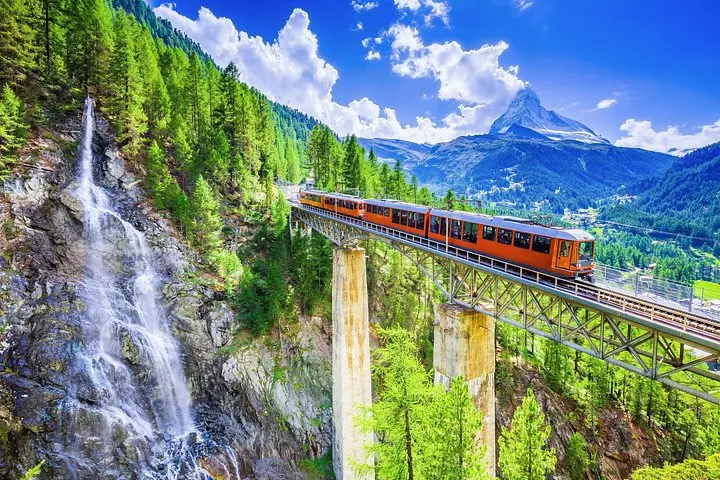
The morning begins with city noise dissolving behind you—Milan’s angular glass and traffic giving way to narrow highways that stitch through orchards and the Valtellina’s terraced vineyards. Your private car hums north while the Alps grow taller, a layered silhouette you can almost feel pressing at the horizon. By mid‑day you’ll trade an engine’s monotone for the measured click of a century‑old railway: the Bernina Express, glass windows framing a muscular alpine narrative of rock, snow, and villages clinging to slopes.
There’s a discipline to this trip: you move deliberately from the urban to the alpine, from Mediterranean‑tinged Italy to the high pastures of the Engadine in Switzerland, and the landscape marks the transition. The Bernina line wedges itself into narrow valleys and climbs steadily—Tirano sits at about 429 meters above sea level, Ospizio Bernina climbs to roughly 2,253 meters before descending toward St. Moritz at about 1,822 meters. In the course of roughly 60 kilometers the train negotiates almost 1,800 meters of elevation change on one of the steepest adhesion railways in Europe—gradients as intense as 7 percent that the rails take in stride.
This is not just a scenic ride. The Bernina Railway—the Rhaetian Railway’s Bernina line—was completed in the early 20th century and, together with the Albula line, earned UNESCO World Heritage status in 2008 for the way human engineering harmonized with the high mountain environment. You feel that history in the curved viaducts, the cuttings through granite, and the tiny villages that have long relied on the iron spine of the line for connection and commerce.
Geology is a quiet actor on this stage. The Bernina massif throws up craggy summits and hanging glaciers; valleys carved by ice hold ribbon lakes. You’ll watch rock faces change color with the light, and in some seasons, ice calving from the higher tongues hints at the slow, patient power that formed these places. Culturally, the route crosses linguistic and culinary borders: Italian Valtellina with its hearty pizzoccheri and chestnut forests gives way to the Romansh‑speaking Engadine, where cured Bündnerfleisch and alpine dairy traditions anchor mountain life.
Why should travelers do this as a private day trip from Milan? Because it compresses alpine grandeur into one manageable day without the friction of scheduling trains and transfers yourself. The comfort of private car transfers, combined with first‑class seats aboard the Bernina Express, lets you be both spectator and slow traveler: take photographs, absorb the panoramas, step onto a platform at Ospizio Bernina for thin‑air photos, or disembark in St. Moritz to stroll the lakeshore and experience Swiss mountain resort culture.
Practicalities matter here. The full outing is a long day—expect about 12 hours door to door. The route crosses an international border: carry ID or passport, and remember Switzerland uses the Swiss franc though many places accept euros. Book the Bernina seats in advance, especially in high season—window seats sell out. Weather can flip quickly at altitude; layers and a windproof shell are necessary even in summer. Cell service is intermittent in the high passes, so download maps and any tickets you need ahead of time.
Photographers should favor the left side heading Tirano → St. Moritz for early morning light, but the carriage is panoramic—move when safe and polite. If you want a short hike, the Morteratsch area near Pontresina offers glacier views and a reasonable loop; otherwise, plan to keep the day leisurely and prioritize the train experience.
There are a few unavoidable realities: this is a full‑price, premium product—expect rates that reflect private transfer comfort and first‑class rail seats. You’ll also pass fragile alpine environments: stay on paths, respect wildlife, and leave no trace. The route’s hard infrastructure is worth conserving; UNESCO designation helps, but visitors make the difference.
By late afternoon the train eases into St. Moritz, with its saltwater‑blue lake and tidy promenades. Here the mountains feel domesticated—in a good way—with mountain hotels, pastry shops, and outdoor cafés that invite you to decompress and compare notes with your travel companions. When the private car returns you to Milan after sunset, you’ll have a day of high mountain memory compacted into a comfortable, well‑planned package: glaciers glimpsed from a panoramic carriage, an engineering classic, and two cultures threaded together by a ribbon of silver rails.
Trail wisdom
Small choices, better day.
Carry ID and small currency
You’ll cross from Italy into Switzerland—have your passport and some Swiss francs in case vendors don’t take cards.
Reserve window seats early
First‑class panoramic seats are limited; book both private transfer and Bernina seats well in advance for the best views.
Dress in layers and bring a shell
Temperatures drop significantly at higher altitudes and wind can be sharp on exposed platforms like Ospizio Bernina.
Plan for intermittent cell service
Download tickets, maps, and any translations before you leave—service gaps are common in the high passes.
Local knowledge
Read the place, not just the route.
Watch for native species including Alpine ibex, Golden eagle.
Keep an eye out for wildlife during the transition between areas and habitats. Respect distance guidelines.
The rail route minimizes the environmental footprint of mountain travel; visitors should stay on paths, avoid disturbing wildlife, and pack out trash to protect fragile alpine ecosystems.
Follow the guide's instructions on size limits, ethical handling, and leave-no-trace practices.
Tirano’s old town and the Basilica di Madonna di Tirano for a quick cultural stop. A short walk from St. Moritz station to the lakeside for sunset photos and local pastries
Locally recommended viewpoints and quiet spots known best to local operators.
The Bernina Railway was completed in the early 20th century and, with the Albula line, was inscribed as a UNESCO World Heritage site in 2008 for its integration of railway engineering with high mountain landscapes.
Maritime roots and regional tradition shape the waterways and working coasts.
Seasonal guide
Four versions of the same landscape.
Spring
Best forEarly snowmelt views · Fewer crowds
ChallengesUnstable weather · Lower frequency of some services
Late spring brings melting snow and dramatic contrasts, but weather is changeable—pack waterproof layers and check schedules.
Summer
Best forClear panoramas · Hikes and lakeside strolls
ChallengesHigh tourist season · Warmer valley temps
Summer offers the most reliable windows for views and the chance to extend the day with short hikes around St. Moritz.
Fall
Best forAutumn color in the valleys · Cooler, crisp air
ChallengesShorter daylight · Possible early snow at altitude
Fall is beautiful for golden larches and crisp air—expect cooler temps and pack insulating layers.
Winter
Best forSnow‑scapes and winter light · Ski resort atmosphere in St. Moritz
ChallengesVery cold temps · Possible service changes in heavy snow
Winter transforms the route into a high‑contrast snowy landscape; it’s striking but dress for alpine cold and check operations.
Operator details
What the booking data adds.
Included
- ✓Private car transfers with pickup and drop-off at your accommodation in Milan
- ✓5-Star Italian-English speaking Driver
- ✓Free time to explore St. Moritz
- ✓First-class Bernina Express tickets for a one-way journey between Tirano and St. Moritz
- ✓Full-Day Tour from Milan to Tirano & St. Mortiz, Switzerland by Private Car & Bernina Express Train
Not included
- —Lunch (optional)
Good to know
- ✓Infants are required to sit on an adult’s lap
- ✓Public transportation options are available nearby
- ✓Infants and small children can ride in a pram or stroller
- ✓All areas and surfaces are wheelchair accessible
- ✓Transportation options are wheelchair accessible
- ✓Wheelchair accessible
- ✓Suitable for all physical fitness levels
- ✓Check your email the day before the tour for important details from Rosotravel, your tour operator.
- ✓Bernina Express departure times vary seasonally, so we will adjust the start time and itinerary for a seamless experience. Depending on seat availability, your one-way train journey may be from Tirano to St. Moritz or vice versa (with a later start and finish). All the details will be confirmed via email.
- ✓This tour includes a one-way First-Class Bernina Express ticket with a reserved seat. As this is one of the world’s most popular train routes, tickets sell out fast. If First-Class is unavailable, you will receive Second-Class tickets with a €24 refund.
- ✓Enjoy private door-to-door transport from Milan—groups of 1-4 travel by sedan, while 5+ get a larger van. Prefer more space? Book for 5+ to guarantee a larger vehicle.
- ✓Restaurant reservations for lunch in St. Moritz can be made on request.
- ✓Check the weather forecast and bring an extra layer, as the mountain climate can be chilly!
Pack with intention
What to bring.
Good to know
Common questions.
Yes—this trip crosses the Italy–Switzerland border; carry a valid passport or EU national ID card.
Plan the edges
The details that make the day easier.
The Bernina Railway reaches Ospizio Bernina at about 2,253 meters—making it the highest adhesion railway crossing in Europe, and the Albula/Bernina lines are a UNESCO World Heritage Site since 2008.
In Tirano, try Valtellina specialties like pizzoccheri and local wines before you board; in St. Moritz sample Bündnerfleisch and alpine cheeses, or grab a hot chocolate and a pastry by the lake—both towns offer friendly cafés for post‑ride relaxation.
- Closest major airport
- Milan Malpensa (MXP) or Linate (LIN); Driving distance to Tirano from Milan ~220–250 km (approx. 2.5–3.5 hours); Cell service: intermittent at high elevations; Permits: passport
Riding the Bernina Express supports low‑impact tourism—trains concentrate travel along established corridors. Respect fragile alpine habitats: keep to paths, minimize waste, and avoid wildlife disturbance.
Explore by topic
Follow the threads.
Keep exploring
Make the story part of the trip.
 Related story
Aksla is the small mountain that makes Ålesund legible: 418 steps, sweeping panoramas, and a short tour that threads architecture and coastline into 90 minutes of memorable sightlines. Perfect for anyone who wants a quick, high-reward encounter with Norway’s west coast.
 Related story
The New York Public Library’s Main Branch is more than a photo stop—it's a civic living room, an architectural landmark, and a waypoint for walking tours that stitch together Midtown’s history, films, and holiday rituals. Here's how to make the most of a visit.
 Related story
Five miles of riverfront walking that reveal NYC’s quieter rhythms—Riverside Park pairs easy urban hiking with history, birdlife and a front-row view of the city’s climate resiliency efforts. Walk a stretch or follow the Greenway; either way, the Hudson makes its presence felt.