
What the day feels like
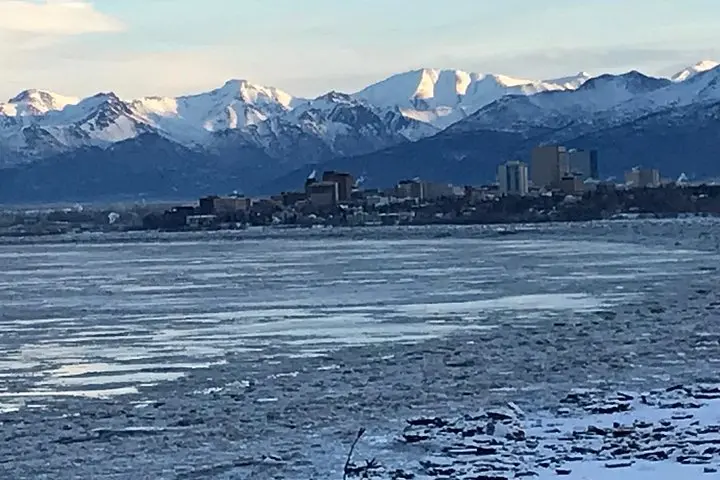
The day begins with the soft crunch of snow under boots and a breath that frosts the air before it disappears. Anchorage wears winter well—quiet streets edged with frost, the Chugach Mountains standing guard like stoic sentinels, and the smell of the sea drifting in from Cook Inlet. A van door slides open, warmth spills out, and the city beckons. This is the Winter – Anchorage All Around City Tour, a half-day loop stitched through the corners of town that are hard to reach without wheels—and perfect for seeing how Alaska’s biggest city lives with winter.
Ship Creek greets you first, where tides breathe like a slow lung and steel girders of the railroad yard frame the skyline. In summer, salmon muscle upriver here; in winter, the creek lowers its voice and runs black and deliberate beneath its own breath of steam. Bald eagles watch from lampposts, heads bright against gray sky. Follow the creek’s curve and Anchorage’s story comes into focus: a frontier rail town turned modern hub, always eyeing the wilderness just beyond its streets.
Earthquake Park pulls you toward the past. The trees lean at odd angles, roots exposed where the ground once swallowed itself. In 1964, a magnitude 9.2 earthquake—still the second-largest ever recorded—ripped this coast open. The land slumped, the clay liquefied, and entire blocks slid toward the water. Today, quiet paths thread the scar. The forest doesn’t forget, but it does adapt, and the park is a living classroom on how a place reshapes itself and carries on.
At Point Woronzof, the city’s pulse quickens. Jets skim low to land at Ted Stevens Anchorage International Airport, their wings slicing the cold as the Inlet spreads out beyond. On clear days, Denali floats above the horizon as if it has drifted in from another world. To the west, Mount Susitna—known locally as the Sleeping Lady—lies on her side in a blue haze, and the tides gnaw at the mudflats with clockwork patience. Winter light arrives late and leaves early, but when it hits the water at the right angle, the whole coast glows.
Back in town, the Alaska Native Medical Center surprises people who mistake it for just another hospital. Its public spaces house one of the state’s largest collections of Alaska Native art—carved masks, textiles, sculpture—work that tells stories in cedar, sinew, and stone. The city’s present-day rhythm taps out alongside a much older cadence belonging to the Dena’ina homeland beneath your feet. You’ll feel that continuity again at the Ulu Factory, where the signature curved knife is still crafted with an eye for balance and a nod to tradition. The blade feels like it’s designed to follow the hand’s natural logic—a tool shaped by the needs of the land.
Between stops, the driver threads through neighborhoods where yard moose saunter like they own the block. In winter, Anchorage’s moose come down from the hills to browse city trees, and they move with a pensioner’s stubbornness, crossing driveways at their own pace. You keep your distance. They don’t make idle threats. The tour’s pace is relaxed—there’s time to hop out, feel the bite of air, watch a raven play at the edge of a gust. It’s a good reminder that these aren’t just photo stops; they’re windows into how Alaskans navigate short days, cold temperatures, and a landscape that likes to push back.
You’ll visit Alaska Wild Berry Products, a cheerful counterpoint to the cold with its syrupy warmth and ruby jellies, and the University of Alaska area, where the city’s knowledge centers run hard even when the light doesn’t. Everywhere you go, winter keeps whispering: dress right, move steady, look up. In Anchorage, the season has a voice. Snow squeaks in the shade and grows quiet in the sun. The Inlet huffs, steam rising on frigid mornings. The Chugach holds its line—a serrated horizon that feels close enough to touch.
As a traveler, the beauty of this tour is its efficiency and its honesty. Anchorage is spread wide, and the can’t-miss corners sit far apart. With a local at the wheel, you connect the dots. You see where earthquake history meets modern resilience. Where a city’s industry brushes up against shorebirds and saltwater. Where a hospital doubles as an art museum, and a factory demo connects you to a blade used for centuries. The camera earns its keep here: telephoto for wildlife, wide-angle for coastal expanse, quick fingers for planes slicing the sky above Point Woronzof. If the day clears, light skims low and kind over faces and snowbanks alike.
Practical notes shape a successful winter loop. Wear insulated boots with aggressive tread—parking lots and pullouts can be icy. Pack a warm parka, hat, and gloves you can operate a camera with. Keep your phone and spare batteries warm; the cold drains them fast. Expect flexible timing and changing conditions. Moose may rewrite the schedule, and wind off Cook Inlet can turn a bluebird moment into a face-numbing gust. That’s part of the charm: Anchorage doesn’t perform. It lets you see how life actually works at the edge of the wild.
By the time you return downtown, you’ll know where to revisit on foot—Earthquake Park’s trails when the light stretches, the Ulu Factory for a gift with a story, Ship Creek at high tide. You’ll be primed for a bigger Alaska, too. The mountains to the east dare you to come back in summer for the Coastal Trail or in fall when the aurora peels across the sky. But winter is its own reward here. The city takes a deep breath, the wildlife moves in close, and the details—the art, the tools, the coast—stand out in sharp relief. Anchorage in winter doesn’t need embellishment. It only asks you to show up, look closely, and let the season do the talking.
Trail wisdom
Small choices, better day.
Layer Like a Local
Wear a warm parka, insulated mid-layer, hat, and gloves you can operate a camera with. Anchorage wind off Cook Inlet can sting even on bluebird days.
Mind the Moose
Keep at least 25 yards from moose and never stand between a cow and her calf. Give them the right of way—always.
Grip for Icy Stops
Pullouts and viewpoints can be slick. Consider low-profile traction cleats for short, icy walks at Earthquake Park and Point Woronzof.
Battery TLC
Cold saps power—carry a spare phone/camera battery in an inner pocket to keep it warm and ready.
Local knowledge
Read the place, not just the route.
Watch for native species including Moose, Bald eagles.
Keep an eye out for wildlife during the transition between areas and habitats. Respect distance guidelines.
Give urban moose ample space and never feed wildlife. Stay on plowed paths and pullouts to protect fragile winter soils and coastal vegetation.
Follow the guide's instructions on size limits, ethical handling, and leave-no-trace practices.
Anchorage Native Medical Center’s public art collection—one of Alaska’s largest—open to visitors in common areas. Point Woronzof at low tide for sweeping views of Mount Susitna and Cook Inlet’s tidal flats
Locally recommended viewpoints and quiet spots known best to local operators.
Anchorage’s coast was transformed by the 1964 Good Friday Earthquake (M9.2), which reshaped the shoreline and created the landslides memorialized at Earthquake Park.
Maritime roots and regional tradition shape the waterways and working coasts.
Seasonal guide
Four versions of the same landscape.
Spring
Best forLonger daylight · Thaw-season photography
ChallengesIcy ‘break-up’ conditions · Variable slush and mud
March–May brings more light and migrating birds. Expect slick trails and puddled pullouts as snow melts.
Summer
Best forShip Creek salmon viewing · Blue-sky mountain vistas
ChallengesMore visitors at viewpoints · Glare and heat mirage on tarmac
June–August offers midnight sun, green hills, and easy temps. Moose are still around but more dispersed.
Fall
Best forCrisp, clear views · Early aurora chances
ChallengesRapidly shortening days · Early ice and wind on the bluff
September–October brings gold birch leaves and calmer crowds. Watch for early frost and gusts off Cook Inlet.
Winter
Best forUrban moose encounters · Snow-lit coastal landscapes
ChallengesCold temperatures · Icy footing and limited daylight
November–March is prime for this tour. Dress warm, use traction, and enjoy big views under low, photogenic light.
Operator details
What the booking data adds.
Included
- ✓Private transportation
Good to know
- ✓Infants and small children can ride in a pram or stroller
- ✓Service animals allowed
- ✓Public transportation options are available nearby
- ✓Travelers should have at least a moderate level of physical fitness
Pack with intention
What to bring.
Good to know
Common questions.
Very likely—moose frequently move into Anchorage neighborhoods in winter. Sightings are common but not guaranteed; guides prioritize safe, respectful viewing.
Plan the edges
The details that make the day easier.
The 1964 Good Friday Earthquake that struck Anchorage registered magnitude 9.2, the second-largest earthquake ever recorded globally.
Warm up afterward with a pizza and local brew at Moose’s Tooth, or head to 49th State Brewing for halibut and views over the Inlet. If you want a cultural encore, visit the Anchorage Museum to connect the city’s art, science, and history—all within easy reach of downtown hotels.
- Closest airport
- Ted Stevens Anchorage International (ANC), 10–15 minutes from downtown. Most pickups occur in central Anchorage; Earthquake Park and Point Woronzof are a short drive from city center. Cell service is strong in town and patchy along some coastal pullouts. No permits required for this tour; dress for winter and allow extra time for icy roads.
Urban wildlife is still wild—maintain distance, never feed animals, and pack out all trash. Stick to plowed areas at coastal parks to minimize erosion and protect sensitive shoreline habitats.
Explore by topic
Follow the threads.
Keep exploring
Make the story part of the trip.
 Related story
Aksla is the small mountain that makes Ålesund legible: 418 steps, sweeping panoramas, and a short tour that threads architecture and coastline into 90 minutes of memorable sightlines. Perfect for anyone who wants a quick, high-reward encounter with Norway’s west coast.
 Related story
The New York Public Library’s Main Branch is more than a photo stop—it's a civic living room, an architectural landmark, and a waypoint for walking tours that stitch together Midtown’s history, films, and holiday rituals. Here's how to make the most of a visit.
 Related story
Five miles of riverfront walking that reveal NYC’s quieter rhythms—Riverside Park pairs easy urban hiking with history, birdlife and a front-row view of the city’s climate resiliency efforts. Walk a stretch or follow the Greenway; either way, the Hudson makes its presence felt.