
What the day feels like
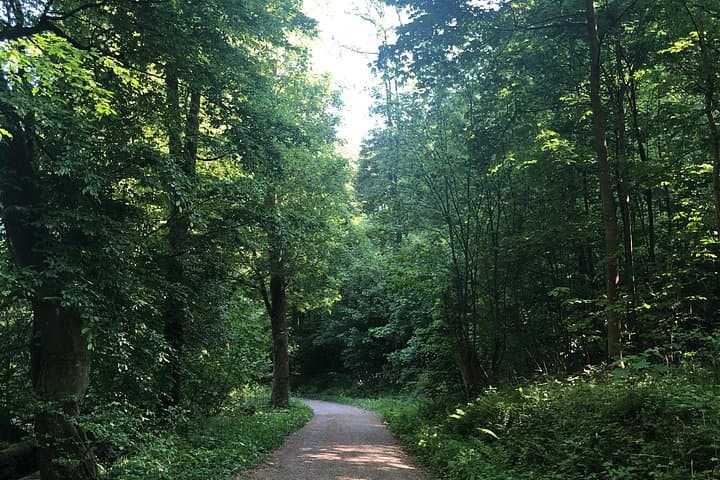
The Neckar slides past Heidelberg’s old stone bridges like a patient guide, pointing you toward the hills. Ten minutes is all it takes—one tram, one curve of cobblestones—and the city’s chatter fades as the Odenwald closes around you. Beech trunks rise like quiet pillars, their smooth gray bark catching the day’s first light. The trail is soft underfoot, pine needles muting each step. Wind nudges the canopy, then backs off, as if reminding you to listen. Somewhere below, the castle keeps its red-sandstone vigil. Up here, the forest takes the lead.
This is the Forest Hike in Heidelberg—a guided, gentle ramble into the Odenwald that feels like a secret door cut into the edge of town. The route adapts to what you need today: an unhurried wander beneath beech and oak, a steady push to a viewpoint on Königstuhl, or a loop past moss-dark ruins that the trees are slowly reclaiming. Expect 5–8 kilometers and 200–350 meters of elevation gain across well-graded paths and soft singletrack. It’s the right kind of effort: honest, present, with just enough uphill to earn a view of the Neckar curling through the valley.
The Odenwald is older than the city it shelters. Its foundations were laid in colorful layers of Triassic sandstone and ancient metamorphic rock, ground down by time and lifted again into low mountains that roll across Baden-Württemberg toward Hesse and Bavaria. If you pass a carved cross along the way or a low stone wall softened by moss, you’re reading footnotes from a long forest history. Heidelberg’s castle itself owes its hue to this same red sandstone, quarried from nearby hills. Farther north on Heiligenberg, the forest keeps the bones of St. Michael’s Monastery and, more recently, the controversial Thingstätte amphitheater—reminders that these woods have watched over centuries of worship, war, and reinvention.
The hike’s rhythm suits the setting. The trail climbs in intervals—up a bank of steps shaped by roots, then leveling out to catch a breeze scented with resin and damp leaves. Switchbacks offer glimpses through the trees: a slate roof glinting in Altstadt, the river sliding past rows of gabled houses, a biking commuter reduced to a moving bead in the distance. On clear days, the Königstuhl tower peers over the canopy like a patient lighthouse. Ravens surf the thermals. A red kite carves lazy circles; it knows the wind by name.
With a local guide, you get more than a walk. You get the forest’s inside jokes: where the sandstone sweats after rain, how the light changes on beech leaves through the seasons, which side trail will drop you quietly into Philosophers’ Walk to finish with a postcard view of the castle. You can thread past the Thingstätte’s tiers when it’s empty and let the space hum, or press higher into the Odenwald if your legs want more. The point is not to rush but to tune in—this is a private, adaptable outing designed to match your pace and curiosity.
Along the way, the Odenwald makes a few practical demands. The soil—rich with loam and leaf litter—can hold moisture for days after a storm. Roots rise like questions in the path. A light pair of trail shoes will keep you sure-footed. In summer, the forest offers shade and cool air that lingers, but it also collects humidity; carry a liter of water and sip as you go. In winter, the trees open their ribs and offer big views, though cold wind prowls the ridgelines and gloves become non-negotiable. Spring brings wild garlic perfuming the understory, white blossoms scattered underfoot like a late snow. Fall arrives with a hush, as if the beech leaves turn color to keep secrets.
Culturally, this hike is a quick primer on why Heidelberg belongs on a traveler’s shortlist. The university—the oldest in Germany—infuses the valley with restless energy, yet the forest stamps its own unhurried pace on daily life. Locals come up here to reset before lectures and lab sessions, to run in the rain, to teach their kids the names of trees. The guide mirrors that ethos, sharing the forest like a good neighbor rather than a tour operator: we’re guests here, the beech says, so step lightly and look closely.
For photographers, the Odenwald is generous but not loud. The red sandstone of the castle pops from any elevated vantage; the forest itself prefers subtler portraits—side-lit trunks, the high gloss of leaves after a shower, fog pooling between ridges at dawn. Bring a polarizer to tame leaf glare and a wide-angle lens for the castle-and-river sweep if your route dips toward Philosophers’ Walk.
Logistics are simple. This is a three-hour experience, private by design, launched close to Heidelberg’s core. Meeting points vary, but you can count on a short transfer to the trail—often by funicular up to Molkenkur or Königstuhl, or a brief bus ride toward the forest’s lower gates. From there, the trees take over. Cell service flickers; conversations improve. Trail signs are frequent, and your guide reads them like a second language. The route may loop to a café terrace for a post-hike espresso or return you to the old town for a well-earned beer brewed the way locals like it—strong and honest.
If you’ve come to Heidelberg for the romance of the river and the charm of its streets, this forest walk adds the missing chapter. It’s where the city exhales. It’s also a reminder that adventure doesn’t have to be dramatic to be memorable. Sometimes it’s just you, a ribbon of trail, and a beech tree watching you pass, approving your choice to spend an afternoon walking instead of rushing. The Odenwald doesn’t brag; it just keeps opening the door.
Trail wisdom
Small choices, better day.
Footing on Roots and Sandstone
Expect some slick roots and occasional sandstone steps, especially after rain. Grippy trail shoes beat flat sneakers here.
Hydrate in the Shade
Even under the canopy, humidity can build. Carry at least 1 liter of water per person for a 3-hour outing.
Layer for the Ridge
Wind can be stronger on Königstuhl ridgelines. A light, packable shell keeps chills at bay.
Check Funicular Hours
If your route leverages the Heidelberger Bergbahn, confirm operating times to avoid a long walk down.
Local knowledge
Read the place, not just the route.
Watch for native species including Roe deer, Red kite.
Keep an eye out for wildlife during the transition between areas and habitats. Respect distance guidelines.
These hills lie within the UNESCO Global Geopark Bergstraße-Odenwald; stay on marked trails to protect sensitive understory plants and minimize erosion.
Follow the guide's instructions on size limits, ethical handling, and leave-no-trace practices.
Thingstätte amphitheater on Heiligenberg—eerie, grand, and best visited early when it’s empty. Königstuhl Aussichtsturm for a panoramic sweep of the Neckar valley and the Rhine plain
Locally recommended viewpoints and quiet spots known best to local operators.
Heidelberg’s red-sandstone castle and many local structures were quarried from nearby Odenwald stone; Heiligenberg hosts the ruins of an 11th-century monastery and a 1930s amphitheater.
Maritime roots and regional tradition shape the waterways and working coasts.
Seasonal guide
Four versions of the same landscape.
Spring
Best forWildflowers and fresh greenery · Cool, comfortable temps
ChallengesMud after spring showers · Unpredictable drizzle
The forest wakes with wild garlic and birdsong; cool temps and soft light make for ideal hiking and photos.
Summer
Best forShaded, cooler hiking · Long daylight windows
ChallengesHumidity under the canopy · Occasional thunderstorms
The beech canopy acts like natural air-conditioning, though afternoon storms are common—start early and carry water.
Fall
Best forFoliage color · Crisp air and clearer views
ChallengesLeaf-covered roots can be slick · Shortening daylight
Gold and copper leaves light up the Odenwald; trails can be slippery with leaf litter, so watch your footing.
Winter
Best forQuiet trails · Long-range views through bare trees
ChallengesCold wind on ridgelines · Icy patches in shaded gullies
A peaceful season with big views; dress warm and consider microspikes if ice forms after freezes.
Operator details
What the booking data adds.
Included
- ✓Bottled water
- ✓Snacks
Good to know
- ✓Infants and small children can ride in a pram or stroller
- ✓Service animals allowed
- ✓Public transportation options are available nearby
- ✓Specialized infant seats are available
- ✓Travelers should have at least a moderate level of physical fitness
Pack with intention
What to bring.
Good to know
Common questions.
Routes vary with the group, but expect 5–8 km (3–5 miles) and roughly 200–350 m (650–1,150 ft) of elevation gain.
Plan the edges
The details that make the day easier.
The Odenwald forms part of the UNESCO Global Geopark Bergstraße-Odenwald, recognized for its outstanding geological heritage spanning over 500 million years.
Refuel with a hearty plate and house-brewed beer at Kulturbrauerei Heidelberg, or try Vetter’s for classic German fare steps from the Old Bridge. For coffee and cake, swing by Café Moro in the Altstadt. If you want a river view, grab a table along the Neckarwiese and watch rowers pull past at dusk.
- Closest airport
- Frankfurt (FRA). Trail access: short tram
- Königstuhl). Drive time
- ~10–15 minutes from Old Town to common trailheads. Cell service: spotty in the forest, better near towns and towers. Permits: none required for day hiking on marked trails.
You’re walking inside a UNESCO Global Geopark and well-loved city forest—stay on marked paths, pack out all trash, skip loud music, and yield to wildlife. Dry seasons raise fire risk; never smoke on trails.
Explore by topic
Follow the threads.
Keep exploring
Make the story part of the trip.
 Related story
Less than two hours from Nairobi, Kereita Forest pairs hands-on canopy adventure with quiet montane trails and a sobering colonial history—perfect for families, teams, and curious travelers seeking a full-day pulse of nature.
Set out from Bass Harbor for a private, customizable day on Blue Hill Bay — lighthouses, puffins, seals, and the chance to feel Acadia from the water. Small groups, local captains, unforgettable views.
In four hours you can move from shaded canyon ferns to wind-scoured coastal ridgelines, guided by someone who knows where the light—and the hidden views—live. This private half-day hike on the Monterey Peninsula or Big Sur is compact, curated, and perfect for travelers who want depth without a multiday commitment.