
What the day feels like
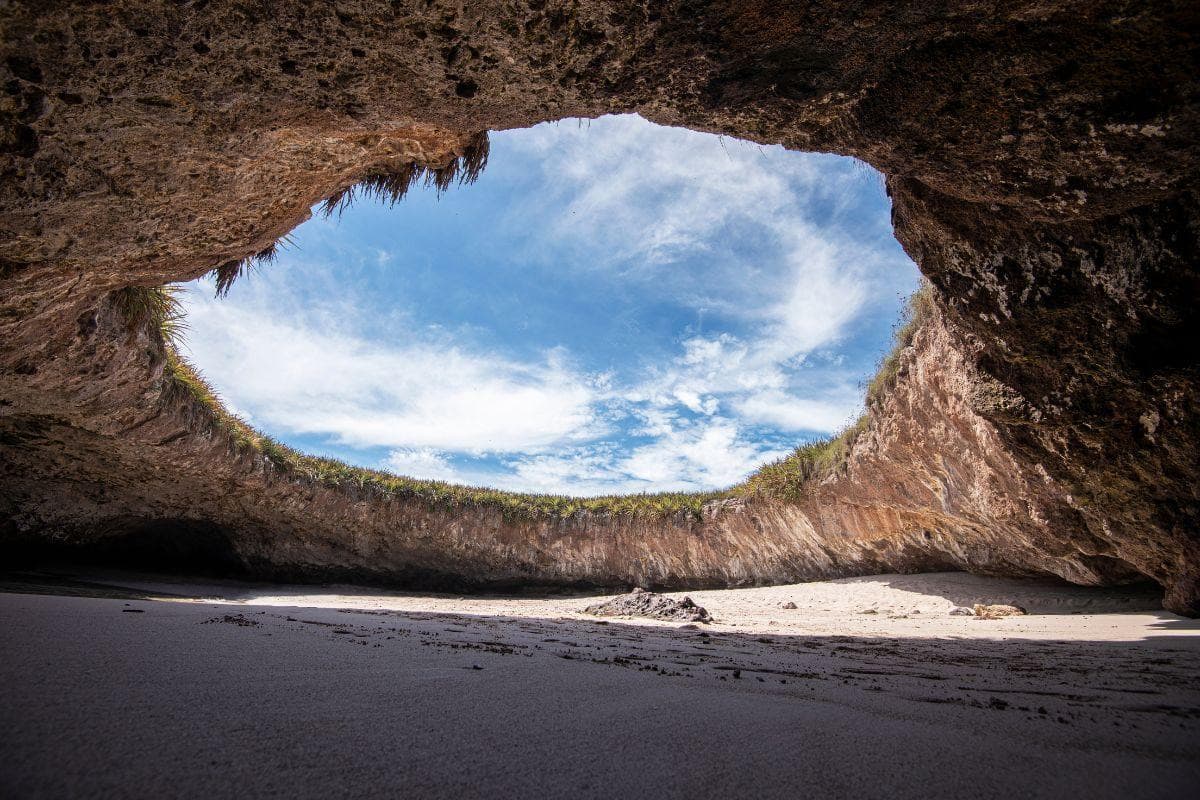
You round the last swell and the cliffs of the Marietas Islands resolve out of blue Pacific haze: pocked limestone faces, gulls like punctuation marks, and a low, steady roar that seems to come from the island itself. Your skiff slows. The guide gestures toward a pair of arches punched through dark rock where a current threads like a seam. The air smells of salt and sun-warmed stone. This place has a private life — coves that existed long before tourism, a blowhole, and that improbable amphitheater: the Playa del Amor, a white-sand hollow reached by swimming through a cave with daylight pouring in like a spotlight.
Marietas Islands (Islas Marietas) sit like a scattered string of secrets a few miles off the coast of Punta Mita and Puerto Vallarta. They’re small—barely a handful of islets—yet their compact drama is outsized: the collapsed roof of a volcanic cavity created the famed Hidden Beach, and the islands’ reefs form a living mosaic of coral and fish that entice snorkelers and marine biologists alike. The park’s cliffs carry the scratched signatures of time: wave-cut terraces, fossilized shells, and the layered history of a seafloor lifted and sculpted by tectonics and erosion.
History here is short and tangled. The Marietas were reportedly used in the early 20th century for military target practice; shells and blast scars made the islands dangerous and, paradoxically, a refuge for wildlife because they restricted access. In 2005 the Mexican government created the Islas Marietas National Park to protect bird colonies, reefs, and the unique geology. Conservation and tourism have since been in a quiet, sometimes tense negotiation: boats now thread regulated routes, landing is tightly limited, and visitors are required to follow no-touch rules for corals and wildlife.
Geology gives the islands their mood. The rock is volcanic tuff and basalt—porous, weathered, and honeycombed by wave action. Where a roof collapsed and rain and waves continued their work, a bowl hollowed into the island’s interior and filled with sand, creating the Hidden Beach. Around it, clear water refracts light into luminous turquoise, and the current beyond the arches dares you outward, pushing small craft into the open ocean.
Culturally, the islands are an extension of the Pacific coast’s rhythm — fishermen, surf guides, and birders cherish them. Local operators in Punta Mita and Puerto Vallarta run most visits, pairing short boat transfers with snorkeling stops, whale-watching (in season), and guided swims into caves. Respectful guides will brief you on marine life, currents, and why the island’s protection matters: here, tourism funds and stewardship have become the islands’ best insurance policy.
The practical edges of a Marietas trip are straightforward but important. Most visitors book a half- to full-day boat charter that leaves from Punta Mita, Nuevo Vallarta, or Puerto Vallarta. Expect a 20–40 minute boat ride depending on sea state. Landing at the Hidden Beach isn’t guaranteed; access is limited, weather-dependent, and controlled by park rangers. If the beach is closed, don’t be disappointed—the snorkel zones around the islands are themselves spectacular: branching corals, curious parrotfish, and the occasional sea turtle.
Snorkeling here is the main narrative thread. The reefs are shallow in places and formidable in others; currents can be deceptive. Swim with a buddy, listen to the guide, and use a reef-safe sunscreen to protect the corals. For photographers, the islands offer classic Pacific frames: stark volcanic silhouettes, blue shafts through cave openings, and sunlit fish clouds that make for dynamic, colorful shots.
Timing matters. Early morning runs are calmer and offer the best light and the highest chance of seeing dolphins or sea turtles. During winter months (December–March), humpback whales come close to the bays and can be spotted from the boat. Summer can bring glassy seas but also the occasional afternoon squall; keep a lightweight rain shell handy.
On the ethics front: Islas Marietas is fragile. Don’t touch coral, don’t feed wildlife, and avoid single-use plastics on the boat. Operators that brief passengers on marine protection, limit group sizes, and work with certified park guides are doing the right thing — choose them.
Why go? Because few small places deliver such concentrated contrast: raw rock and bright reef, paddleable caves and a secret beach that feels like an invitation. It’s a half-day that reorients you to ocean scale—how currents host life, how a collapsed roof can create a moment of wonder, and how coastal communities and conservation can coexist when visitors are thoughtful.
If you plan to go: bring a good snorkel mask, reef-friendly sunscreen, a light wind layer, and a camera with a waterproof case. Book with a reputable operator that includes park fees and a guide. And leave time to ride back toward the sunset; from the stern of the boat, the islands look even more mythic as your wake fades into open water.
Trail wisdom
Small choices, better day.
Book early-morning departures
Calmer seas and softer light make snorkeling easier and sightings of dolphins and turtles more likely.
Use reef-safe sunscreen only
Chemicals in common sunscreens harm coral; use mineral-based SPF or a rash guard for protection.
Swim with a buddy and follow guides
Currents near the arches can be tricky—stay within sight of your guide and never swim alone.
Bring a waterproof bag for valuables
Boat decks get wet; a dry bag keeps phones and cameras safe during transit.
Local knowledge
Read the place, not just the route.
Watch for native species including Humpback whales (winter months), Blue-footed boobies and frigatebirds.
Keep an eye out for wildlife during the transition between areas and habitats. Respect distance guidelines.
Strict visitor quotas and no-touch rules aim to protect coral and nesting birds; choose operators who contribute to conservation fees.
Follow the guide's instructions on size limits, ethical handling, and leave-no-trace practices.
Snorkel drop at the north reef—less crowded and home to large parrotfish. A vantage point near Punta Mita for sunset views of the islands from the mainland
Locally recommended viewpoints and quiet spots known best to local operators.
The islands were used for military target practice in the early 20th century; protection began in 2005 when they were declared a national park.
Maritime roots and regional tradition shape the waterways and working coasts.
Seasonal guide
Four versions of the same landscape.
Spring
Best forwhale watching (late winter to early spring) · calm seas for snorkeling · wildflower bloom on nearby shorelines
Challengesvariable winds · increased tour bookings over spring break
Spring offers mild seas and lingering whale activity; book early to secure a morning slot.
Summer
Best forwarm water and excellent visibility · snorkeling vibrant reefs · sightings of juvenile marine life
Challengesoccasional afternoon storms · higher UV exposure
Summer brings warm, inviting water and clear visibility—watch the forecast for afternoon squalls.
Fall
Best forfewer crowds · pleasant water temperatures · good chances for clear skies
Challengeshurricane season overlaps (low probability but worth monitoring) · sea conditions can change quickly
Fall is quieter and often offers long stretches of calm sea, but keep an eye on tropical activity.
Winter
Best forhumpback whale watching · cooler air temperatures · crisp mornings with glassy seas
Challengesmore tourists during holidays · slightly cooler water temperatures
Winter is prime for whale encounters; early departures avoid windier afternoons and crowds.
Pack with intention
What to bring.
Good to know
Common questions.
No; access is controlled by park authorities and limited by weather and conservation quotas—book with an authorized operator and expect closures.
Plan the edges
The details that make the day easier.
The Hidden Beach in Islas Marietas was formed by a collapsed sea cave roof and only became widely known internationally after photographs circulated in the 1990s; the islands were declared a national park in 2005.
Punta Mita and Puerto Vallarta anchor the local experience: fishermen bring fresh ceviche to shore stalls, local guides share stories of whale migrations, and beachfront palapas serve up grilled fish and cold coconut water after a morning at sea.
Choose operators who follow park rules, limit group size, use mooring buoys instead of anchors, and educate passengers about reef protection to reduce visitor impact.
Explore by topic
Follow the threads.
Keep exploring
Make the story part of the trip.
 Related story
Less than two hours from Nairobi, Kereita Forest pairs hands-on canopy adventure with quiet montane trails and a sobering colonial history—perfect for families, teams, and curious travelers seeking a full-day pulse of nature.
Set out from Bass Harbor for a private, customizable day on Blue Hill Bay — lighthouses, puffins, seals, and the chance to feel Acadia from the water. Small groups, local captains, unforgettable views.
In four hours you can move from shaded canyon ferns to wind-scoured coastal ridgelines, guided by someone who knows where the light—and the hidden views—live. This private half-day hike on the Monterey Peninsula or Big Sur is compact, curated, and perfect for travelers who want depth without a multiday commitment.