
What the day feels like
You feel the jeep inhale before it drops. One moment the horizon is neat and tame—the low-slung town of Mitzpe Ramon perched like an observant neighbor—and the next the vehicle tilts forward and the world opens into a bowl of rock and story. Sandstone striations stack like pages of a slow, patient chronicle; dykes cut the landscape like pens scored by ancient hands. Wind tugs at your hat and sunlight sharpens every color—pale creams, bruised purples, a rust so deep it looks volcanic. The crater doesn’t whisper. It insists.
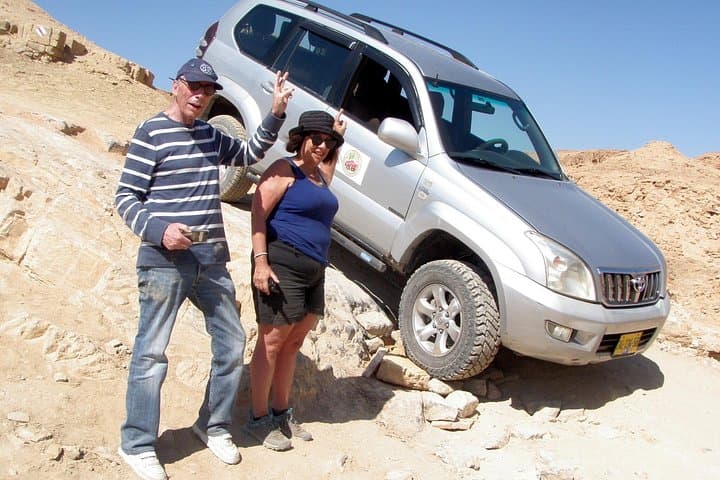
This is the East Makhtesh Ramon route, a classic 4x4 ride through Israel’s largest erosion crater. The Ramon “makhtesh” — roughly 40 km long, 2–10 km wide and up to 500 m deep — is an exposed record of 240 million years of earth’s crustal drama. On a guided 4x4, spots are short hikes and long pauses: a polished gorge where water once clenched the rock, a plateau of baked sand prisms, a window into plutonic formations that cooled beneath a vanished sea. Your driver/guide is as much a translator as a pilot: naming features, pointing out the Nabatean Spice Route traces, and threading human history through the geology so the landscape reads like a map of time.
There’s an intimacy to exploring the East side of the crater—the paths are less trafficked than the western rim, the washes are deeper, and the color contrasts are sharper because erosion here is actively sculpting new faces on ancient stones. Bedouin communities have traveled these routes for millennia; caravans carrying frankincense and myrrh crossed the same compass bearings that your tires will hug for a day. Archaeologists and geologists prize this place because it stores transitions—the shift between marine and continental layers, intrusive dykes, and the erosional fingerprints of climate shifts that shaped the Negev.
Beyond the science, this is a sensory trip. The desert has a voice: gravel grinds under tires, jackrabbits dash across flat basins, and thermals lift heat into visible shimmers. The air tastes of dust and something mineral. At a high viewpoint you can watch a train of 4x4s snake along a pale bench, engines humming like distant bees, and then push down into a gorge where the jeep becomes a modest machine in a very large cathedral of stone.
Practical realities matter here. The full tour is a long, full-day outing—expect 10–12 hours including transfers. It’s largely off-road in purpose-built vehicles, with short walks at viewpoints that can include loose scree and uneven surfaces. Temperatures swing, so plan layers: the crater bakes midday and chills when the sun slides behind a ridge. The tour operator notes a minimum booking for departure and offers last-minute cancellation flexibility—useful if you’re syncing weather or flights.
What the trip delivers is a rare combination: dramatic, open-sky scenery with a curated, interpretive approach. For travelers who like their adventures loud with context—not just the thrill of a drive but the why behind the view—this day unspools geology, history, and local culture in one package. You’ll leave with dust in your shoes, new reference points for the desert’s vocabulary, and photos that make your living room feel small.
If you go: choose spring or late autumn if you dislike heat; pack three liters of water, sturdy soles for short hikes, sun protection, and a camera with a wide lens and a polarizer. Plan to stay in Mitzpe Ramon the night before to watch the crater’s light shift at dawn from the main lookout. If you have extra time, consider a Bedouin dinner or an overnight under the stars—this landscape is best felt both in motion and in stillness.
The jeep tour is approachable for most people in reasonable shape; it’s not technical climbing or multi-day trekking. But it rewards curiosity: ask your guide about the Nabatean trade corridors, about how a dyke forms, or where to spot the fossilized remains tucked into certain strata. Those conversations turn a scenic drive into a school of stone. And when the jeep climbs out and drops you back at the rim, there’s an odd, satisfying humility—the land is older than your map, louder than your plans, and not finished telling its story.
Trail wisdom
Small choices, better day.
Hydrate early and often
Bring at least 3 liters of water per person—desert heat and wind dehydrate faster than you think, and potable water isn’t available on the route.
Wear sturdy shoes
Short hikes at viewpoints involve loose scree and sharp rocks; hiking shoes with ankle support are recommended even though most travel is in the jeep.
Protect against sun and dust
Wide-brim hat, sunglasses, SPF 50, and a neck gaiter or bandana will improve comfort when standing on exposed ridges or during dusty stops.
Bring a wide-angle lens
The crater’s breadth photographs best with a wide lens and a polarizer to deepen skies and reduce glare from pale rock faces.
Local knowledge
Read the place, not just the route.
Watch for native species including Nubian ibex (sometimes seen on rocky ledges), Desert lark and other arid-adapted bird species.
Keep an eye out for wildlife during the transition between areas and habitats. Respect distance guidelines.
Stay on designated tracks to avoid fragile desert crusts, pack out all trash, and support local guides and Bedouin-run services to help sustain the regional economy.
Follow the guide's instructions on size limits, ethical handling, and leave-no-trace practices.
A small polished gorge on the East route where layers reveal marine fossils. Outsized sand prism formations that glow at golden hour—best seen with a short scramble off the main track
Locally recommended viewpoints and quiet spots known best to local operators.
The area sits along sections of the ancient Nabatean Spice Route that connected Arabia to the Mediterranean; traders traversed these valleys for centuries.
Maritime roots and regional tradition shape the waterways and working coasts.
Seasonal guide
Four versions of the same landscape.
Spring
Best formild temperatures · wildflowers in desert basins · comfortable hiking stops
Challengespossible afternoon winds · variable rainfall some years
Spring is the most pleasant season—warm days and cool mornings—and ephemeral wildflowers can carpet low basins after winter rains.
Summer
Best forlong daylight hours · clear skies · dramatic heat-hazed landscapes
Challengesextreme heat · limited shade · avoid midday activity
Summer brings intense heat; early starts and shaded breaks make it manageable, but midday exposure is risky.
Fall
Best forstable weather · crisp mornings · sunset photography
Challengesshortening daylight · cooler evenings
Autumn mirrors spring’s comfort—stable conditions and pleasant daytime temperatures ideal for full-day outings.
Winter
Best forcooler exploration · low visitor numbers · unique light after rare rains
Challengescold nights · possible muddy washes after rain
Winters are cool and can be wet; storms change the crater’s look and may affect access to some washes.
Operator details
What the booking data adds.
Included
- ✓Desert picnic lunch, Herbal tea, Turkish coffee, lemonade.
Good to know
- ✓Not recommended for travelers with spinal injuries
- ✓Not recommended for travelers with poor cardiovascular health
- ✓Not recommended for pregnant travelers
- ✓Public transportation options are available nearby
- ✓Suitable for all physical fitness levels
- ✓Not suitable for under 4 years old.
Pack with intention
What to bring.
Good to know
Common questions.
The tour is a full-day experience—expect about 10–12 hours door-to-door, including transfers from Mitzpe Ramon and multiple stops inside the crater.
Plan the edges
The details that make the day easier.
Makhtesh Ramon is the world’s largest erosion crater (a makhtesh), roughly 40 kilometers long and up to 500 meters deep—its exposed layers chronicle millions of years of geological change.
After the day’s run, head into Mitzpe Ramon to visit the Ramon Crater Visitors Center and the Ilan Ramon Memorial lookout. For food, seek out local cafés for hearty hummus or shakshuka and inquire about Bedouin-run dinners or tea—these meals are excellent ways to connect with regional culture.
- Closest airport
- Ben Gurion (TLV), ~2.5–3 hour drive; Nearest town
- trailhead
- Mitzpe Ramon (on the crater rim); Driving distance from Mitzpe Ramon: 0–30 minutes to various access points; Cell service: patchy in the crater; Permits: none normally required for public tour routes; Tour details: full-day, minimum group size may apply.
This is a fragile desert environment—stay on tracks, pack out waste, avoid collecting rocks or fossils, and book local operators who follow low-impact practices.
Explore by topic
Follow the threads.
Keep exploring
Make the story part of the trip.
 Related story
Less than two hours from Nairobi, Kereita Forest pairs hands-on canopy adventure with quiet montane trails and a sobering colonial history—perfect for families, teams, and curious travelers seeking a full-day pulse of nature.
Set out from Bass Harbor for a private, customizable day on Blue Hill Bay — lighthouses, puffins, seals, and the chance to feel Acadia from the water. Small groups, local captains, unforgettable views.
In four hours you can move from shaded canyon ferns to wind-scoured coastal ridgelines, guided by someone who knows where the light—and the hidden views—live. This private half-day hike on the Monterey Peninsula or Big Sur is compact, curated, and perfect for travelers who want depth without a multiday commitment.